News
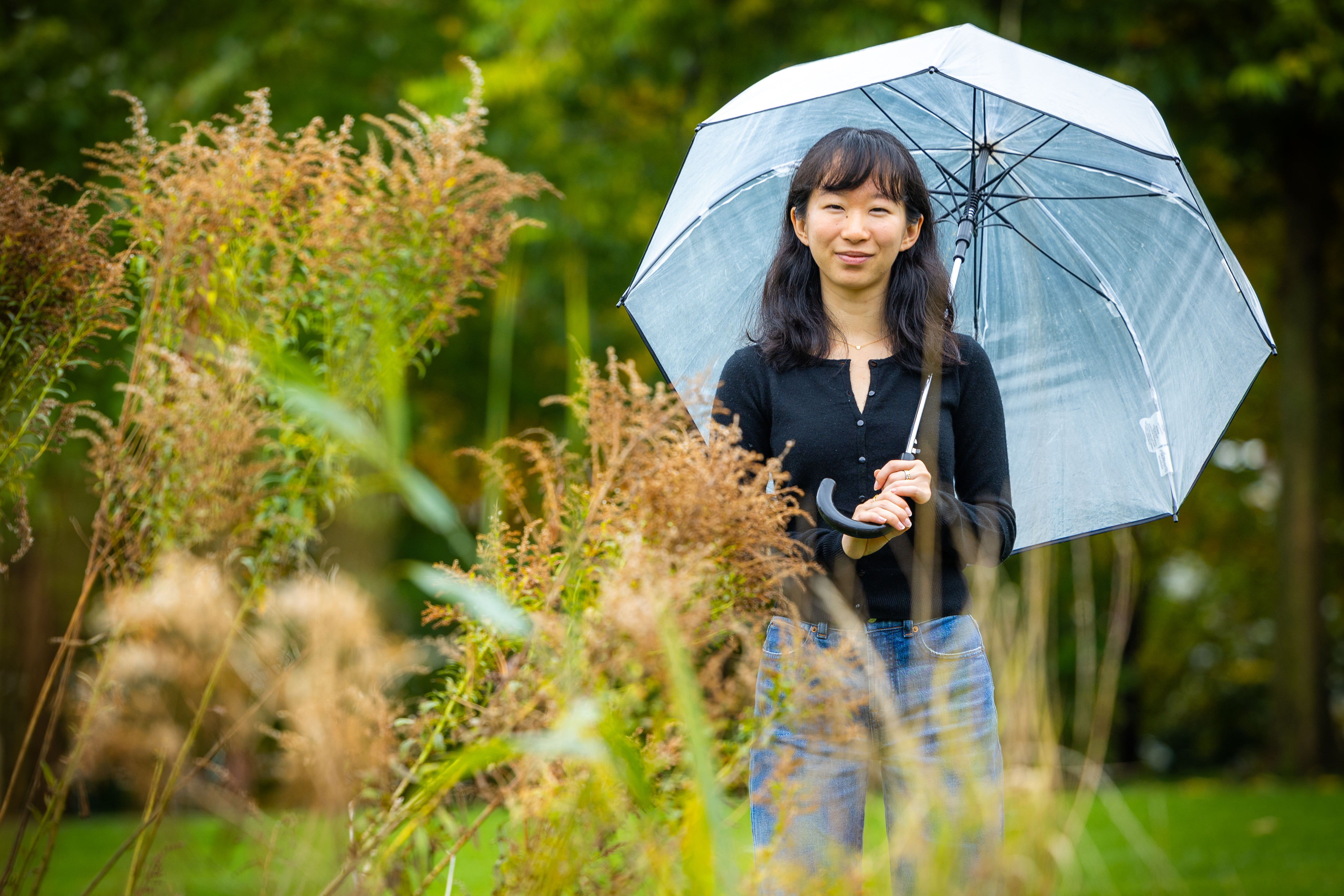
Hannah Guan spent a summer using machine learning to predict weather subseasons at Microsoft Research (Eliza Grinnell/SEAS)
Getting information about tomorrow’s weather can be as easy as tapping an application on your smartphone. Modeling weather patterns years down the line is the job of climate scientists. But what about predicting 2-6 weeks out? These intermediate periods, known as subseasons, are when predictive models are critical.
“This time horizon is very important for farmers who are looking to plan when they want to either plant or harvest their crops,” said Hannah Guan, a fourth-year applied math concentrator. “It's important for city planners who are trying to decide how much energy to allocate to the grid in anticipation of a cold front. This horizon obviously has a lot of very important impacts, but it's also a horizon where there just hasn't been that much research done before, and the models that currently exist just don't reach the same level of accuracy as the short-term or the longer models are able to do.”
Following her sophomore year at the Harvard John A. Paulson School of Engineering and Applied Sciences (SEAS), Guan spent her summer as an intern at Microsoft Research, where she helped develop machine learning algorithms to better predict subseasonal weather and precipitation patterns. Even after finishing her internship, Guan continued her research, eventually becoming first author on a recent publication in Nature.
“There already exist a lot of really big physics-based models or AI foundation models that are pretty good at getting the overall trends, but they still have a lot of errors on the subseasonal timescale,” she said. “Instead of trying to predict the weather directly, we wanted to try to predict where these models that are typically used get it wrong. We're basically trying to build a model that models the error in existing models.”
Guan’s research focused on “probabilistic subseasonal forecasting,” which breaks down a weather prediction into a range of conditions or temperatures, and the percentage likelihood of each scenario. The project focused on correcting existing forecasts, finding potential errors in how the forecast was made, then using their machine learning algorithms to remove the errors.
“There are a few different advantages to this,” she said. “It means that we don't have to build something that's extremely large and compute-intensive. It also means that our method is extremely adaptable, because it can be applied to correct the forecasts from any existing weather model.”
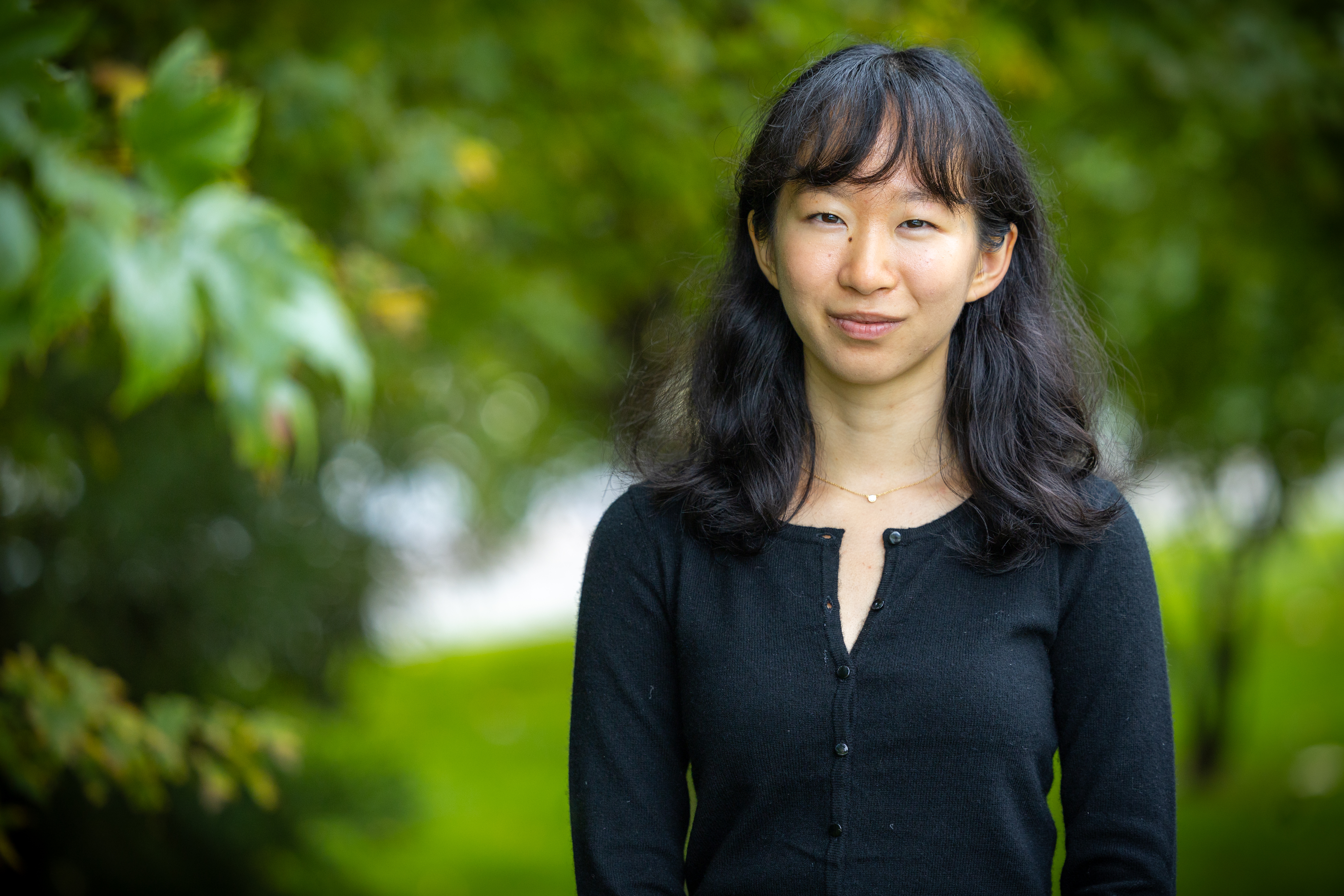
Hannah Guan, A.B. '27, in applied math (Eliza Grinnell/SEAS)
This internship wasn’t Guan’s first research experience, having studied genetic variations and traits at the Harvard T.H. Chan School of Public Health and worked at the Kempner Institute of Natural and Artificial Intelligence throughout her first two years at SEAS. She sought out the Microsoft Research internship as a way to contrast academic and corporate research experiences.
“I had no clue that this was even a field that people worked on when it came to machine learning and computer science," she said. “After I was accepted to the internship, I got matched with a mentor who had been working on the problem of weather forecasting. A lot of the problems that I find interesting are generally ones where the problem is very applied, and it's very clear what the end result is and how it can help other people. So this was a project that I was immediately interested in.”
Using her interests to benefit her community is a common thread throughout much of Guan’s time at SEAS, and even as a high school student in San Antonio. She served as Co-Director of Programming for the 2025 Women Engineers Code (WECode) Conference at SEAS, and in high school founded Math Include, a now-international STEM tutoring nonprofit. She’s also been a course assistant for several classes.
“That was something I started initially because when I was trying to do math competitions in middle school and high school, there was no existing community in my hometown,” she said. “I wanted to build up this framework that allowed not only me to connect with others, but also for all the students that came after me to connect with other students who were very like-minded. With WECode, there are so many women who are interested in computer science these days, but they're still lacking a lot of venues in which they can connect with each other on a deeper level, connecting over their shared interests and shared challenges that they may have faced in their journeys.”
A high school valedictorian, Guan chose Harvard because it offered more breadth than a more engineering-specific school. She wanted more variety in her courses, but also a more diverse student community with interests and life experiences much different from hers. Similarly, she chose applied math as a concentration because it seemed to offer the broadest range of applications.
“By sophomore fall, I'd taken computer science classes, I'd taken stats classes before, I'd taken a couple of economics classes, and I knew that I was interested in all of these things,” she said. “Applied math was the perfect concentration where I could take all of these classes and combine my interests in each of them to figure out how they all interact with each other and the types of work I can do by combining them.”
Between her research at Harvard Chan School, Kempner and Microsoft Research, as well as her ongoing senior thesis on task memory challenges in artificial intelligence, Guan has devoted much of her time at SEAS to research. She hopes to continue along the same trajectory after graduating, as she’s in the process of applying to Ph.D. programs related to computer science and applied math.
“I really appreciate not only the work itself, but also the community that you are able to foster when you're working on research,” she said. “I've been able to make really close connections to both my mentors and the other students I've also met during this process. What really appealed to me about doing a PhD program was that you're able to make these really deep and close connections with other people just by virtue of being interested in the same problems, and you all have this shared desire to work on the hardest problems in the world and try and solve them for the greater good.”
Topics: AI / Machine Learning, Applied Mathematics, Environment, Research, Undergraduate Student Profile
Cutting-edge science delivered direct to your inbox.
Join the Harvard SEAS mailing list.
Press Contact
Matt Goisman | mgoisman@g.harvard.edu
Related News

Applying AI to Accelerate Design, Test and Manufacture
University of Washington Mechanical Engineering
AI / Machine Learning, Applied Physics, Computer Science, Electrical & Computer Engineering, Materials Science & Mechanical Engineering, Meet Our Faculty, Research, Technology
