Concentration Information
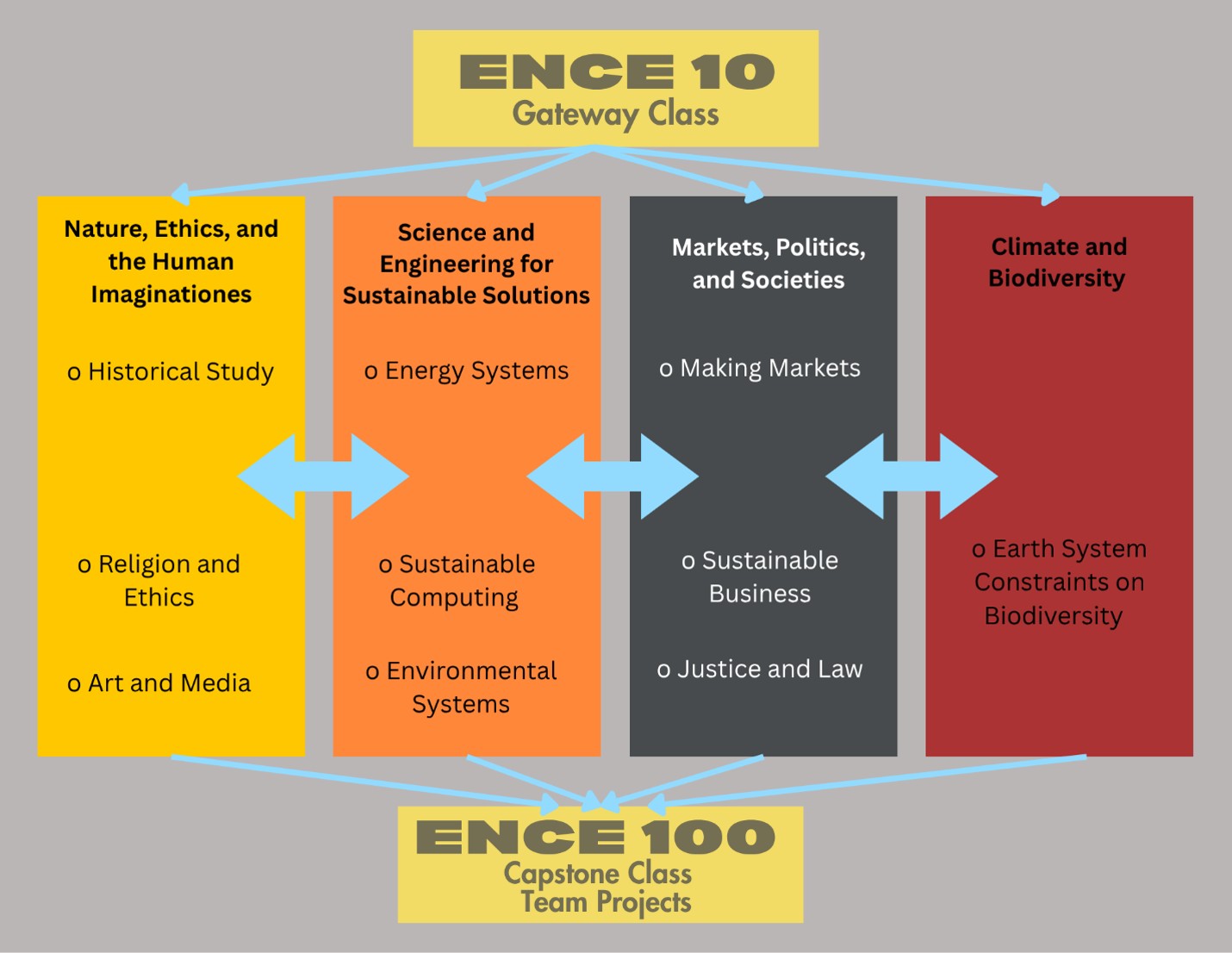
Within the ENCE program, each student selects 1 of 4 divisional Tracks for their specific program. All students, regardless of their specific track, take a shared gateway course, ENCE 10 (ordinarily in the first term), and a shared senior team project course, ENCE 100.
Energy, Climate, and the Environment Tracks
Nature, Ethics, and the Human Imagination (Arts & Humanities)
This track provides students with core competencies in understanding and addressing environmental challenges from historical, ethical, literary, artistic, and other value-sensitive perspectives. The curriculum covers diverse positions on the foundational causes and ultimate costs of human-caused climate change, biodiversity loss, and marine degradation, discussions of why we should care, and exploration of individual roles in the quality of all lives on the planet. It includes innovative design strategies, morally persuasive literary and art forms, values and practices of different cultures, and historical cases of environmental care. Pre-approved Braids have emphasis in: Historical Study, Religion and Ethics, or Art and Media.
Science and Engineering for Sustainable Solutions (Engineering and Applied Sciences)
The SESS Track prepares students to be future inventors and drivers of technical solutions to the world’s converging problems of growing energy needs, climate change, and environmental pollution. The students will gain depth and expertise in sciences and engineering, with a focus on decarbonization and electrification of the energy, chemical manufacturing, and transport sectors, design of state-of-the-art computing systems optimized for both compute performance and environmental impacts, and mitigation of human impacts on natural environmental systems with outcomes ranging from climate to public health. Pre-approved Braids have emphasis in: Energy Systems, Sustainable Computing, or Climate and Environmental Systems and Modeling.
Markets, Politics, and Societies (Social Sciences)
This track provides rigorous social-science training in fields such as economics, political science, sociology, and AAAS. Students utilize quantitative and qualitative methods to understand the systemic forces – from global markets to local governance to community life – that shape climate mitigation, sustainability finance, and social adaptation. Pre-approved Braids have emphasis in: Making Markets, Sustainable Business, or Justice & Law.
Climate and Biodiversity (Sciences)
This track focuses on the interface of Earth system science and biology. Climate governs how ecosystems function, and ecosystems influence how carbon, water, and energy move through the Earth system. Topics covered in this track include climate–ecosystem interactions and physical drivers of biodiversity change. Students develop the tools to analyze and address questions such as how climate change reshapes species distributions and ecosystem services, when and how nature-based strategies can contribute to climate mitigation, and how to evaluate tradeoffs among emissions goals, ecosystem integrity, and land use needs across coupled human–natural systems.
Energy, Climate and the Environment Learning Objectives
Graduates of the Energy, Climate, and the Environment program achieve the following objectives as part of their program completion, and they are trained to become solutions focused and informed leaders prepared to address real-world challenges in energy and climate.
- Disciplinary Depth with Multidisciplinary Literacy & Collaborative Leadership: The ability to operate effectively within "T-shaped" professional environments, leveraging deep expertise in a specific track while communicating and collaborating fluently with experts across science and engineering, the social sciences, and the arts and humanities to address systemic societal challenges.
- Integrated Problem-Solving & Design Thinking: The capacity to translate complex, large-scale energy and environmental challenges into tractable problems through an iterative design process that incorporates stakeholder needs, real-world boundary conditions, and iterative experimentation.
- Technical & Disciplinary Mastery for their Track: A rigorous command of the quantitative and qualitative foundations, methods, and tools specific to their chosen track; ranging from energy systems and climate science to economic policy analysis and historical critique.
- Synthesis of Theory and Real-World Application: The proficiency to apply academic frameworks to real-world scenarios through experiential learning and team-based capstones, resulting in viable solutions that account for technical, social, and cultural dimensions of energy-climate issues.