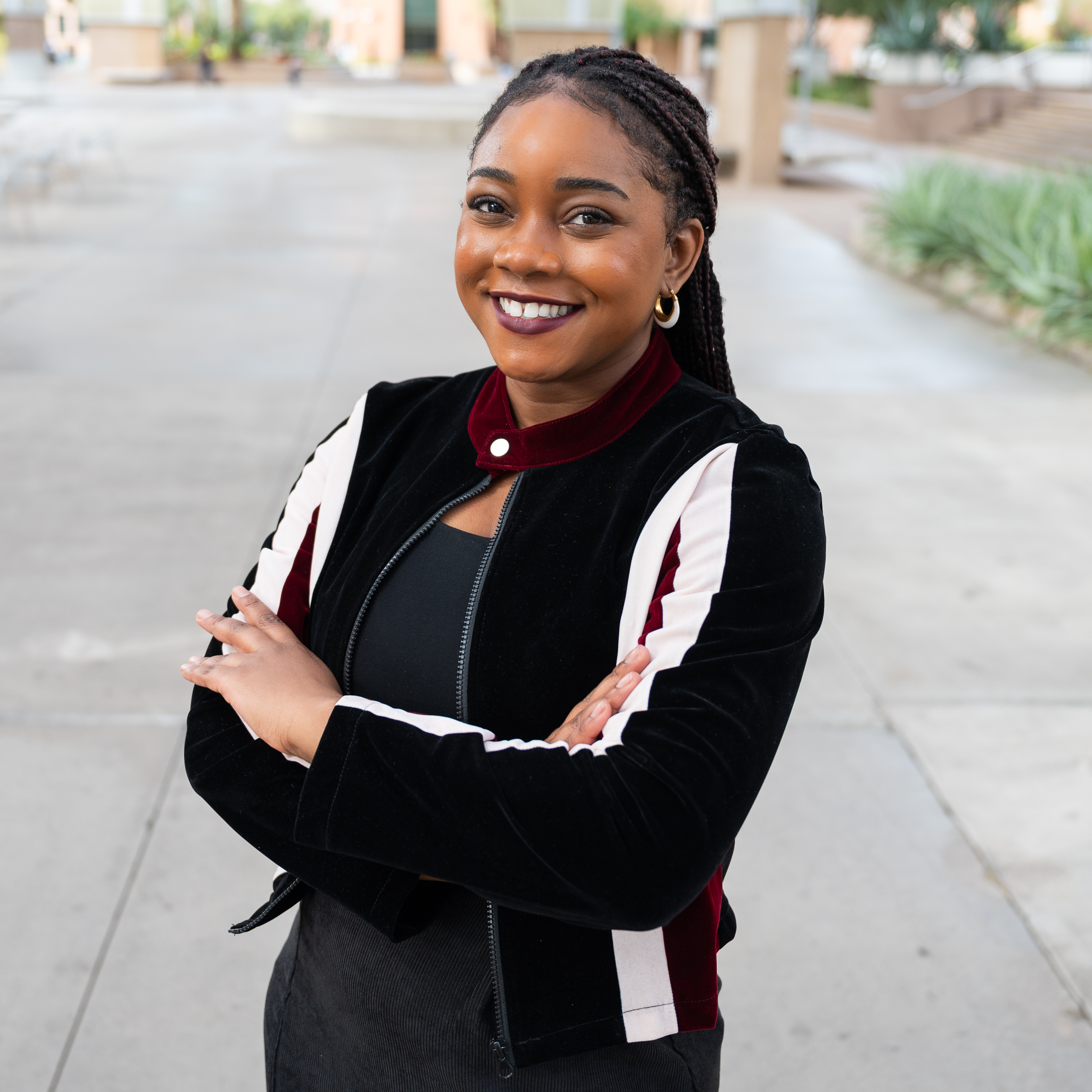
Grace Kossia, A.B. '16, Ed.M. '17
Grace Kossia came to Harvard planning to be a teacher, but she also wanted a foundation of technical knowledge. Her roots are deeply tied to the Democratic Republic of the Congo, and she grew up in the Dallas-Fort Worth area, navigating life and an entirely new culture as refugees of the Congolese civil war. From a young age, she enjoyed tinkering with broken devices around the house and loved math and science.
“When I was younger, it was really simple things like just being enamored by the chalkboard, and then the whiteboards, and then the smart boards,” she said. “Wanting to work with the tools that I was seeing teachers use was a motivation. I would be at home pretending to type on the keyboard, just imitating the things I would see my teachers do.”
Beneath that early fascination with the tools of the trade lay a much deeper, personal driver. Navigating a completely new culture and language, Kossia experienced firsthand the transformative power of the personal investment her teachers put into her. They gave her a sense of belonging, saw her potential, and actively ensured she stepped into it.
That profound investment became her blueprint for entering education. When applying to college, she knew exactly what she wanted to achieve.
“My application letter was in honor of some of the teachers that had really impacted my journey,” she recalled. “I wanted to have that same effect on other students, being able to pour into young minds, being able to see talent in students that may have not recognized it themselves, and bringing it to the forefront”.
Studying mechanical engineering as an undergraduate at the Harvard John A. Paulson School of Engineering and Applied Sciences (SEAS) provided that technical foundation, and it’s served her well since leaving almost a decade ago. She completed her master’s in education at the Harvard Graduate School of Education, and has since worked across organizations at the intersection of education and technology.
“The thing I probably gleaned the most from my engineering time at Harvard was the systems thinking mindset,” said Kossia, A.B. ‘16, Ed.M. ‘17. “Knowing that you're going into a space, you have to iterate. You can't just spend all your time brainstorming and planning. Being able to brainstorm, plan, test, and assess, I feel like that's been something that I use often in my line of work.”
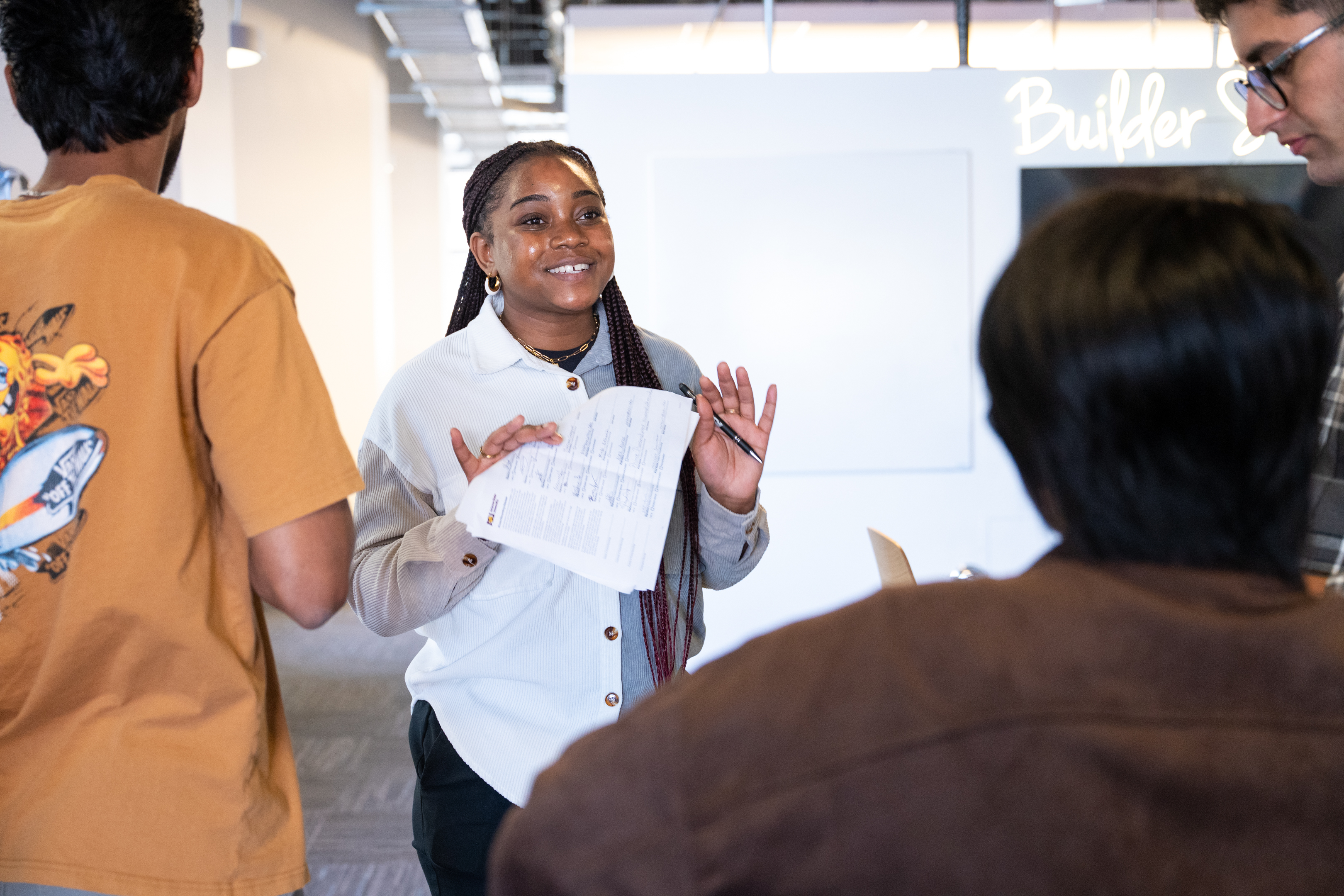
Grace Kossia works with Arizona State University students
Kossia currently works at Arizona State University, as an Artificial Intelligence (AI) Strategist Specialist on the AI Practice Team at Arizona State University. In this strategic capacity, Kossia helps anchor the team's mission to serve as the university's center of excellence for applied artificial intelligence. Her work shifts focus from individual tool deployment toward driving the responsible, value-driven adoption of AI across academic, research, and administrative domains, translating emerging capabilities into practical, scalable solutions aligned with institutional strategy.
She also worked with student interns through the Mastercard Foundation AI Youth Fellowship, focusing on designing a mentorship and onboarding framework that treated student interns as true contributors. For Kossia, the true impact of the project wasn't just the successful launch of "KnowledgeBot," an enterprise-ready AI tool now deployed to over 800 foundation staff, but watching the fellows shed their imposter syndrome and step into the spotlight as absolute geniuses.
“In the spirit of innovation, ASU takes a completely unique approach,” Kossia explains. “While most schools commit to a single company and go with it, ASU makes a wide assortment of AI technologies available. My job is to make sure our faculty are equipped to step into that potential.”
Because she works with AI on a daily basis, Kossia knows all about the technology’s simultaneous potentials for harm and benefit. Her strategy is to treat AI as a tool used to assist with larger tasks, rather than the creation of the tool itself as the final step.
“If I have a vision or idea that I'm wanting to bring to life that would normally require a lot of financial or manpower resources that I might not have access to, I can use AI as a tool to bring those ideas to life,” she said. “It's not so much the AI itself, but more so what it's allowing me to build and create as a thinking partner. I think where the division happens is when the solution ends at the AI.”
Kossia’s current work reflects a ten-year career in education and technology. After finishing at Harvard, she spent five years as a physics teacher in New York City and then back home in Texas. In 2020, she became Chief Academic Officer for Almost Fun, a non-profit founded by SEAS alumna Lisa Wang (A.B. '16) dedicated to improving math education in traditionally underserved communities.
“Where my background came in handy was just being able to come up with analogies for the math concepts,” she said. “The core of that work was how we can help students make sense of the foundational math concepts using objects that they interact with all the time. I feel like just the physical nature of mechanical engineering and all the tinkering, that exposure helped me with coming up with those analogies, and then the solutions thinking as well was something I still use even here at ASU.”
Kossia’s path reflects a continuous loop of technology and human investment. The collaborative, problem-solving environments she first encountered at Harvard remain the foundation of how she leads today.
“When I think back about my engineering experience, the parts that I really appreciated besides getting to work with renowned professors, were those collaborative spaces where you could ask your questions, and it was better to ask and look like you didn't know something versus pretending like you knew something and messing up,” she said. “Knowing in those collaborative spaces, knowing how to work with other people, especially now with technology and AI and post-pandemic, that is something that I really got to develop at Harvard by way of working in a field that required collaboration and group work.”
Press Contact
Matt Goisman | mgoisman@g.harvard.edu