News
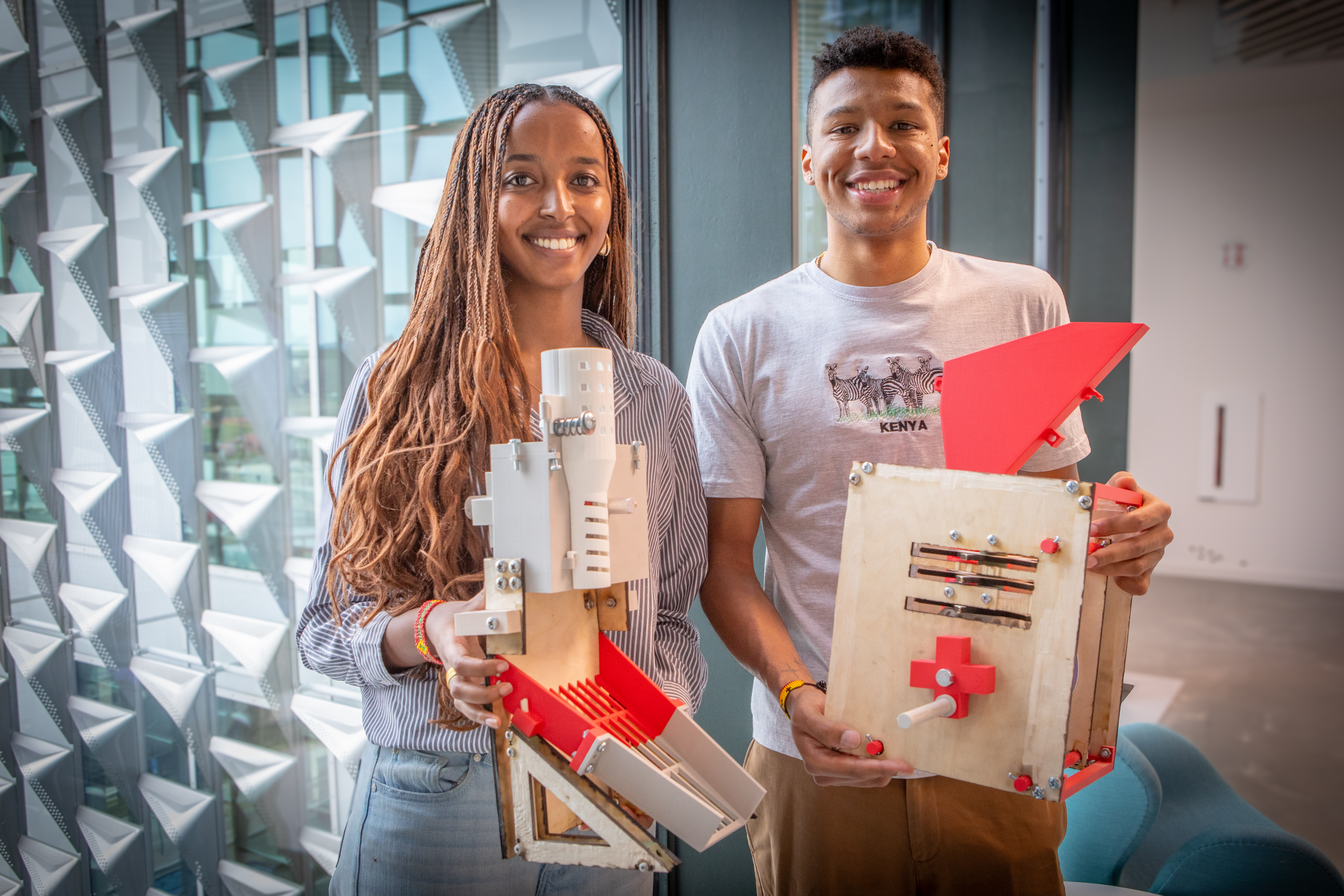
For their senior capstone project, Kulani Temesgen and Ayande Joseph built a portable maize shelling device to optimize production for small-scale farmers (Eliza Grinnell/SEAS)
Engineering Design Projects (ES 100), the capstone course at the Harvard John A. Paulson School of Engineering and Applied Sciences (SEAS), challenges seniors to engineer a creative solution to a real-world problem.
An Affordable Maize Shelling Device for Enhanced Post-Processing in Kenya
Ayande Joseph and Kulani Temesgen, S.B. ‘26, Mechanical Engineering
Advisor: Chris Lombardo
• Please give a brief summary of your project.
Maize is a critical cereal grain globally and an important staple for the diets of many families in Kenya. For small-scale farmers, the crop offers economic support and familial subsistence. However, consuming maize requires a multi-step processing procedure – from harvesting to milling – which can become difficult without the proper tools. A lack of access to agricultural industrialization in the region further inhibits small-scale farmers by increasing manual labor needs while decreasing production. This thesis project presents a portable maize shelling device that optimizes shelling efficiency while minimizing the manual labor to retrieve kernels. The product has a funnel component to allow for easy insertion of dehusked cobs and allow for continuous use. Shelling is initially done by crank and eventually through an external power source, which will minimize labor input. To be accessible for smallholder farmers, the shelling product is designed to be manufacturable within the context of local materials in a specific area, such as Migori County, Kenya. This will allow for greater accessibility and an affordable cost for farmers, ultimately allowing them to shell more maize for subsistence and economic mobility.
• What real-world challenge does your project address?
In sub-Saharan Africa alone, over 208 million people rely on maize for nutritional value and economic empowerment. Thus, the cereal grain has become a significant staple food in many African cultures, preferred for its considerably fast growth and wide range of uses. As regional populations grow, the demand for maize also increases. Consequently, there is increased pressure for higher production rates by local farmers who supply much of the maize consumed. However, a lack of accessible agricultural technology has forced farmers to continue relying on inefficient and unfit maize processing systems, which ultimately lower potential crop output.
• How did you come up with this idea for your final project?
This project was born from a strong relationship with our in-country partner, Paul Olang'o, in Kenya. Harvard's chapter of Engineers Without Borders has been working with Paul since 2018, creating a water distribution system in the community of Kibuon. Our project continues the torch of a 2025 ES100 project by former EWB member Sofia Casillas-Perez, producing three new prototypes that addressed the Kibuon community's feedback and points of improvement in Sofia's designs.
• What was the timeline of your project?
For our project, we split it into two phases: pre-travel and post-travel, both a semester long. We knew that we were going to travel to Migori County, Kenya, in January to interview our stakeholders (farmers within the community) about our current prototype. In the pre-travel phase, we prioritized having a working prototype so that the farmers could get an idea of how we would change their current maize production workflow. In the post-travel phase, we prioritized having a prototype that adhered to as many of our technical specifications as possible, while keeping the stakeholder feedback in mind.
• What part of the project proved the most challenging?
The most challenging part of the project was designing a device while keeping local material constraints in mind. In international development, you have many more design limitations. These communities don't have access to 3D printers or laser cutters, as we do in the R.E.E.F. Makerspace. This encouraged us to be adaptable in our iteration of the device and prioritize preliminary research to rule out any construction methods that aren't locally available.
• What part of the project did you enjoy the most?
Our favorite part of the project was traveling to interview the stakeholders during our J-term. The two-week trip to Migori County, Kenya, was an immeasurably important stage in the project. The face-to-face interactions and on-site device demonstrations could not have been replicated in any other way. Talking with our stakeholders gave us valuable information that recentered the design to more accurately reflect what they need in the device.
• What did you learn, or skills did you gain, through this project?
This project and the overall design process taught us invaluable skills. Having the opportunity to dedicate a year to researching, designing, testing, and evaluating one project greatly increased our organizational, leadership, and time-management skills. Additionally, through this project, we were exposed to many different facets of the engineering design process that we expect in the professional industry. Most importantly, this project reaffirmed our joint interest in international development projects and how we can best contribute to this area of work.
Topics: Academics, Materials Science & Mechanical Engineering
Cutting-edge science delivered direct to your inbox.
Join the Harvard SEAS mailing list.
Press Contact
Matt Goisman | mgoisman@g.harvard.edu
Related News

Applying AI to Accelerate Design, Test and Manufacture
University of Washington Mechanical Engineering
AI / Machine Learning, Applied Physics, Computer Science, Electrical & Computer Engineering, Materials Science & Mechanical Engineering, Meet Our Faculty, Research, Technology