News
Key Takeaways
With partners in South Africa, Harvard researchers are testing whether artificial intelligence could enhance a digital health intervention program aimed at generating peer referrals for HIV services.
A field trial involving a free, confidential AI health coach and chatbot that's now underway in the KwaZulu-Natal province is part of HIV-LIFT, a larger initiative for improving HIV testing and care.
When faced with the possibility of an HIV diagnosis, sometimes the best initial prescription is support from a trusted friend — someone who might offer not just emotional guidance, but also critical, practical health resources.
A Harvard research team thinks artificial intelligence has a role to play in that process.
Led by Milind Tambe, the Gordon McKay Professor of Computer Science in the John A. Paulson School of Engineering and Applied Sciences (SEAS), researchers are testing whether AI could enhance a digital health intervention program aimed at generating peer referrals for HIV services, especially among populations that have been traditionally harder to reach. South Africa has about 8 million people living with HIV – the highest of any country in the world.
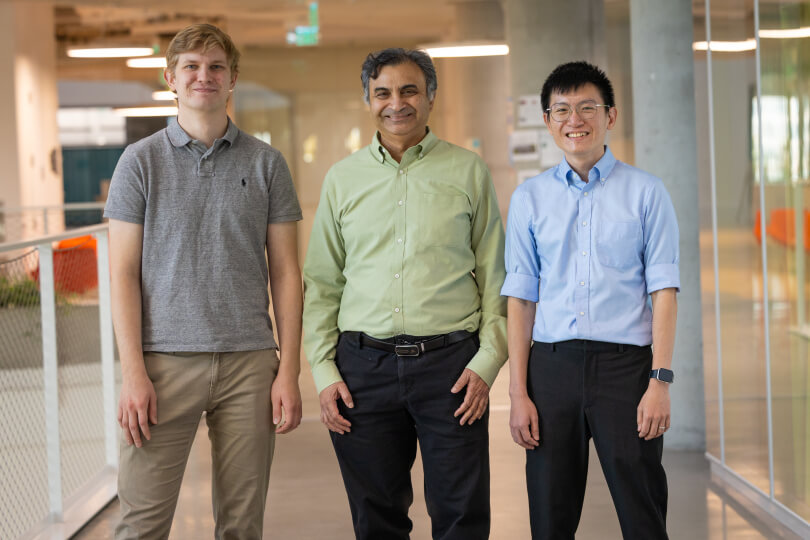
The Harvard HIV-LIFT team includes graduate student Akseli Kangaslahti, Professor Milind Tambe, and postdoctoral researcher Davin Choo.
A field trial now underway in the KwaZulu-Natal province of South Africa is part of HIV-LIFT – Leveraging Innovation and Friendships to Improve HIV Testing — a Gates Foundation-funded initiative that includes Wits University in South Africa, Harvard’s Teamcore research group led by Tambe, partners at the World Health Organization, and others.
HIV-LIFT, whose principal investigator is Alastair van Heerden of Wits University, is a multi-year study aimed at improving HIV testing and care in South Africa among populations, such as men and adolescents, who are less likely to seek testing and are more likely to remain undiagnosed or to attend clinics. The Harvard team is contributing a machine learning protocol added to an existing smartphone app that’s designed to incentivize more people from underserved groups to seek HIV services.
“It’s great to see real-world deployments of computer science,” said Davin Choo, a postdoctoral fellow who has led the development of the algorithms and is working closely with partners on the ground running the field trial. “It’s also interesting to see that when real-world constraints come in, you have to adapt. There’s no point in having fancy things look good on paper but cannot be used in practice.”
For example, said graduate student and team member Akseli Kangaslahti, the Harvard team first approached the problem of AI-guided targeting with a more complex simulation algorithm, but they found that results from this algorithm were not easily interpretable for regular users. “I think we learned a lot from that work, even if we weren’t able to directly employ the algorithms that we proposed in them,” Kangaslahti said.
Also collaborating on HIV-LIFT is Cheryl Case Johnson, a technical officer and innovation lead at the World Health Organization’s department of HIV, TB, Hepatitis and STIs with expertise in HIV network-based interventions.
Improving an existing AI health coach
The ongoing field trial focuses on Coach Mpilo, a free, confidential AI health coach and chatbot available through WhatsApp. Designed specifically for South Africans, Coach Mpilo provides information and support related to HIV testing and treatment, as well as other health issues. With more than 150,000 enrolled users, only about 15% of the app’s users are men; men are historically less likely to seek HIV testing and treatment than other groups due to factors like social stigma or long working hours.
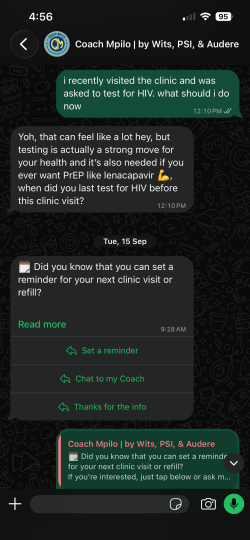
Coach Mpilo is a free, confidential health care coach available through WhatsApp.
Within the Coach Mpilo app is a financial incentive for existing users to send referrals to others who might also need HIV services. The field trial will seek to answer the question: When a program only has the financial resources to encourage a limited number of people to recruit their friends and other contacts, whom should it prioritize?
The Harvard team has developed a machine-learning and optimization approach intended to improve the process of referrals by more intentionally targeting existing users to be “nudged” with an incentive to recruit others. Their AI model discerns which users are most likely to refer people in underserved groups, including men and adolescents.
The work is intended to supplement — not replace — clinics, health workers or the social relationships that make peer referrals possible.
The planned study will compare two groups: one in which eligible users will be selected for outreach at random, and the other, with the added AI filter that further narrows the incentive-eligible pool of users. The AI system will provide a fixed priority list developed in advance from data collected during earlier incentive campaigns.
The Harvard team developed the AI-guided approach based on previous HIV-LIFT incentive campaigns. In retrospective evaluations involving approximately 16,000 historical nudges of existing users collected over two months, this “nudging” approach was estimated to generate more successful referrals than any other strategy.

The Coach Mpilo app offers an incentive for users to provide referrals to friends or family.
The prioritization solution the researchers developed demanded transparency so that users on the ground could easily understand it, added Tambe. “Specifically, partners proposed policy restrictions to ensure fairness and equal treatment for users with identical profiles, while maintaining a simple, transparent, and practical framework that works within real-world system constraints.”
Now, with the Harvard team’s AI algorithms generating the right groups to target for incentivizing, the research team will determine whether this priority-group approach could be implemented permanently within Coach Mpilo or potentially other applications.
AI for social good
The current work at Harvard builds on more than a decade of Teamcore research into the use of AI and social networks for HIV prevention. Tambe has worked on leveraging AI for socially meaningful purposes for more than 20 years and began focusing on HIV prevention in 2013, initially through work with youth experiencing homelessness in Los Angeles.
“We hope that our work will ultimately contribute to some improvement in how HIV-affected people may be cared for, or how people can get access to HIV information,” Tambe said.
Beyond his Harvard appointment, he leads the Google Research AI for Social Good initiative, which is separate from the HIV-LIFT work.
Topics: AI / Machine Learning, Computer Science, Health / Medicine, Meet Our Faculty, Research
Cutting-edge science delivered direct to your inbox.
Join the Harvard SEAS mailing list.
Scientist Profiles
Milind Tambe
Gordon McKay Professor of Computer Science
Press Contact
Anne J. Manning | amanning@seas.harvard.edu
Related News



Applying AI to Accelerate Design, Test and Manufacture
University of Washington Mechanical Engineering
AI / Machine Learning, Applied Physics, Computer Science, Electrical & Computer Engineering, Materials Science & Mechanical Engineering, Meet Our Faculty, Research, Technology