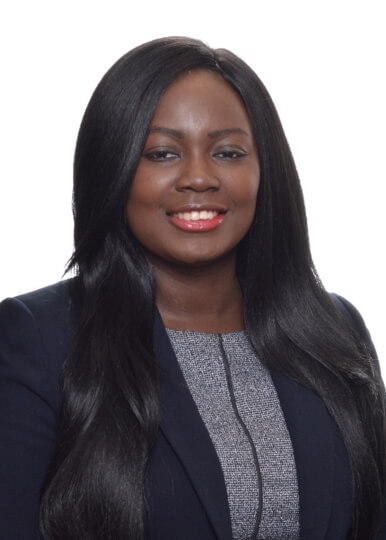
Adenike Adewuyi, S.B. '09 (Northwestern Feinberg School of Medicine)
Adenike Adewuyi spent much of her early childhood on hospital campuses. Her father was a physician and mother a physical therapist, and in her native Nigeria physicians often lived on campus.
“When I was about four years old, I saw an amputee at the hospital,” she said. “I walked up to him because I was curious as a child and asked what happened. He said he got hit by a car, and I told him that the next time you cross the street, you should look left, look right, and look left again before crossing the street.”
By the time her family immigrated to the U.S. when she was around 8 years old, Adewuyi was already thinking about becoming a doctor. But as a high school student in New York, she enrolled in a three-year program that introduced her to topics such as computer science, biomedical engineering and physics.
“What I really liked about the course was its application to medicine,” she said. “We had to design our own EKG machine in addition to building the circuits. I was going to study medicine, but this engineering was cool, and it could take medicine even further.”
That desire to combine medicine and engineering informed every choice Adewuyi, S.B. ‘09, has made over the last two decades. She studied engineering sciences on the biomedical engineering track at the Harvard John A. Paulson School of Engineering and Applied Sciences (SEAS), and upon graduation joined a combined M.D.-Ph.D. program at Northwestern University. She finished the Ph.D. in biomedical engineering and neural and rehabilitative engineering in 2016, the M.D. two years after that. Adewuyi is now a physician scientist at theS hirley Ryan AbilityLab, as well as an assistant professor of physical medicine and rehabilitation at Northwestern’s Feinberg School of Medicine. She also co-directs the Complex Nerve Injury Clinic at the Shirley Ryan AbilityLab, providing care for patients with peripheral nerve injuries within a multidisciplinary program that includes plastic surgery, neurosurgery, and occupational therapy.
“Everything that drives my research and my love for research is its impact on health,” she said. “I'm interested in the bigger picture. How do we restore health? What is important that we haven't been looking into or researching into that could have immense effects?”
Adewuyi’s current research involves lower motor neurons, which are nerve cells in the brainstem and spinal cord that connect to skeletal muscles. This makes them essential to a wide range of bodily functions, and injuries to lower motor neurons can cause a range of debilitating conditions, including muscle weakness, diminished reflexes and even impaired breathing.
“A lot of research focuses on recovery of upper motor neurons, which start in the brain and end in the spinal cord,” she said. “People are stimulating the spine to get people walking, trying different pharmaceuticals or stem cell therapies for nerve regeneration, but there’s not as much focus on that lower motor neuron. No matter what we do to regrow that upper motor neuron, if that lower motor neuron is not intact, that is going to affect function.”
This research builds on Adewuyi’s Ph.D. dissertation at Northwestern, and even ties back to some of her undergraduate work at SEAS. Following her third year at SEAS, she joined the Harvard Neuromotor Control Lab of Maurice Smith, Gordon McKay Professor of Biomedical Engineering. Spending a summer in Smith’s lab as part of the NSF Research Experience for Undergraduates, she helped research the mathematical models of muscle memory, how with enough repetition, the body simply remembers how to perform certain tasks.
“It seemed to be complex and involved different parts of the brain, and yet he was able to develop this mathematical model that would simulate that,” she said. “That was this great interface between physiologic systems and how they work and our knowledge of these mathematical models, can help us understand it. That spoke to what initially got me interested in high school, how we could use engineering to influence the medical world. If you can understand that, then maybe you can understand how to get someone who is injured to better learn and recover.”
After doing her senior capstone project in the lab of Rob Howe, Abbott and James Lawrence Professor of Engineering, Adewuyi joined the M.D.-Ph.D. program at Northwestern. After rotating through several labs, she eventually settled on one studying the rehab process for people who’ve suffered partial hand injuries, how they relearn motor control tasks using prostheses. This became the focus of her Ph.D. dissertation.
“We were working on systems where we could take the electrical impulses that the body creates naturally, and interpret the user’s intent,” she said. “I’d put several sensors on the forearm and ask someone to open their hand, close it, do a peace sign, motions like that. We were essentially using machine learning algorithms to then learn what the signals mean, and then relay that command to the prosthetic device.”
Once she finished her M.D. in July 2018, Adewuyi began her residency at Northwestern Memorial Hospital. She joined a neuromuscular fellowship at the hospital in 2022, and joined the Northwestern Faculty and Shirley Ryan AbilityLab in early 2024.
“Having a breadth of knowledge allowed me to be able to adjust to wherever I was, to learn whatever I was doing and to be good at that,” she said. “There was a real breadth of my training at Harvard, because my degree was in general engineering sciences with a biomedical track. I took courses in solid mechanics, tissue engineering and cardiac biophysics, electrical circuits. Those might seem broad, but I think that really set me up for the future. You really need a multidisciplinary team to really affect change in research and in medicine.”
Press Contact
Matt Goisman | mgoisman@g.harvard.edu