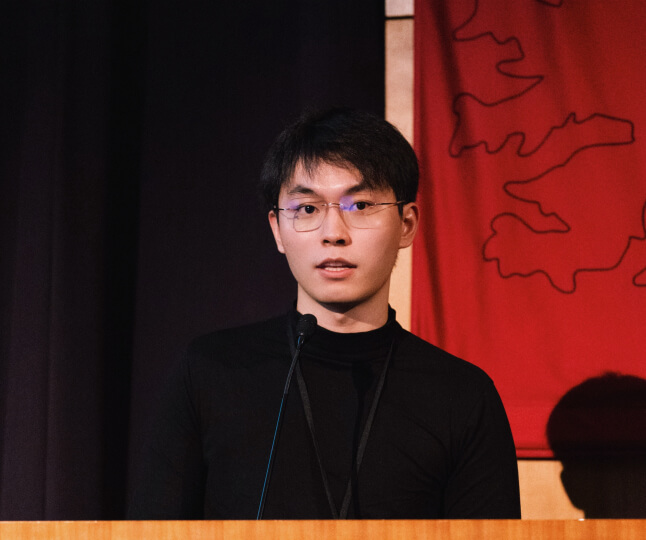
Kejun Ying, S.M. '24, Ph.D. '25
Aging is inevitable, but can we age healthier? There are all kinds of biological and physiological phenomena that cause degeneration – physical degeneration such as loss of bone density or glaucoma, and neurological degeneration such as Alzheimer’s or Huntington’s disease. With the right medical interventions, some of these phenomena can be combatted, allowing us to enjoy our full capabilities much later in life.
Kejun Ying has wanted to make aging easier since a young age, and combatting the degenerative effects of aging has been the motivation for all of his academic choices. He pursued a bachelor’s degree in biological sciences at Sun Yat-sen University in his native China, then immediately joined Harvard Medical School to pursue a Ph.D. in the same subject. Along the way, he also achieved a master’s degree in computational science and engineering from the Harvard John A. Paulson School of Engineering and Applied Sciences (SEAS).
“Before I joined Harvard and during the first year here, I was a wet lab biologist mostly,” said Ying. “And then in the second year, COVID arrived. We could no longer go to the lab, so I transitioned to more computational work. I realized I was doing much better on computation than wet lab work, so even after returning to the lab I fully transitioned to computational biology. While I could learn whatever tool I needed, I lacked the big picture when it came to computation. So I started taking some computer science courses, and then pursued the degree.”
Ying, S.M. '24, Ph.D. '25, now puts both his computational and biological education into practice as a postdoctoral researcher. His work is funded by a grant through the National Institute of Health’s National Institute on Aging, enabling him to split his research between a lab at the University of Washington and another at Stanford University. His research in the Baker Lab at Washington focuses on protein design, while his work in the Wyss-Coray Lab focuses on aging.
“The main project is to design a novel enzyme to combat neurodegenerative disease,” Ying said. “Currently, small molecule medicine either increases or decreases the activity of certain proteins. We're trying to build a new protein never seen by evolution that can break down the protein aggregation that is a hallmark of neurodegenerative degenerative disease. This protein will aggregate in your neurons or extracellular space, and cause cell death. We’re trying to design active enzymes to just break down those proteins.”
He added, “In the Baker Lab, I'm working with a group of scientists on a diffusion-based model for a protein structure generation, which uses knowledge I learned during the master’s. Foundational concepts such as linear algebra are very important when you're trying to build a model from scratch.”
Ying’s computational background has already directly benefited his postdoctoral research. He recently was lead author on a publication about the development of artificial intelligence tools that can scan through millions of RNA sequence samples publicly available from previous studies, then determine if the medicine being tested for a specific disease or intervention had an unintended anti-aging effect. Having already founded a company, Avinasi Labs, that offered a decentralized network for the collection of data related to aging research, Ying was able to draw on both his academic and entrepreneurial backgrounds throughout the publication process.
“I started working on this master’s degree right before AI research became super hot,” he said. “So I think it's a very great timing. If you look at LinkedIn right now, everyone's working on AI. I'm happy I studied before the wave hit.”
Ying currently splits his time between both labs, usually spending about three months at either site. His goal is to stay in academia long term by becoming a tenure-track faculty member. For him, academia allows him to focus on foundational research, answering the earliest questions in a research area long before industry would get involved.
“Right now we're at the very early stages of aging research,” he said. “It's really exciting. If middle-school me could meet me now, I think he would be super happy. Everything worked out almost exactly as I wanted.”
Press Contact
Matt Goisman | mgoisman@g.harvard.edu