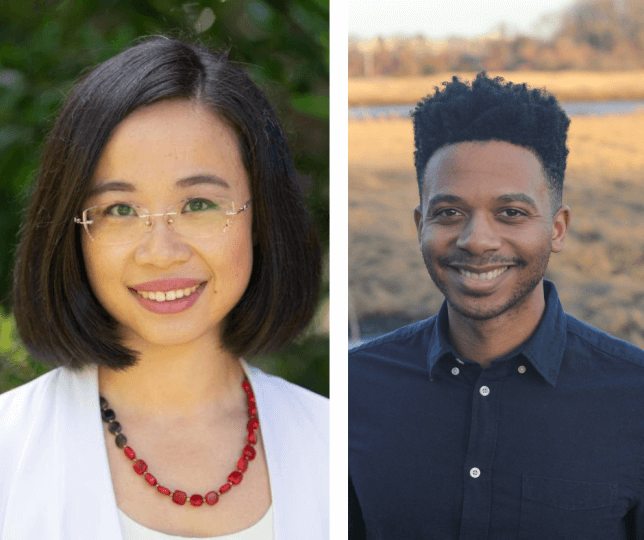
Former Elsie Sunderland Lab researchers Cindy Hu and Jahred Liddie, now at George Washington University
Cindy Hu is a professor at George Washington University where she leads the Water Health Opportunity Lab in the Milken Institute School for Public Health. Her research focuses on drinking water quality and its effects on public health. She previously worked in Prof. Elsie Sunderland’s Lab at the Harvard John A. Paulson School of Engineering and Applied Sciences as both a Masters and Ph.D. student.
Jahred Liddie is a postdoctoral researcher at George Washington University in Hu’s lab. He worked in the Sunderland lab as an undergraduate, Masters, and PhD student.
What brought you to the Sunderland Lab?
Cindy: I was an undergrad in environmental science from Peking University in China, and I learned a lot about analytical chemistry, physics, and biology in the first couple years of the environmental science program. Then, in my junior year, I took a class called Human Health Risk Assessment and that was really eye-opening for me! I never thought that physics, chemistry, and biology classes could be combined in a way that was so relevant for human health, policy, and regulations. It was after that I decided to pursue a graduate degree in public health. I found a really good match with Elsie’s research.
Jahred: I did my undergrad at Harvard and I studied environmental engineering. I chose it because it was a nice mix of a lot of things I was interested in, such as chemistry, math and biology. I was also drawn to it because the goal of engineering, and environmental engineering in particular, is to improve human health and wellbeing. In my junior year, I took Elsie’s Applied Toxicology class, and I was exposed to her research and interests. During the class I asked Elsie if I could work in her lab as a research assistant, and that’s where I met Cindy! When I finished undergrad, I went into sustainability consulting, focusing mainly on environmental life cycle assessments and the impacts of product life cycles on climate change. Eventually I decided to pursue a graduate degree, and chose Harvard because it would give me a chance to do more independent research. I felt like Elsie had the right combination of skills and experiences that would help me grow as a Ph.D. student.
What do you find most rewarding about doing research related to human health and environmental pollutants?
Cindy: I didn’t realize how academic research can connect to people. One of my first papers as a Ph.D. student with Elsie was about PFAS – also known as ‘forever chemicals’ – in drinking water nationwide. I realized that if you do high-quality, rigorous research that is policy-relevant, you can really make a difference. A lot of people want to hear about it and you can use that research to improve people’s lives.
Can you tell me a little bit about your recent WIREs review project?
Jahred: That was a piece that Cindy, Elsie, and another former lab mate, Mona Dai, and I worked on. A lot of the research was driven by the recent events that have impacted public health data and accessibility around the country. We envisioned a need for a unified drinking water quality database to be able to address the concerns of both researchers and the public on exposure disparities, as well as for individuals in particular how to mitigate exposures and make their own choices.
Can you tell us a little bit about the future directions of your research?
Cindy: Jahred is becoming an increasingly big part of all of our research projects! We use a variety of data science and big data techniques to study the question of “what is the impact of drinking water quality on public health at a very large scale?” In particular, our research has three focus areas: addressing the lack of nationally consistent drinking water data; bioinformatics or health informatics, which involves mining large-scale electronic health record data or other healthcare big data to understand the health effects of drinking water contaminants; and asking the question “What works?” when it comes to environmental regulations that improve environmental quality and also reduce population health burdens.
Jahred: It’s been great to work on all of these different projects. Now, I’m focusing more on data science and data analysis. I was really grateful throughout my Ph.D. to have gotten to develop my lab skills, because a lot of projects about drinking water quality involve laboratory work. So it’s really great to have the combination of statistical analytical work as well as exposure to the lab and the tools that people use in the lab too.