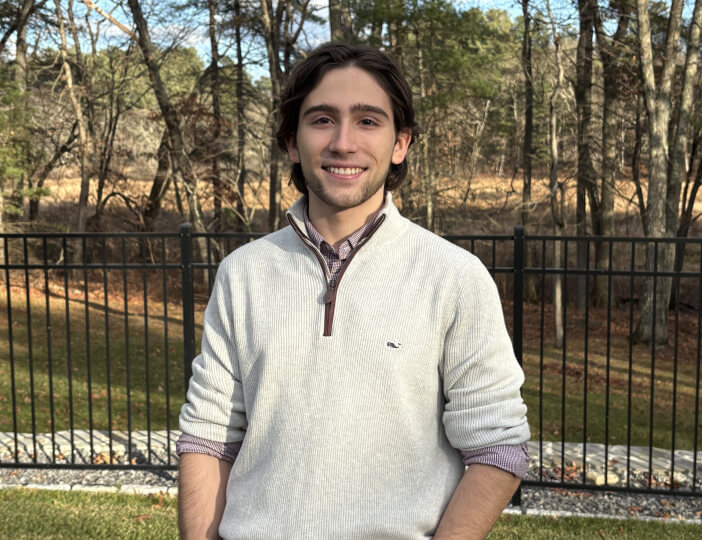
Enzo Carminati, A.B. '28
Enzo Carminati’s summer days started early in the morning and ended long past midnight. A second-year concentrator in computer science and economics at the Harvard John A. Paulson School of Engineering and Applied Sciences (SEAS), Carminati has interned at Draper Labs in Cambridge for each of the past two summers. His work at Draper covered a range of areas, including alternate navigation tools for the U.S. Air Force and development of a lunar rover prototype.
“This supports the US military's alternative navigation capabilities when we don’t have our usual methods,” he said. “Working on the program that I was working on, actually seeing something real and fungible that I could hold and control with programs that I was creating, was really riveting. It was really great to see the actual thing work, and see that the things that we do at Draper had a genuinely big impact on making sure that our military can get from point A to point B, or making sure that people stay safe.”
Carminati first got on Draper’s radar as a high school student in Stoneham, a town about 15 miles north of Boston. A competitive robotics participant since he was in middle school, he attended a robotics camp at MIT, and was one of six selected from several hundred for the Draper internship.
“The CEO of Draper told the group of interns that he was CEO 50% because of grind, and then 50% because of luck,” he said. “Industry experience is always a plus. My internship took the skills that we learned at MIT and put it into a more aerospace-specific application. I always thought it'd be sick to work on a rocket. If you're gonna work on something interesting, it's gonna be in space, because we've done everything on earth.”
Once his internship was done for the day, Carminati would hit the gym, head home and go back to work. But his nights weren’t for his internship – they were for CollegeSensei, his own company. College Sensei’s mission is to make college consultation more affordable, helping to match high school students with current or recent graduates of their dream colleges. Because these consultants recently went through the application processes themselves, they can give advice tailored to specific schools about interviews or other factors that helped them get in.
“Right now, on average the wage for a private college consultant is around $300 per hour, which is completely outside of most people's budgets,” he said. “Sometimes the edge to getting into a top school is knowing the specifics that got someone over the finish line there. A college counselor at a public school might be worrying about 50 kids who each have 10 options, so now they have to worry about 400-500 colleges, all of which have different application criteria. Having somebody who actually went to your dream school and succeeded, they will know what makes sense.”
Carminati used a $10,000 private grant to hire a team and begin developing the website. His work has continued this fall, even as he juggles it with some of the most challenging courses of his degree.
“Recently we started getting some of our first clients, and that was really rewarding to see,” he said. “I'm trying to make sure that on the weekends, when I have the time, that I'm working on the company. I’m always responding to emails as quickly as possible, and I'm always talking with the team that we have contracted to continue working on the website. I’m contacting a lot of CEOs in the area, talking with nonprofit organizations as well as specific schools to create connections. Being able to build out my own website is honestly even more interesting for me than working on a navigation user interface.”
Press Contact
Matt Goisman | mgoisman@g.harvard.edu