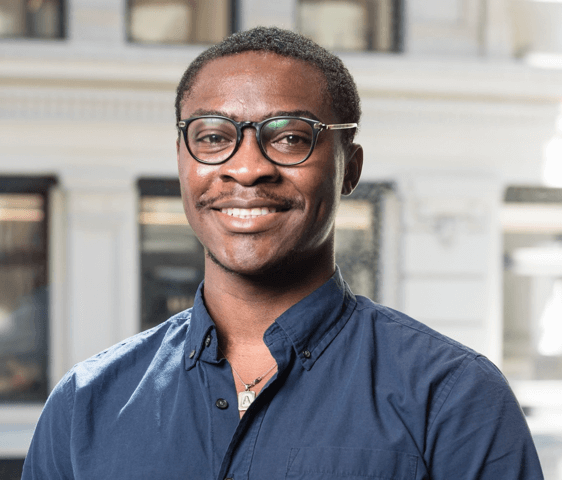
Daniel Alabi, S.M. '19, Ph.D. '22
Daniel Alabi knew almost nothing about computer science (CS) as a high school student in Nigeria. He loved mathematics, but he didn’t start to learn about CS until joining EducationUSA, which helps international students transition to American universities.
“I really liked the mathematical aspects, but also the algorithmic aspects,” said Alabi, S.M. '19, Ph.D. '22. “In the hard sciences, you can't just run experiments on your own. You need an actual lab. But with computer science, you just need a computer.”
Since that first exposure, Alabi has dedicated his academic and professional career to CS and CS education. He’s an assistant professor in the Electrical and Computer Engineering department at the University of Illinois Urbana-Champaign, where his research focuses on communication safety and privacy. In the summer, he runs NaijaCoder, a program that teaches introductory CS concepts to high schoolers in Nigeria. He developed the program as a computer science Ph.D. student at the Harvard John A. Paulson School of Engineering and Applied Sciences (SEAS), building on a preexisting program in Ethiopia founded by Jelani Nelson, an associate professor of computer science at SEAS at the time.
“I didn't have the exposure in high school, so I'm giving these kids a leg up so they can compete,” Alabi said. “I can directly see the impact, and that just really warms my heart. There was a kid who graduated in 2023 from NaijaCoder, he messaged me that he’d be in computer science classes, and there were concepts he learned from NaijaCoder that have helped him. He interned at Nvidia in the summer recently, and he was telling me he was able to pick up a lot of concepts because he had this exposure.”
After studying math and computer science as an undergraduate at Carleton College, Alabi spent a year as a software engineer at MongoDB, working on the company’s signature database program. But it wasn’t long before he felt the pull to return to academia.. He spent his first year at SEAS finding the ideal lab, eventually pursuing both his master’s and then Ph.D. with Salil Vadhan, Vicky Joseph Professor of Computer Science and Applied Mathematics.
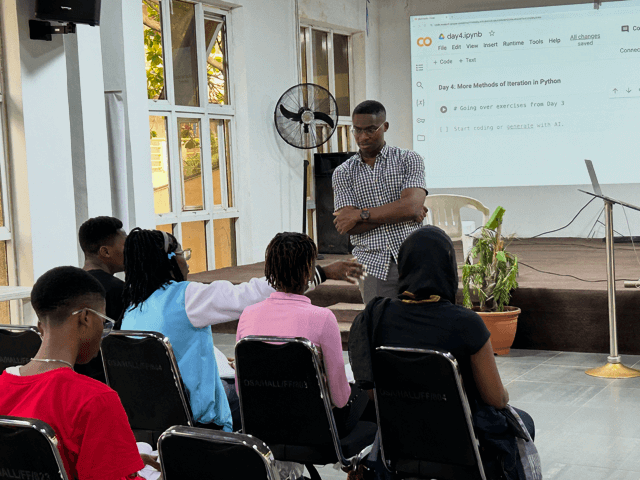
Daniel Alabi teaches NaijaCoder students in Nigeria
“He does mathematical research, and he does research in privacy, and that's something I wanted to do – research in privacy and more mathematical research,” Alabi said. “My dissertation was about exploring the privacy challenges and implementations for statistical analysis through a specific framework known as differential privacy. My dissertation was really about analyzing common operations for statistical analysis, and analyzing the validity of such analysis.”
“Naija” is a shortened version of “Nigeria,” as well as a commonly used English-based creole language in the country. Alabi met Nelson at SEAS and began developing NaijaCoder, with additional guidance from Boaz Barak, Catalyst Professor of Computer Science. He launched the program in 2022, which has now grown to 100 students split across the Nigerian cities of Abuja and Lagos.
“The first year, to be honest, was not that good because I forgot certain things,” he said. “For example, kids are supposed to have lunches. You're supposed to pay for that. They can't just be hungry and coding, right? In 2023, we decided to revamp the entire thing – provide lunches, make it more structured, put in an application form. And then 2024 got even better.”
A Simons Foundation fellowship funded three years of postdoctoral research at Columbia University, then Alabi formed the Data structures and Algorithms for Communications Engineering Safety research group at Urbana-Champaign this past fall. His current work expands on the research he did at SEAS, covering areas such as security and privacy in communication networks, safety of quantum information, and watermarking for generative AI.
“Definitely my dissertation research was and is directly connected to what I've been doing,” he said. “My lab at Illinois is really focused on how you create computational tools for the safety of communications engineering. That safety includes things like privacy, how you make sure that channels of communication are private. My dissertation was focused on differential privacy, but I'm just broadening my scope a little bit more to consider all definitions of privacy.”
Press Contact
Matt Goisman | mgoisman@g.harvard.edu