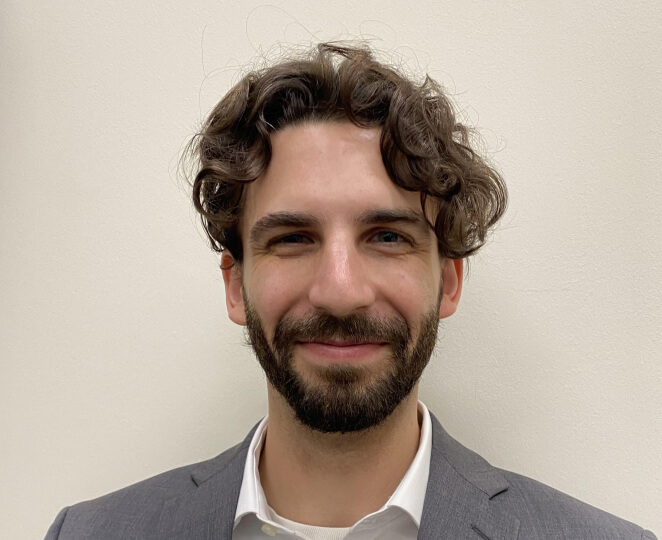
Nicholas Bobbs, S.B. '16
A pair of summer experiences showed Nicholas Bobbs what kind of engineer he wanted to be. In Nicaragua, where he spent a summer building solar panels and irrigation systems for an underserved community, he learned how engineers could improve people’s lives. That experience convinced him to concentrate in environmental science and engineering at the Harvard John A. Paulson School of Engineering and Applied Sciences (SEAS). As a rising fourth-year student two summers later, he interned at Chevron Phillips Chemical, which taught him about environmental standards from the regulated community’s perspective.
Bobbs, S.B. '16, then spent his fourth year at SEAS applying for consulting firms and government positions – places where he thought he could use his engineering knowledge to benefit people. Within six months of graduation, he joined the U.S. Environmental Protection Agency (EPA) as an environmental engineer, traveling all over New England to inspect air, soil and water samples at industrial sites. He’s still with the EPA almost a decade later, and now works at the EPA Office of Civil Enforcement’s Air Enforcement Division in Washington, D.C.
“Environmental equity is a big passion of mine,” he said. “Every neighborhood should be protected from air pollution in their backyard.”
Bobbs grew up near Cleveland, Ohio, and from a young age loved building things. His grandfather was a mechanical engineer with the Stouffer’s frozen food company, and Bobbs always liked math and science. He competed on his school’s Science Olympiad team, and when it came time to choose a school, Harvard offered the best opportunity.
“It’s a top university in the country, and I was applying to a lot of different places,” he said. “I liked Boston, and I was very fortunate to get in. The engineering program, especially 10 years ago, was still growing.”
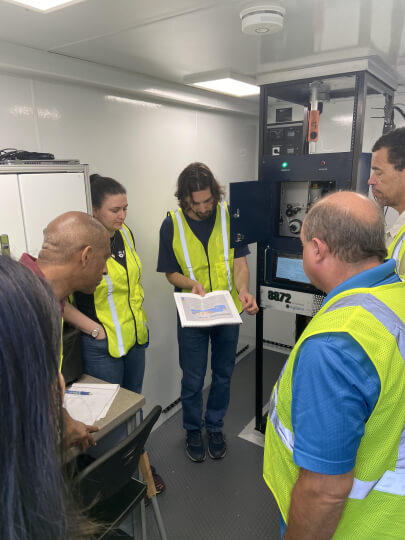
Nicholas Bobbs, S.B. '16, conducts a training from an EPA air monitoring trailer
Though initially leaning towards mechanical or electrical engineering, Bobbs took the introduction to environmental engineering class in his first year. Between that and his summer work in Nicaragua, he decided to switch.
As an upperclassman, he took on a number of projects that required skills he’d benefit from later in his career. He designed a spectroscopy instrument for ozone monitoring as a third-year student with Jim Anderson, Philip S. Weld Professor of Atmospheric Chemistry. For his senior capstone project, he designed a weather balloon for methane emissions monitoring under the guidance of Steve Wofsy, Abbott Lawrence Rotch Professor of Atmospheric and Environmental Science.
“I definitely draw on things I learned in my engineering classes,” he said. “Even though I don't really design anything myself, except for little things related to the air monitoring equipment, I do a lot of evaluating other people's engineering designs. So the principles I learned in all my different classes really helped me.”
As a student at a liberal arts college, Bobbs took plenty of non-engineering courses as well. Both sides of his education would prove invaluable at the EPA.
“Some days I would be in the mountains of Maine, trudging through the snow to collect water samples or digging soil cores with this track-mounted hydraulic press digger,” Bobbs said. “And then other days I would be in meetings with big companies to negotiate settlement agreements. My initial role did a lot with stack testing, which is when companies have to test their air pollution coming from a smoke stack. And so there's a variety of methods that they use to test for different pollutants, and there's a lot of chemistry involved. I would observe stack tests in the field, and also approve protocols and method changes. I also did a lot of work with air monitoring equipment.”
The EPA sent Bobbs to Puerto Rico to help with recovering from Hurricane Maria in 2017. A few years later, he transitioned to Washington, D.C.
“I'm one of the national leads on cases involving benzene emissions at refineries, ethylene oxide emissions from sterilizers and other sources,” he said. “We assist all of the EPA regions, provide expertise and help connect the regions with each other. We're trying to set a level playing field so that one region isn't doing a case a certain way that's gonna affect another region's case. It's a lot of time in meetings and coordination, but I also get in the field a good amount. We have a laboratory, and I manage all of our air monitoring equipment.”
Ten years into his career, and it’s clear Bobbs has found his calling. His work is at the perfect intersection of law and science, allowing him to apply the environmental engineering that he loves in a way that directly impacts people’s health and wellbeing. It requires him to draw on both his engineering and humanities education, making Harvard the ideal foundation for his career goals.
“I have a purpose to my job that just goes way beyond making money, where I really see the difference that I’m making,” Bobbs said. “With this government work, you're improving the health of countless children with asthma and reducing cancer risk. You're protecting communities that can't always fight for themselves.”
Press Contact
Matt Goisman | mgoisman@g.harvard.edu