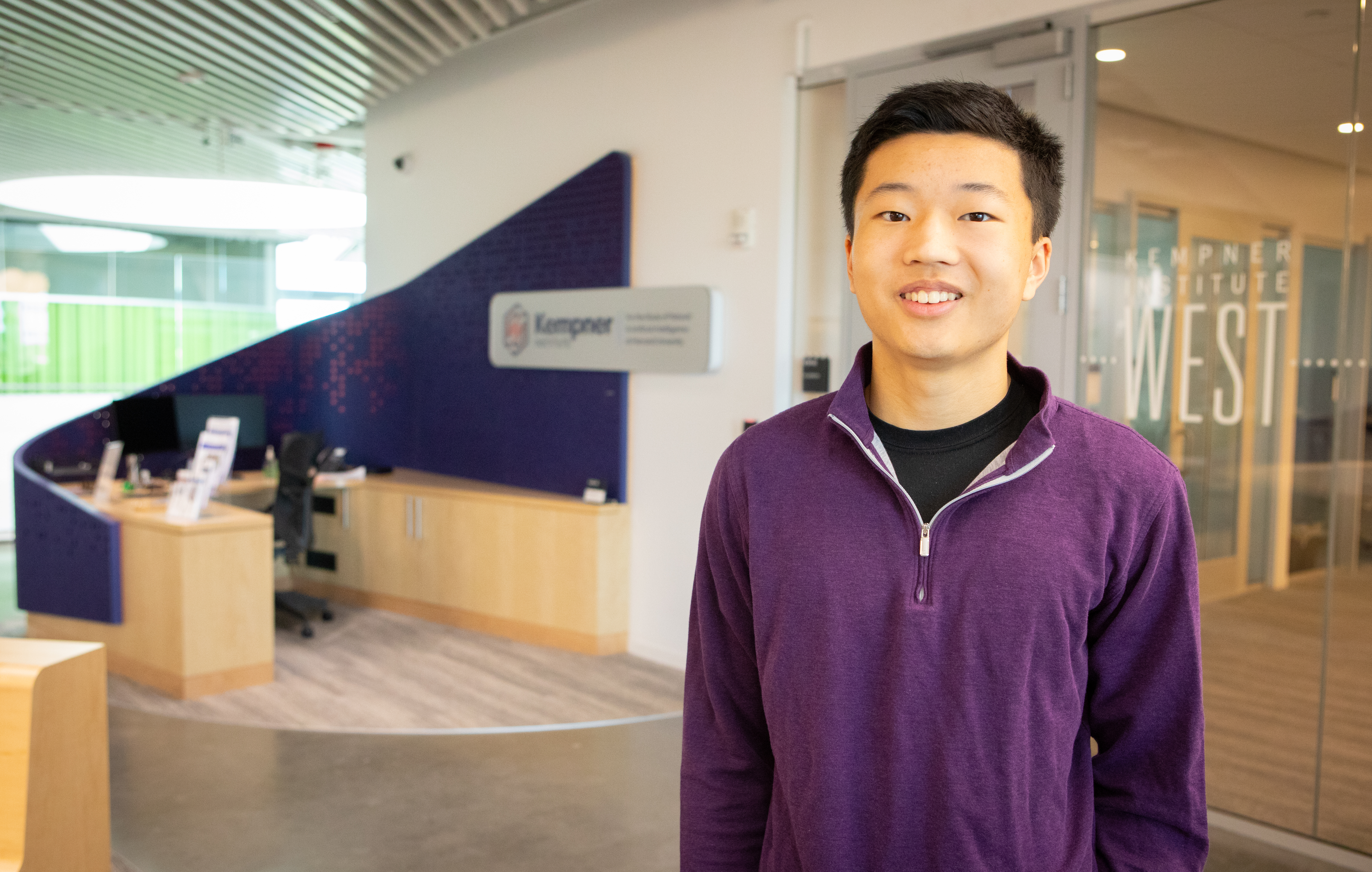
Benjamin Choi, A.B. '26 in applied math and S.M. '26 in computer science (Eliza Grinnell/SEAS)
Benjamin Choi built a mind-controlled bionic arm as a high school student in Virginia, and it made him realize something critical about human brains: they’re noisy. Brains constantly send out all kinds of signals regulating everything from breathing to hunger to planning one’s daily schedule. For his prosthetic to work, it needed software that could filter out the noise and recognize the signals specifically intended to manipulate the arm.
“One of the takeaways from that project that really stuck with me was that you can have these very noisy high-dimensional signals where you don't know what's going on, but there are all sorts of fun things from linear algebra you can do to actually find real signals in these kinds of noisy spaces,” he said.
That project became the foundation for Choi’s interest in applied math and machine learning. Now a senior, Choi is about to graduate with a degree in applied math and concurrent master’s in computer science from the Harvard John A. Paulson School of Engineering and Applied Sciences (SEAS). He’s done machine learning research at Johns Hopkins University, NASA and the Kempner Institute for the Study of Natural and Artificial Intelligence at Harvard University, and after graduation will be working as a machine learning researcher in industry.
“What's been nice about the applied math curriculum is that I feel like it is kind of like the liberal arts of STEM,” Choi said. “I enjoy how interdisciplinary it is. I feel that I have generally broad ranging interests, and the flexibility of the applied math curriculum has really enabled me to take advantage of that while also going deep into a very interesting subject as well.”
Though he always loved math, Choi didn’t consider applied math as a potential major as he was applying to colleges. Harvard’s broad liberal arts education appealed to him, but it was really his first visit to the Science and Engineering Complex that clinched his decision to come here.
“I remember when I visited the Allston campus, I was just super, super impressed,” he said. “It was very clear that this is an area that the school has been investing so much in, and that certainly paid off in terms of the amazing classes and faculty and resources I've been able to take advantage of while here.”
One particularly impactful class was ‘AM220: Geometric Methods for Machine Learning’ with Melanie Weber, Assistant Professor of Applied Mathematics and of Computer Science. Choi later joined Weber’s Geometric Machine Learning Group as a researcher, and she eventually became his advisor on a senior thesis comparing how artificial intelligence large language models map data using frameworks similar to human emotions.
“It was really just an eye-opening class, because it showed me that there are all sorts of really cool intersections between geometry and the underlying principles undergirding these kinds of machine learning concepts,” he said. “I really, really loved that class. There was kind of a cross-pollination between some of the geometric concepts from that class and how I was thinking about my own research into signal processing and machine learning at the time. Professor Weber was super kind and super generous in terms of offering to mentor some of the research ideas I had.”
The Kempner Institute began its research initiatives just as Choi arrived on campus, giving Choi a second outlet for his machine learning interests. As a junior, he was part of the inaugural cohort of Kempner Undergraduate Research Experience students, working with Demba Ba, Gordon McKay Professor of Electrical Engineering, on a project applying the same AI architecture behind chatbots to clean up noisy gaps in brainwave signals.
“I was really drawn to the overall thesis of the institution, which is if we can find these parallels between artificial intelligence, machine learning and natural intelligence and brainwaves – a problem I was already working on with the bionic arm,” he said. “Professor Ba was kind enough to sponsor my work for the first cohort of the Kempner program. That was a wonderful experience.”
The computer science master’s degree helped broaden Choi’s understanding of machine learning, going from the applied math that explains it to the computer architecture that executes it. Through the master’s, Choi became first author on multiple publications, learning both the theories of computer science and an approach to problem solving that will work even as specific programming languages or AI models change over time.
“The Harvard CS curriculum instilled in me a way of thinking about things,” he said. “Teaching me how to think has been really, really valuable, and has ended up being way more useful than if I had spent freshman year learning some specific language that’s now obsolete.”
The bionic arm, whose underlying signal processing he continued developing at Johns Hopkins, was the foundation of Choi’s interests. But his time at SEAS, whether with the Weber Group or Kempner Institute, has both broadened and refined his understanding of machine learning. Now set to enter the workforce, Choi is fully ready to continue what he’s always done: find ways to apply his research in the world around him.
“I've definitely tried to seek out a diverse range of experiences throughout my time here in terms of doing research, and applying that research to make meaningful differences in my field,” he said. “I really think in terms of the way Harvard has positioned itself with the Kempner Institute, I've gotten to take cool classes on AI and hear from all sorts of really cool speakers here. It has been quite thrilling to see how rapidly things are evolving.”
Press Contact
Matt Goisman | mgoisman@g.harvard.edu