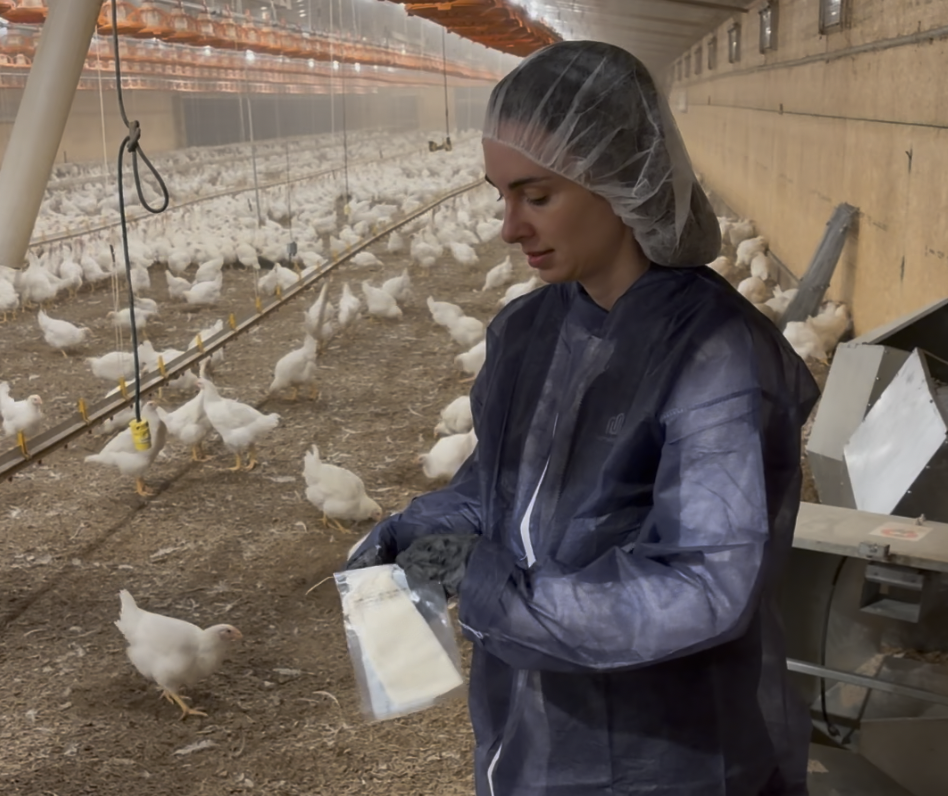
Casey McGinley, MS/MBA '21, collects genetic samples in a chicken coop
Disease epidemics can devastate a farm. If a chicken gets sick, the whole coop could catch a potentially fatal disease. And while individual animals can always be tested, those tests are often invasive and inefficient for larger populations.
Casey McGinley, MS/MBA '21, is creating tools that can monitor a whole barn instead of just an individual animal. She’s co-founder and Chief Operating Officer at Barnwell Bio, an agricultural technology start-up whose platform can simultaneously analyze thousands of samples of genetic material, enabling farmers and farm veterinarians to more accurately prevent disease and track the effectiveness of nutritional or breeding changes. The New York-based company completed a $6 million seed round of fundraising earlier this year and is already being used by multiple farms.
“It’s pathogen biosurveillance,” McGinley said. “We leverage environmental samples on an ongoing basis to look at how levels of pathogens and other microbes in the environment are trending to give producers an early warning signal. If we start to see something rise ahead of or alongside them seeing clinical symptoms, we can provide information on how things that they're trying are impacting the barn environment.”
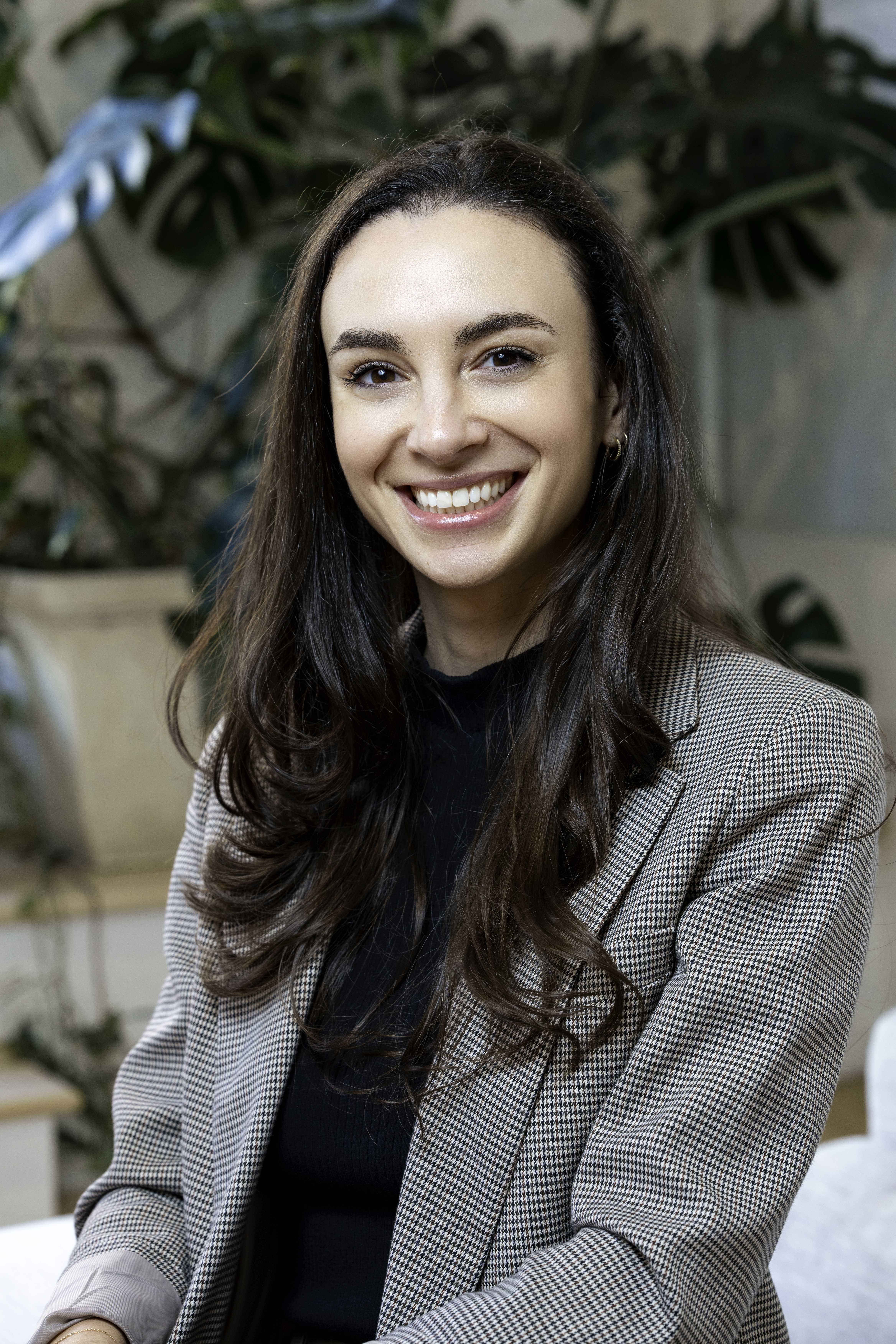
Casey McGinley, MS/MBA '21, is Chief Operating Officer and co-founder at Barnwell Bio
The idea for Barnwell began when McGinley was working at Biobot Analytics, a public health start-up that she joined as an intern while pursuing her MS/MBA in Engineering Sciences through the program run jointly by the Harvard John A. Paulson School of Engineering and Applied Sciences (SEAS) and Harvard Business School. Biobot’s products focused on deriving insight from wastewater samples, and McGinley joined in the early days of the COVID-19 pandemic, when wastewater tracking was especially critical to understanding the spread of the disease.
“I had come across Biobot at an event in Cambridge at Greentown Labs, and reached out to see if I could be helpful,” she said. “They had just launched their pro bono campaign for wastewater treatment plants across the U.S. to send them samples, because they were really trying to give information to these communities at a time where there was really limited information.”
McGinley spent four years at Biobot, rising from intern all the way to Senior Director of Product. It was there where she met her eventual Barnwell co-founders, all of whom wanted to see if similar population-level analytics could benefit farms.
“Visiting farms is the best part of this job – getting to work with veterinarians and heads of operations at these places, seeing their wheels turn when we share what kind of information we can provide and how it can help,” she said. “I'm most focused on operations and product – making sure our customers have the information that they need to be using the product, helping understand how they're using it, and what improvements that we can make are going to be helpful.”
Growing up about 25 miles north of Philadelphia, McGinley earned her bachelor’s degree in biomedical engineering at Duke University. She spent five years at pharmaceutical company Catalent before feeling the pull back towards academia, and eventually the second-ever MS/MBA cohort.
“I wanted to pivot into something more sustainability-focused and in the startup world, and thought that grad school could be a great way to do that,” she said. “Once I saw that that sort of dual degree program existed, I was really excited. I was an engineering undergrad, loved that part of the job and learning, but an MBA is also super applicable and relevant.”
Harvard’s courseload was different from anything McGinley experienced as an undergrad. Even in her classes that were more engineering-oriented, there was still a focus on case studies that was unlike her time at Duke. Those studies proved invaluable at Biobot and then Barnwell, teaching her lessons about design and market sizing and penetration that are essential for early-stage start-ups. And even as she was learning new concepts, she was getting closer to her classmates, which has proven just as invaluable.
“If you look at my class in particular, it seems like half of us have started our own thing or are at early-stage startups,” McGinley said. “It really was such a group of sort of like-minded individuals, which was really special. There’s a friend from my class who’s now COO at a Series B-stage company. She has been incredible to chat with when I have questions about how they handled challenges when they were at our stage.”
Now at Barnwell, McGinley finds herself at the intersection of technology and business – perfect for someone with her background. Her work involves frequent conversations with the technical experts on her team, but also speaking with farmers and others who might not have that same training. That ability to help translate technical knowledge into something that helps farms keep their animals safe is incredibly gratifying work.
“I think about when we started this, and how much we had to learn about livestock and poultry and animal health,” she said. “I am one of the least technical people in the group that we have now, which is exciting because I learn so much from them. It's been incredible to see how much farther we get as we grow and really build out that expertise.”
Press Contact
Matt Goisman | mgoisman@g.harvard.edu