
Danika Rodrigues, Ph.D. '26, in bioengineering (Eliza Grinnell/SEAS)
Danika Rodrigues has been researching cancer therapies since she was a biomedical engineering undergraduate and master’s student at the University of Michigan. But it was working at Janssen Pharmaceuticals, a division of Johnson & Johnson, that convinced her that not only was cancer research interesting — it was what she wanted for her career.
“There’s been so much advancement in the cancer field, and yet it's still really hard to treat, and there's still so much research left to be done,” Rodrigues said. “I realized this was a career that I wanted to pursue, being in the R&D space, being able to make medicines for patients.”
Rodrigues knew she needed further training, which led her to look for Ph.D. programs. That led her to the Samir Mitragotri Laboratory for Drug Delivery at the Harvard John A. Paulson School of Engineering and Applied Sciences (SEAS), where she’s spent the last six years researching cancer therapeutics as a Ph.D. candidate in bioengineering.
“Samir's lab was the perfect place,” she said. “I was drawn to the lab’s novel approaches to research in translational drug delivery. It was really exciting to have the opportunity to be at an institution where there are so many resources, so much interesting research, and so much collaboration in a huge hub of biotechnology. It was an amazing opportunity and I feel so lucky to have been a part of it.”
For her dissertation, Rodrigues combined two branches of the lab: ionic liquids and cell-based therapies. Ionic liquids are essentially liquid salts; but unlike table salt, whose small ions form crystalline structures and are solid at room temperature, ionic liquids are comprised of bulky, organic components that prevent them from forming a lattice structure, keeping them in a liquid state at room temperature without needing to be dissolved.
Rodrigues devised a personalized therapeutic cancer vaccine by using an ionic liquid cocktail to re-engineer tumor cells to then be delivered as a cell therapy. This vaccine approach is designed to train the patient’s own immune system to recognize and attack the cancer and could potentially reduce the need for more aggressive treatments such as radiation or chemotherapy, which risk damaging healthy parts of the body alongside tumors.
“In a clinical setting, you would take a biopsy of the tumor, process those tumor cells into a single cell suspension, modify them, and inject them back in,” she said. “This ionic liquid cocktail enables a single step modification to inactivate the cells while also loading them with an adjuvant cargo to make them more immunogenic, or readily detected by the immune system. Because you're using that patient's own tumor cells, you don't need to figure out the antigens or identifiers to target ahead of time. All that information is captured in those cells.”
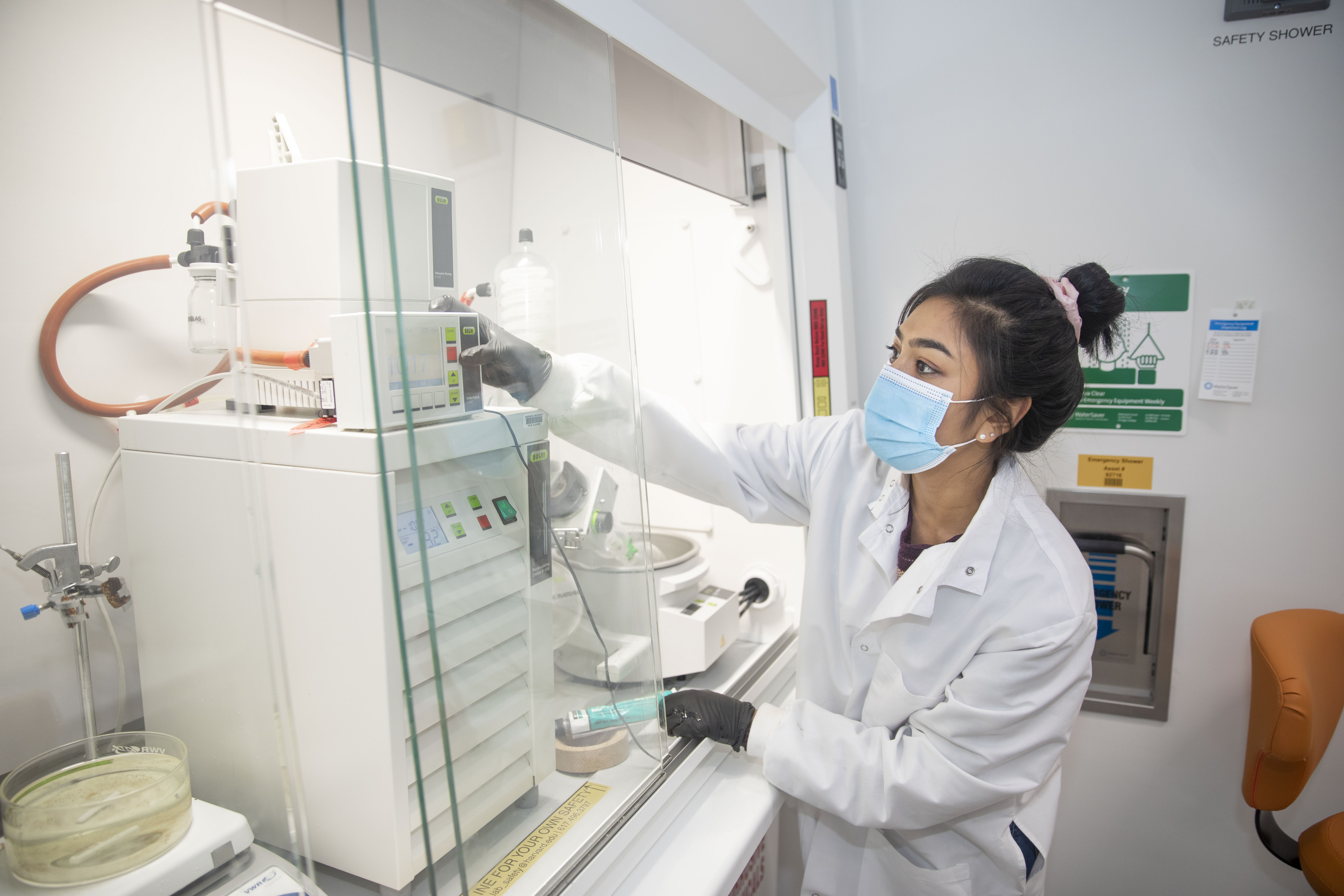
Danika Rodrigues, Ph.D. '26, works in a SEAS wet lab (Eliza Grinnell/SEAS)
Rodrigues defended her dissertation in November and has since returned to Pennsylvania to work full-time in the same group, now renamed Johnson & Johnson Innovative Medicine.
“I’m back in the same drug product development and delivery group, working on the formulation of antibody therapeutics,” she said. “I know how to design an experiment, and that's something that I developed during the Ph.D. This is especially helpful as we run different formulation screening experiments to identify the best ingredients to make the drug product-stable and in a form that is suitable to be delivered to patients. The last time I was in this job, I had really no knowledge of immunology, and I've really got a lot of that training in my Ph.D. Now coming back, it’s so helpful to have that background of what disease we're targeting or the mechanism of action for these molecules.”
At Harvard, Rodrigues never lost her interest in the biotech world. She was active in the Harvard Griffin GSAS Harvard Biotech Club, serving on the leadership team as Co-Director of Info Sessions, and also volunteered with Biotech Connection-Bay Area, a non-profit biotech consulting organization.
As an undergraduate, Rodrigues learned how to execute experiments but not how to lead a project. As a Ph.D. student, she learned how to take ownership of a research project, appreciating both the independence to plan her own approach but also the responsibility to understand and grow when an experiment fails.
“You really learn how to really question every step of what you're doing, or look in the literature as to why people are doing it this way,” she said. “Sometimes you don't understand until you try something and fail. The independence and critical thinking are huge components of the Ph.D.”
Rodrigues came to SEAS with a clear goal: expand her knowledge of cancer therapeutics, immunology and drug delivery in order to build on a career in pharmaceutical research. She’s already putting that degree to good use, using what she learned here to develop therapies that could positively impact the health of so many people.
“My advisor is an incredibly kind and intelligent person, which made him such a good mentor,” she said. “I'm so grateful for the opportunity to work on a project that I found super interesting and got to see through to a stage I was really happy with.”
Press Contact
Matt Goisman | mgoisman@g.harvard.edu