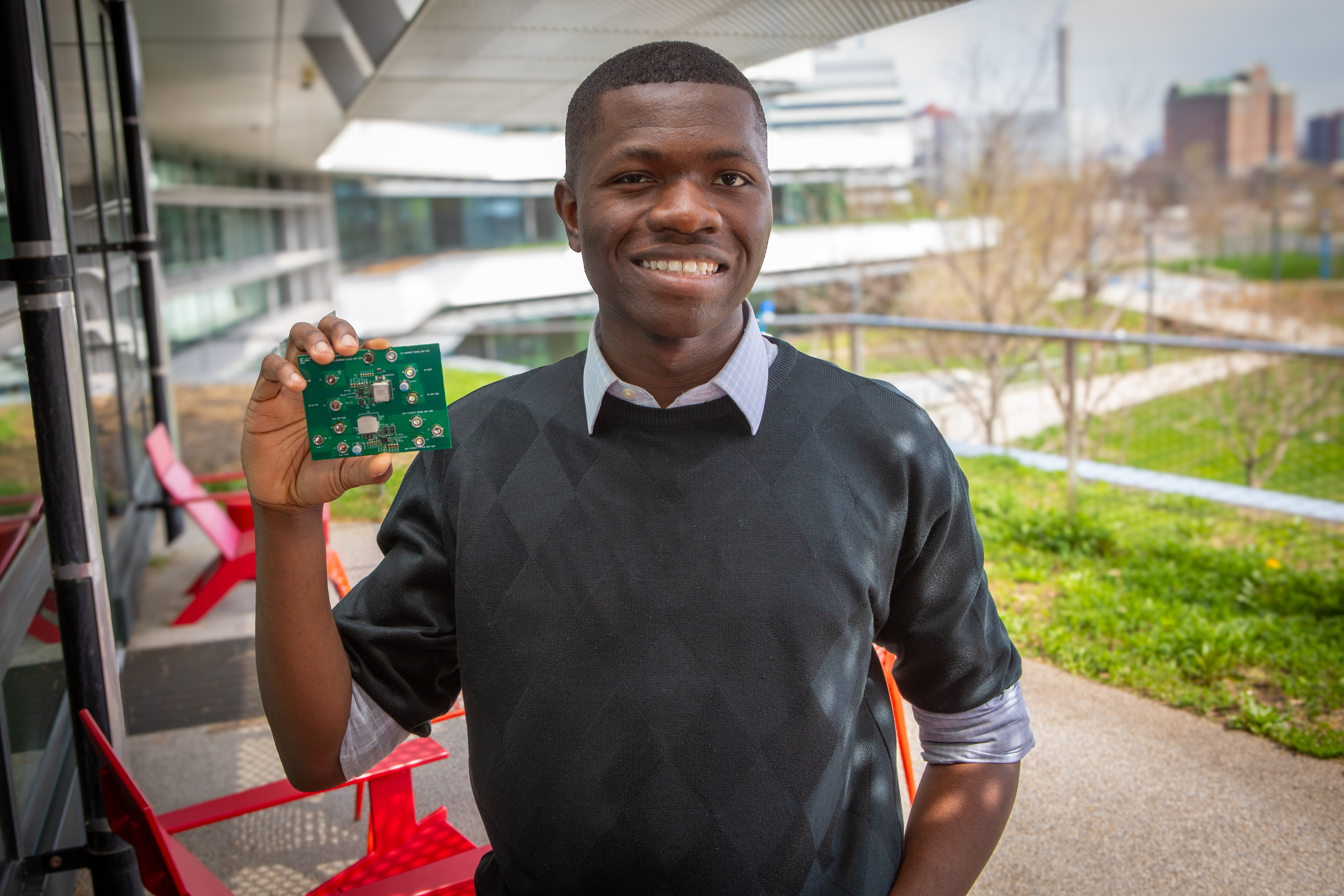
Ike Ogbu, S.B. '26, in electrical engineering (Eliza Grinnell/SEAS)
Ike Ogbu didn’t arrive at Harvard with a clear academic plan. He’d taken an engineering design class at Foxborough Regional Charter School in southeastern Massachusetts, but wasn’t sure if he wanted to study engineering, computer science or another topic entirely.
Two classes at the Harvard John A. Paulson School of Engineering and Applied Sciences (SEAS) changed everything for him. “ES50: Introduction to Electrical Engineering” taught him the fundamentals of the discipline he’d eventually pick as a concentration, while “ES152: Circuits, Devices, and Transduction” made him realize how much he specifically loved circuit design. ES152 was also his first time being taught by Gage Hills, Associate Professor of Electrical Engineering.
“His enthusiasm and commitment to the students, that combination really drew me in,” Ogbu said. “I asked him about research, and he explained how one of his research focuses is electronic-photonic integrated circuits, and that sounded cool.”
Ogbu joined Hills’s Nano-Design Research Group soon after, and outside of classes, that’s where he’s spent most of his four years at Harvard. His research has focused on creating a device known as an optical amplifier, which can amplify the strength of transmitted light signals without first converting them into electricity.
“We have an electronic version of this device called an op-amp, which is extremely useful in electronics,” Ogbu said. “The thinking was that perhaps we can take this extremely useful electronic component, and then make an optical version of it in order to facilitate electronic and optical or photonic co-design.”
Ogbu’s research in the Hills Group eventually helped him secure a prestigious WAVE Fellowship at Caltech this past summer, where he worked on a wireless power transfer system. Hills then became Ogbu’s advisor for his ES100 senior capstone project, a voltage regulator module to improve the energy efficiency of artificial intelligence data centers.
“I am very proud to have Ike representing electrical engineering at Harvard,” Hills said. “When we first met, Ike was a starry-eyed freshman curious about electrical engineering. Now, he is a seasoned veteran, with multiple years of research experience in my lab and at Caltech.”
After graduating in May, Ogbu will head to the University of Texas-Austin, where he’ll continue his research as a Ph.D. student in electrical engineering.
“The nature of research is that you're working on cool, novel stuff,” Ogbu said. “Being able to see what world class researchers in the field right now are working on, what they're worried about, what they're excited about, is super valuable. I liked this research experience, so I decided to continue.”
Parental encouragement helped convince Ogbu, the son of Nigerian immigrants, to apply to Harvard. Though he also got into several schools with more traditional engineering-focused curricula, he realized that the breadth of students he’d interact with at Harvard would be just as beneficial.
“Among engineers, we often like to bemoan taking classes that are outside of our curriculum,” he said. “But honestly, I think some of those humanities courses that I've taken have been my favorite here. Being able to see so many people that are doing other stuff outside of engineering and beyond our students and faculty was super valuable.”
Since coming to Harvard, Ogbu hasn’t just studied for his own sake – he’s tried to instill in others that same passion and enjoyment for electrical engineering. He’s been a course assistant for both ES50 and ES152, continuing to work with Hills both in and out of the lab.
“My CA-ing for ES152 I remember especially fondly,” he said. “I’d have like a five-hour block on Sundays where people would come and we’d work on problems together. Those were often the highlights in my week.”
Studying engineering hasn’t just taught Ogbu how to design circuits that work – it’s also taught him how to adapt when they don’t. ES50 students typically display their final projects at the annual spring SEAS Design & Project Fair. His group built three electronic instruments for their project, but at the Design Fair only one worked.
“That was, I think, an introduction to the concept that you can do this work, and sometimes it doesn't quite come together at the end, but even so the engineering process is super important and super fun,” he said. “When you're dealing with circuits and trying to figure out how to debug them, sometimes it just takes time in order to do that, and time isn't super friendly to deadlines. I’ve definitely tried to impart on people that it is the process that matters. Learning the material and struggling with it, that’s what really sets your foundations as an engineer.”
Had he taken different courses in his first year, Ogbu’s path through SEAS might’ve been completely different. But his early choices led him into the world of research, and those early choices have positioned him for even further success in the lab in the years to come.
“I'm super excited,” he said. “There are always things that I wish I could have done, but I think I have done enough that I am satisfied with my time here, and I'm ready to go on and do the next thing.”
Press Contact
Matt Goisman | mgoisman@g.harvard.edu