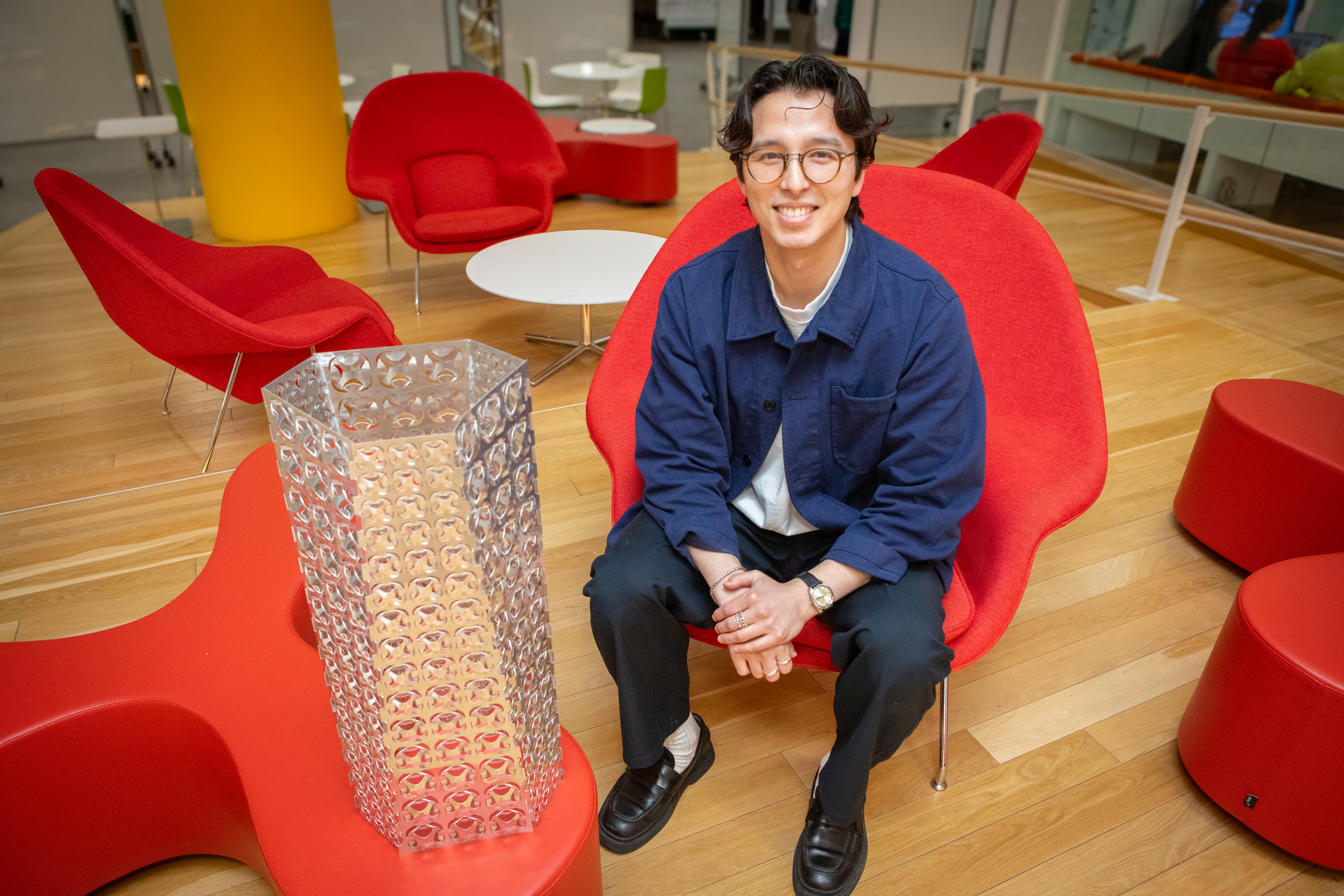
Luke Fiorante, MDE '26 (Eliza Grinnell/SEAS)
After three years as a Waymo software engineer, Luke Fiorante wanted a change. He'd been coding ever since he was a computer science major at Brown University, but the Vancouver native knew he could do more. Also interested in design and the arts, he decided to search for master’s programs focused on design and engineering.
The Master in Design Engineering (MDE) program, run jointly by the Harvard John A. Paulson School of Engineering and Applied Sciences (SEAS) and Harvard Graduate School of Design, was the first link he came across.
“When I saw it and I read the homepage, it really resonated with me,” he said. “There's a fundamental optimism inherent to MDE's philosophy that says big problems are worth tackling, and here are the skills that you can learn to begin to make sense of a complex world.”
Over the last two years, Fiorante has undertaken a number of projects aimed at addressing a wide range of challenges. He helped build a tool for the NASA Jet Propulsion Laboratory that can plan optimal routes for the Perseverance Rover on Mars; helped develop a start-up aimed at easing communication barriers between doctors and patients; and created “Ground State,” an open-source platform to help nations anticipate future droughts.
Fiorante created the drought prediction platform with classmate Mitul Iyengar for their Independent Design Engineering Project (IDEP), the program’s year-long capstone project. After graduating, the duo plan to open an independent design studio that will allow them to continue developing Ground State while also taking on design engineering projects for clients in private industry.
“The MDE program has transformed the way I think and the way that I work, and I don't think I can go back to the desk job of being a software engineer anymore,” he said. “Software engineering is now just one of many tools in my toolkit that I will apply to these broader design problems.”
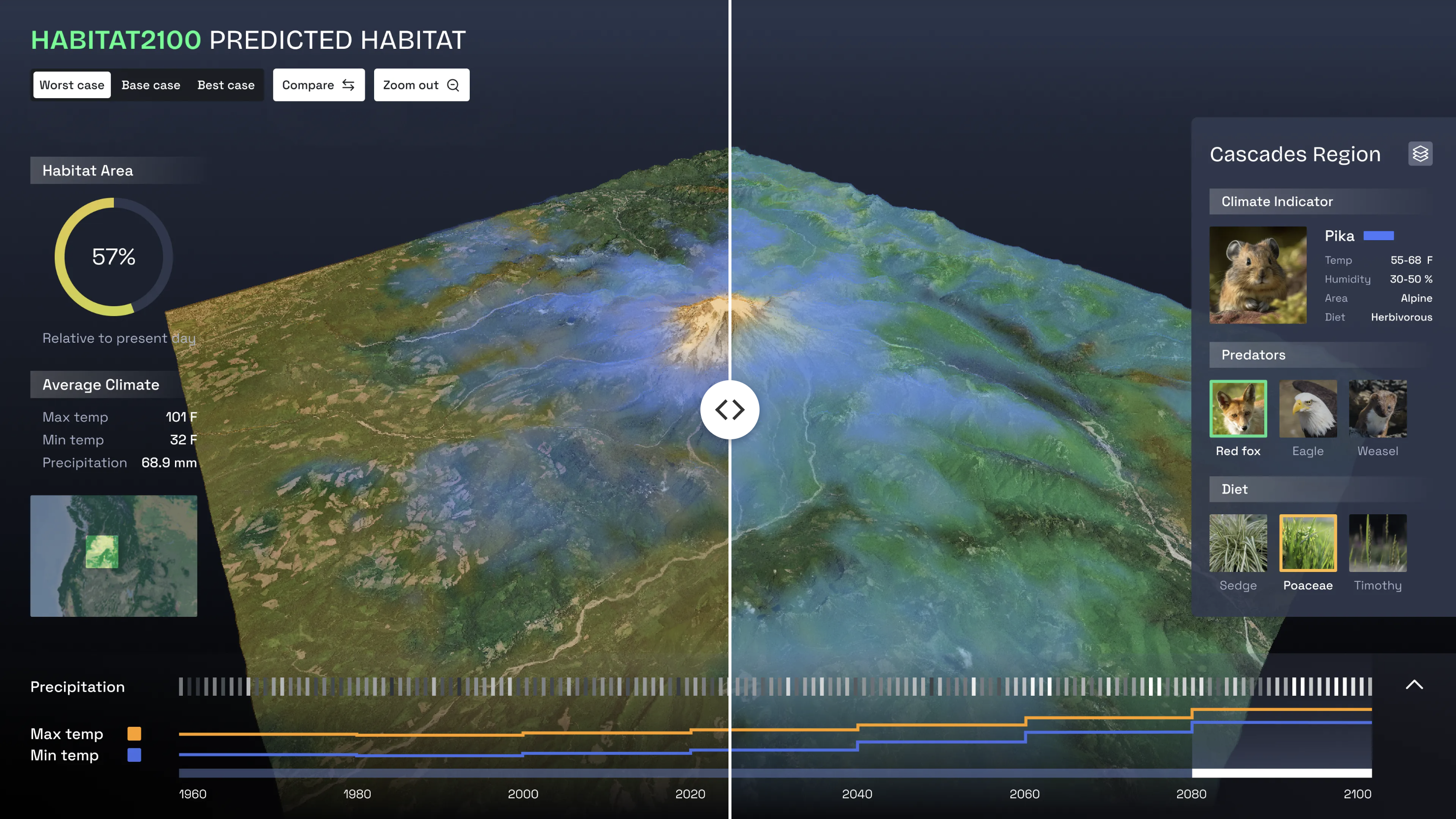
Luke Fiorante's first studio project at Harvard modeled the future of different species under climate change.
Ground State draws on data visualizations concepts he began developing as soon as he arrived at Harvard. His initial studio project, “Habitat 2100,” modeled the future of different species under climate change. It was his first real lesson in data visualization, a critical tool in his subsequent work.
“I've been drawn to data visualization as a natural focal point for my skills because it combines engineering and very visual design aspects,” he said. “There's a storytelling aspect to it. There's an information design aspect to it. I feel like it's been a natural fit for me.”
Fiorante took those data visualization skills to the Jet Propulsion Laboratory (JPL) last summer. His task: build a tool that would visualize data from previous Perseverance expeditions, making it much easier for engineers to plan future driving routes.
“They're trying to collate all these different data streams that represent telemetry of the robotics itself, software logs, positioning on the global map, or camera imagery,” he said. “Every day that they spend on Mars, they collect valuable data. And every future day that they plan for, they want to look for precedents – if they’d seen terrain like this before, and how they dealt with it. It's all an exercise in de-risking this billion-dollar project.”
JPL pitched the project on a visit to Harvard, but Fiorante also knew about it from Linh Pham, an MDE classmate with whom he’d helped develop Lexi. A 2025 finalist in the Harvard President’s Innovation Challenge, Lexi is a real-time artificial intelligence translation tool for doctors and patients. The start-up has won multiple awards, including selection to the Harvard Innovation Labs Social Impact Fellowship Fund and the grand prize at the Harvard Business School New Venture Competition.
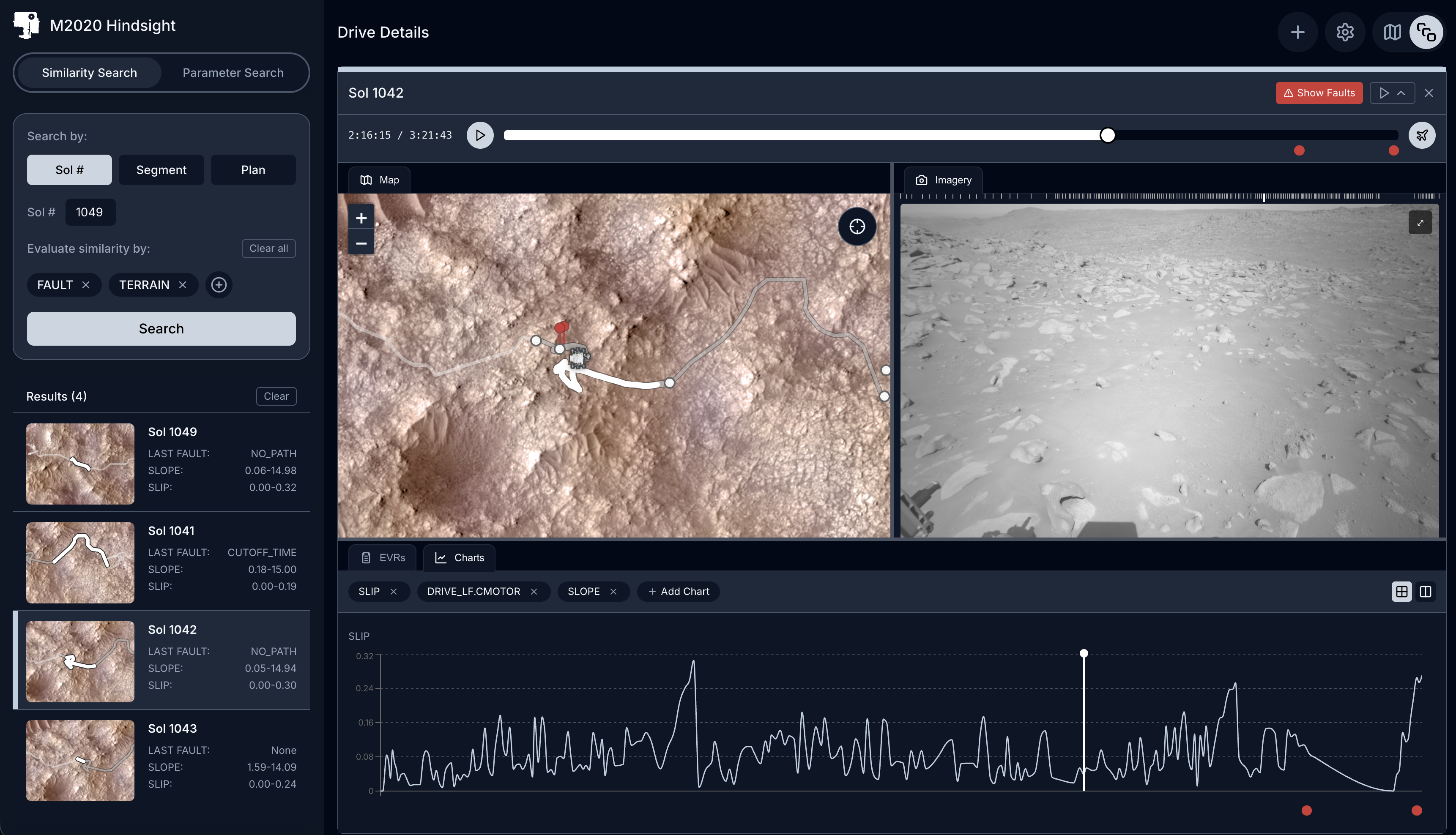
Luke Fiorante spent last summer building a tool for the NASA Jet Propulsion Laboratory that can plan optimal routes for the Perseverance Rover on Mars
“Working on a project in the healthcare space was entirely new to me,” he said. “Linh and co-founder Siddharth UR are brilliant, and so getting to work with a really talented team of MDE people who share that same interdisciplinary mindset of wearing whatever hat we need to solve a problem that we care deeply about was really gratifying.”
Along the way, Fiorante has undertaken a number of design projects that taught him skills outside of data visualization. “Rooted in Place” was a bio-fabrication project that explored if plant root systems can follow 3D-printed scaffolds and become architectural components. “Project Disha” produced a field guide for organizations in India to help prevent early hysterectomies in women. And “Hikarigami” took flat aluminum sheets etched with a pattern, punched holes into each sheet using a robotic arm, then combined the sheets into a functional lamp.
“I'm probably not gonna go on to become a lighting designer, but I'm really grateful for the opportunity to have worked on something new and different and fun,” he said. “I am thrown into teams with people who come from environmental engineering backgrounds, from visual design backgrounds, from architecture, from fashion, and I think there's an expectation that you will all learn from each other, lend your skill sets and also work across the aisle. There were projects where I was expected to take on the design aspects of it, while my partner who has a non-technical background is expected to do the engineering. The encouragement to step outside of your comfort zone was necessary and crucial and really set us up for success.”
Press Contact
Matt Goisman | mgoisman@g.harvard.edu