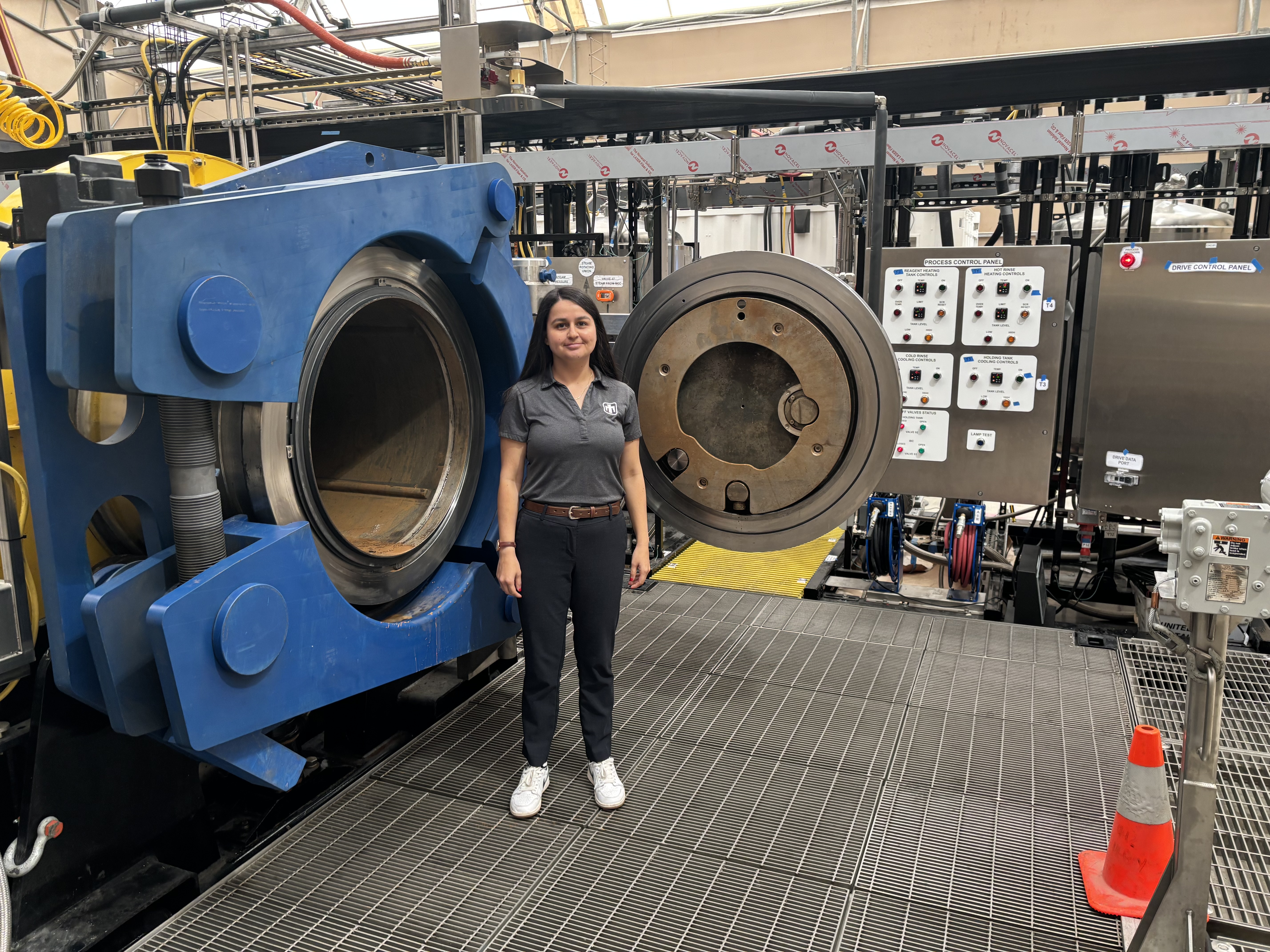
Nancy De Haro Castañón, S.B. '13 (Sandia National Laboratories)
Nancy De Haro Castañón, S.B. '13, built a human heart from household supplies, and that was it – she wanted to be an engineer. The project was part of MESA (“Mathematics, Engineering, Science, Achievement”), a college-prep program run through the University of California Office of the President that offered a hands-on approach to STEM education.
“The creativity and hands-on aspect that you could easily create something new from scratch was what I liked about engineering,” she said.
That program became the foundation of Castañón’s career in engineering. She studied mechanical engineering at the Harvard John A. Paulson School of Engineering and Applied Sciences (SEAS), then went on to a master’s in mechanical engineering at California State University, Los Angeles. She spent three years developing air handling systems for diesel engines at Cummins in Indiana, then in early 2020 joined Sandia National Laboratories, one of the primary research laboratories for the U.S. Department of Energy. Over the last six years, her work has included developing gas transfer systems for hydrogen isotope storage and leading integration of the Explosive Destruction System, which provides on-site treatment of chemical warfare material in unexploded munitions in a safe, environmentally sound manner.
“There’s a sense of satisfaction that the work that I'm doing affects geopolitics and helps keep the country and the world safe,” she said. “I go home every night and I'm like, ‘I did good work.’”
Castañón wasn’t sure what kind of college experience she wanted, so as a high school senior applied to a range of schools both in New England and her home state. Harvard’s visiting student week, now known as Visitas, ultimately convinced her that Cambridge would be the right choice. Harvard not only offered a quality engineering education – it introduced her to numerous people hoping to excel in other fields as well.
Once she got here, it didn’t take long for her to join the S.B. track in mechanical engineering.
“The SB program was pretty intense, but you need to have that background knowledge and those tools to do the technical work,” she said. “Now that I'm at a national lab, I can see why we had all those requirements for the SB program. I do think the SB program really did prepare me for a technical career at Sandia and when I was in industry.”
While at SEAS, Castañón took on two student research positions that taught her skills she’d need later in her career. As part of the Concord Field Station run by Andrew Biewener, Charles P. Lyman Professor of Biology, Emeritus, she learned how to use MATLAB software while studying the movement of pigeons. As part of the Sloan Automotive Lab at Massachusetts Institute of Technology, she researched exhaust flow in diesel particulate engines. Her principal investigator in the Sloan Lab, Victor Wong, had previously worked at Cummins, which helped Castañón eventually get a job there.
“At the MIT Sloan lab, I would go on Thursdays or Fridays and then just run experiments,” she said. “That taught me about the meticulous nature of technical work. It really comes down to the details. I'm still running experiments, and you just have to be extremely careful and meticulous and write down and document everything you did. It's all about the details.”
Castañón also joined multiple student clubs while at SEAS, including founding the Harvard Society of Latino Engineers and Scientists. Those club experiences helped her learn communication skills that her coursework didn’t teach, which has also proven invaluable.
“I'm an introvert like most of my colleagues, but I do think that being engaged in extracurriculars at Harvard forced me to get outta my shell and meet other people,” she said. “Engineering presents technical problems, but you're working with people.”
Castañón joined Cummins as a performance engineer in the air-handling integration department in 2017, but wanted a change after three years working in industry. She found industrial engineering to be too repetitive, as she was working on the same products and components over and over again. Alongside a mission she believed in, Sandia National Laboratories also offered collaborative, multidisciplinary experimentation, something she’d missed from her college and graduate school years.
“At the labs, it's all about research and doing fine technical work,” she said. “I've been able to work with five departments now doing completely different work. That's what I love about the labs: you get to really bounce a lot.”
Castañón has never forgotten the foundation of her engineering career that has now stretched to over a decade. She joined MESA’s Industry Advisory Board last year, hoping to help more young people fall in love with engineering and gain the resources to pursue it as a career. And if it leads to more people like her studying at places like SEAS, that’s even better.
“I loved every bit of it,” she said. “Knowing everything that I know now, I still would've picked Harvard.”
Press Contact
Matt Goisman | mgoisman@g.harvard.edu