News
Key Takeaways
- A Harvard study shows that snakes “stand” by focusing bending and muscle activity in a small region near their base.
- The study demonstrated how a snakelike “active elastic filament” could provide a blueprint for efficient, resilient robots that must stand or reach.
Snakes may be best known for slithering. But consider that these animals also perform one of the most extreme feats of posture control found in nature: They can stand nearly straight upright on a narrow perch without falling, lifting 70% of their body length, despite having no limbs.
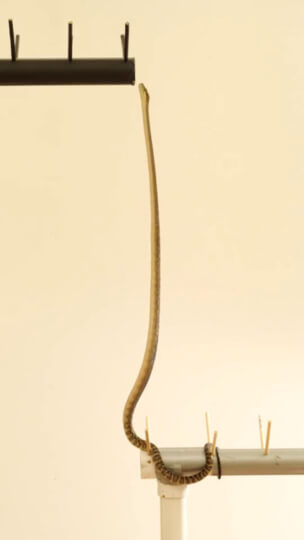
A video frame of a snake standing upright. Credit: Bruce Jayne
A Harvard-led, theoretical and experimental study that blends biology, physics, and mathematics has uncovered how tree snakes’ muscles, gravity, and proprioceptive feedback, or sense of their own shape, work together to keep these limbless climbers balanced.
Published in Journal of the Royal Society Interface, the study is led by L. Mahadevan, the Lola England de Valpine Professor of Applied Mathematics, Physics, and Organismic and Evolutionary Biology in the John A. Paulson School of Engineering and Applied Sciences and the Faculty of Arts and Sciences.
“For some it may be the stuff of nightmares, but we’ve now analyzed, mathematically and physically, the hidden physics and control strategies that allow snakes to defy gravity,” said Mahadevan, whose co-authors include physicists and biologists at Harvard and University of Cincinnati.
Beyond explaining a natural curiosity, the findings point to general design principles for soft robots, medical devices, and other flexible structures that must remain stable while standing tall or reaching far.
“By concentrating control where it counts, engineers may learn to build machines that are both efficient and resilient,” said first author Ludwig Hoffmann, a postdoctoral researcher in applied mathematics.
Standing tall
Brown tree snakes and scrub pythons can rise vertically to bridge large gaps between branches, sometimes suspending more than two-thirds of their body in mid-air. Unlike humans or birds, snakes have no limbs to brace themselves. And unlike rigid poles, their bodies are soft, flexible, and prone to buckling under their own weight.
So how do they do it?
By carefully tracking snake motion and using previously published muscle activity, the researchers discovered a simple strategy. Rather than stiffening their entire body, snakes concentrate bending and muscle activity into a short “boundary layer” near their base, where the body leaves the perch. Above that zone, the snake stays almost perfectly vertical, where gravity produces very little bending torque. This localized control dramatically reduces the energy required to stand tall, while still maintaining balance.
To explain these observations, the team developed a minimal mathematical model that treats the snake as a so-called active elastic filament: a soft structure that can sense its own shape and respond through muscle forces.
They explored two control strategies: Local feedback, in which muscles respond directly to local bending, effectively stiffening the body; and optimal control, in which muscles coordinate non-locally along the body to minimize energy use.
Both approaches reproduce the snakes’ characteristic S-shaped posture, but they found that the optimal strategy requires far less muscular effort.
The real challenge: stability
The study also revealed that it’s not lifting the body that’s hardest, but rather, staying upright. While only modest muscle forces are needed to achieve the posture, much larger forces are required to dynamically stabilize the animal against toppling, like balancing an inverted pendulum. This explains the slow, gentle swaying observed in tall, upright snakes.
From tree-climbing snakes to future robots, this work shows how nature solves extreme control problems, not with brute force, but with subtle, economical intelligence, Mahadevan said.
The study was co-authored by Petur Bryde, Ian C. Davenport, S. Ganga Prasath, and Bruce C. Jayne.
Cutting-edge science delivered direct to your inbox.
Join the Harvard SEAS mailing list.
Scientist Profiles

L Mahadevan
Lola England de Valpine Professor of Science and Professor of Organismic and Evolutionary Biology and of Physics
Press Contact
Anne J. Manning | amanning@seas.harvard.edu