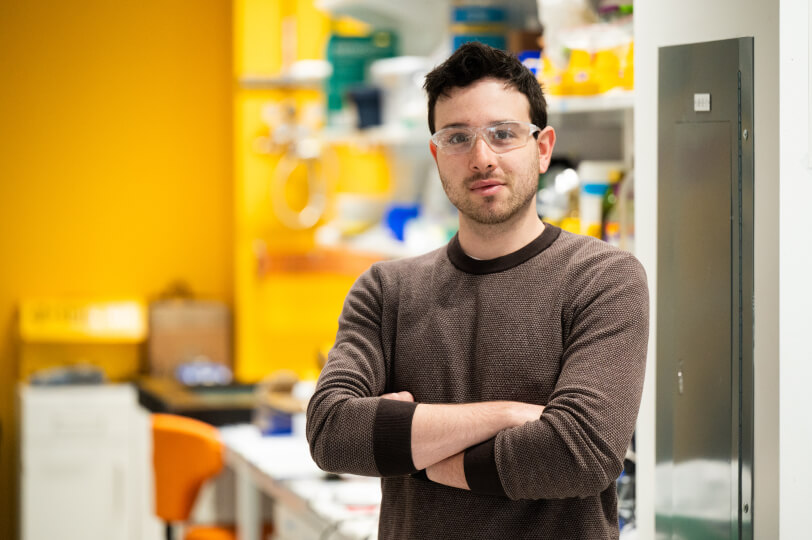
Raphael Kay, Ph.D. student in materials science and mechanical engineering (Sarah Bastille Photography)
Raphael Kay likes to imagine buildings as bodies. The concrete and windows? That’s like skin, acting as a barrier against the outside world. The heating, cooling and ventilation systems? Those are guts, ensuring temperature regulation. The people inside doing their jobs? Those are bodily systems that work best in stable climate and environments.
Like bodies, buildings require a lot of power to properly function. And thermal regulation through heating and cooling represents a significant percentage of the approximately $140 billion U.S. spent on energy in commercial buildings.
“There's just a mismatch in the outdoor conditions and the indoor occupancy desires,” Kay said. “This adds variable heating loads, lighting requirements and cooling loads at different times.”
Kay, a third-year Ph.D. student in materials science and mechanical engineering at the Harvard John A. Paulson School of Engineering and Applied Sciences (SEAS), thinks biological organisms could offer a solution to cost-effective heating and cooling. As a researcher in the lab of Joanna Aizenberg, Amy Smith Berylson Professor of Materials Science and Professor of Chemistry & Chemical Biology, Kay is leading the team developing Liquafilm, a liquid-based screen that can adhere to windows. His Ph.D. work is a continuation of research he began at the University of Toronto.
The approach is inspired by how animals control temperature using liquids, whether it’s the perspiration and blood vessel constriction in humans, or the arrangement and disbursement of fluid-like materials in crabs.
“These are common examples of organisms across totally different classes that use movements of soft or liquid matter within the skin to control light and heat,” he said. “Biology readily uses confined fluids to regulate flows of energy.”
Kay first arrived at SEAS as a research fellow in September 2022, having pursued a bachelor’s degree in architecture and master’s in mechanical engineering at the University of Toronto. Those architecture courses taught him about cities, but he realized that the lessons he learned focused on past human architects. Nature goes much farther back than that, leading him to begin thinking about biology-inspired solutions to urban design.
“I became exposed early on to this notion that there are other non-human sources of inspiration that we can pull from to solve challenges, specifically in the context of energy and sustainability, which were very important to me,” he said. “And so from my undergraduate degree in architecture, I became interested in nature- and biology-based strategies for solving challenges around transport efficiency, urban resiliency, building climate control efficiency, and efficient use of energy. Joanna is a titan in this world of bio-inspired design. I did my research fellowship here, fell in love with it and then came back for my PhD about a year later.”
Kay was recently named to the Forbes’ 2026 30 Under 30 list in the Science category. His award recognizes both his work at SEAS and that with his previous supervisor, Prof. Ben Hatton, at the University of Toronto.
“Ultimately these ideas that resonate with people are amalgamations of what I learned in Ben’s lab, Joanna’s lab, and required the input of dozens of incredible collaborators,” he said. “You scroll through the Forbes’ 30 Under 30 list, and you have this feeling that you've done very little relative to them. The healthiest outlook is that it's incredibly inspiring. I’m motivated to earn my spot, and deliver unconventional nature-based sustainability solutions to the world.”
Because Liquafilm’s development began during Kay’s fellowship, he’s been able to accelerate elements of his dissertation research, engaging in demonstrations, accelerators, pilot projects and even a partnership with Harvard Graduate School of Design to test Liquafilm in real houses. He expects the tech translation efforts to ramp up even more in the back half of his Ph.D., the goal being to take something from his labwork and make it available in the world.
Press Contact
Matt Goisman | mgoisman@g.harvard.edu