News
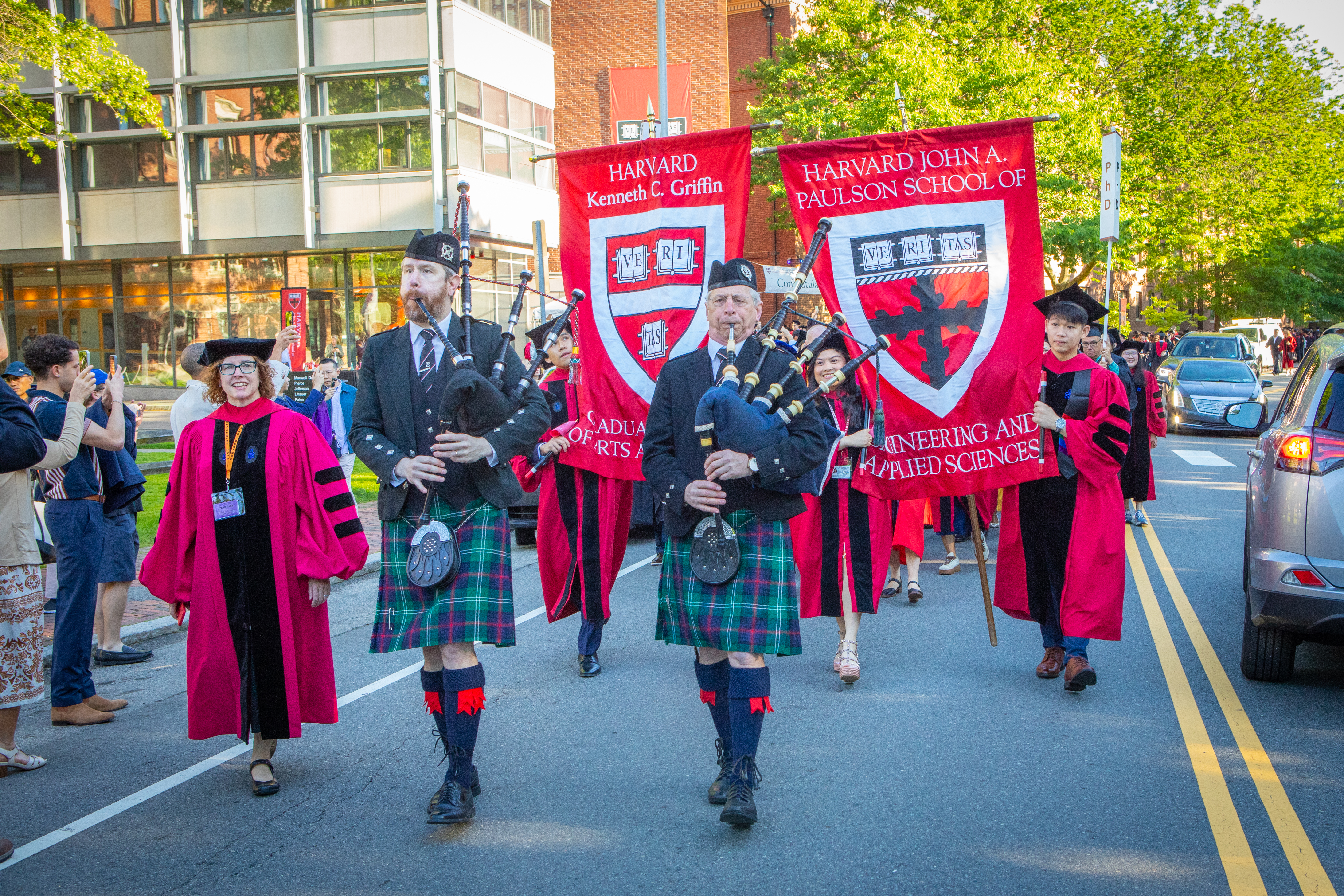
Harvard Kenneth C. Griffin Graduate School of Arts and Sciences Ph.D. and Master's students process down Oxford Street towards Tercentenary Theater. (Eliza Grinnell/Harvard SEAS)
Check out our images of Harvard Commencement for the Class of 2026, and find out where some students from the Harvard John A. Paulson School of Engineering and Applied Sciences are going after they graduate.
I really took the opportunity to do research here during my master’s. If you have an interesting idea, you can easily find people to work with.

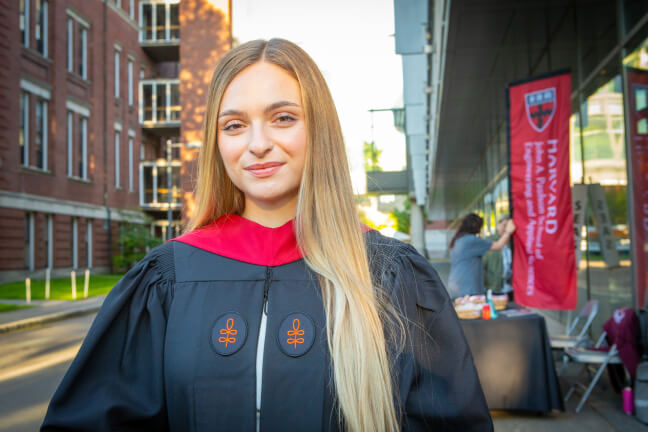
Ioana-Andreea Cristescu, S.M. in data science, will be joining an AI team at Amazon Web Services. “In undergrad I studied computer science and mathematics. I wanted to get more into the AI space. Harvard had a great program for that, and it naturally prompted me directly here. My classes were so meaningful, and I’ll be able to directly apply them to my job.” (Eliza Grinnell/Harvard SEAS)
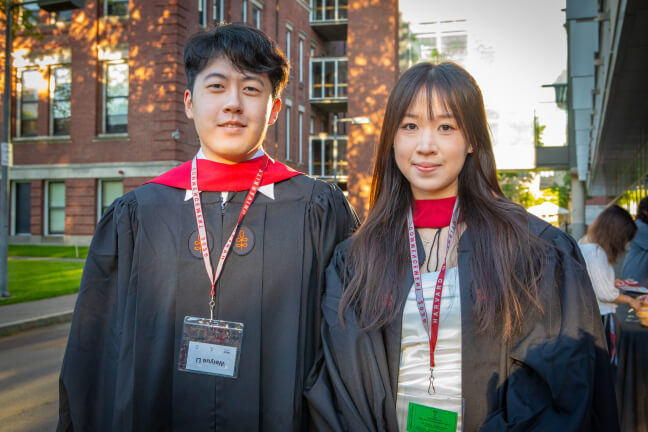
Weiyue Li (left) and Yiwen Li (right), S.M. in data science. Weiyue Li will be working as a data scientist while considering Ph.D. programs. “I really took the opportunity to do research here during my master’s. I had the opportunity to work with professors from both Harvard and MIT. If you have an interesting idea, you can easily find people to work with.” Yiwen Li will be working in industry after graduation. “The connections within my cohort, I felt like everybody knew exactly what they wanted to do right now, and what they plan to do in the future.” (Eliza Grinnell/Harvard SEAS)
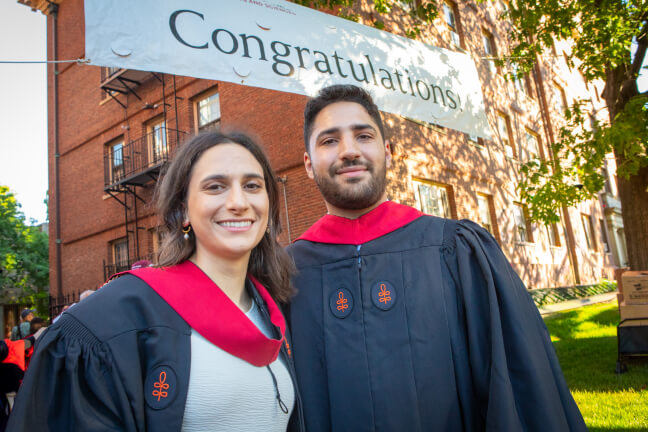
Elena Ghazi (left) and Hadi Khalaf (right), S.M. in computer science. Elena Ghazi will continue pursuing her Ph.D. in the labs of Flavio Calmon and Salil Vadhan “I am very excited about data privacy and its applications to machine learning, social sciences, and healthcare,” she said. “Harvard hosts a very impactful privacy community, and I am really lucky to get to be a part of it.” Hadi Khalaf will continue pursuing his Ph.D. in the lab of Flavio Calmon. “My advisor here is the perfect match for me. I work with different problems of AI safety and reliability. I come from a theoretical background, and I’m trying to apply these concepts to AI.” (Eliza Grinnell/Harvard SEAS)
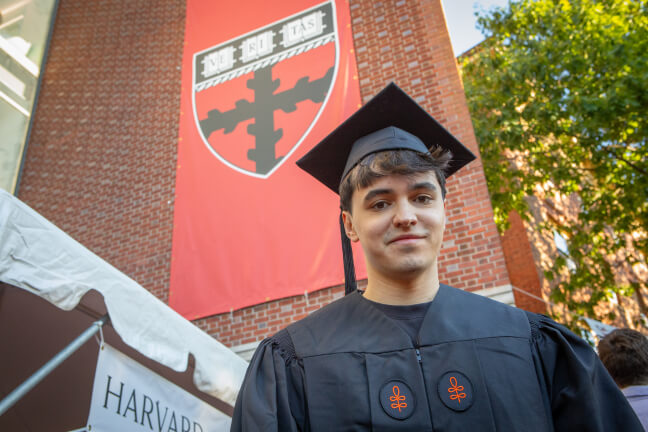
Eliot Atlani, S.M. in data science, will be working at Palantir. “Harvard is one of the best universities in the world. I always wanted to do AI-related research, and this is the best place to do it.” (Eliza Grinnell/Harvard SEAS)
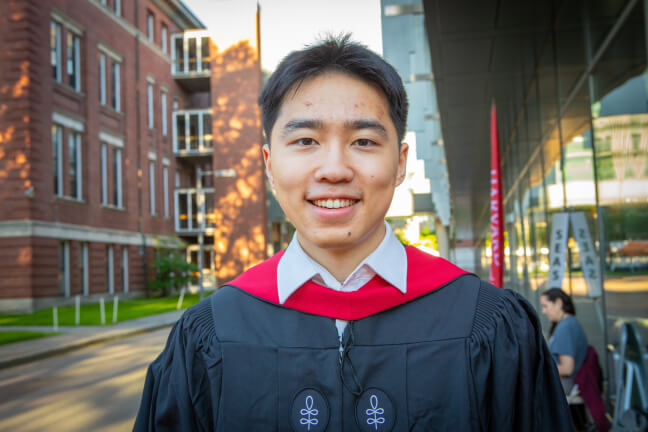
Daniel Li, S.M. in computational science and engineering, will be working as a software engineer in New York. “I wanted to focus on theoretical computer science, and the faculty here are really strong. I got more exposure to a wide variety of topics. More importantly, the people and their diverse backgrounds and experiences made it a lot more meaningful.” (Eliza Grinnell/Harvard SEAS)
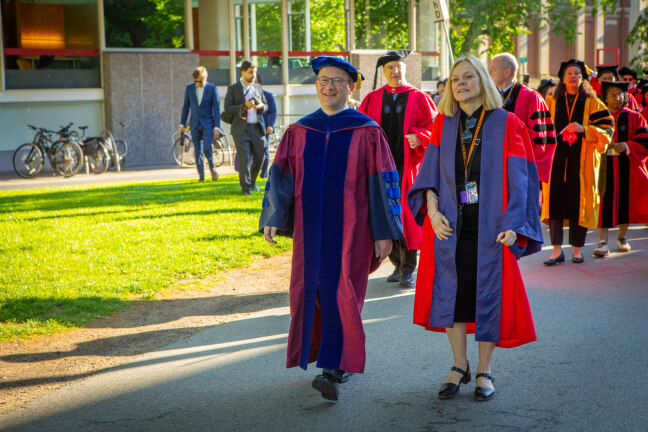
David Parkes (left), John A. Paulson Dean of the Harvard John A. Paulson School of Engineering and Applied Sciences, and Emma Dench (right), Dean of the Graduate School of Arts and Sciences, process towards Tercentenary Theater. (Eliza Grinnell/Harvard SEAS)
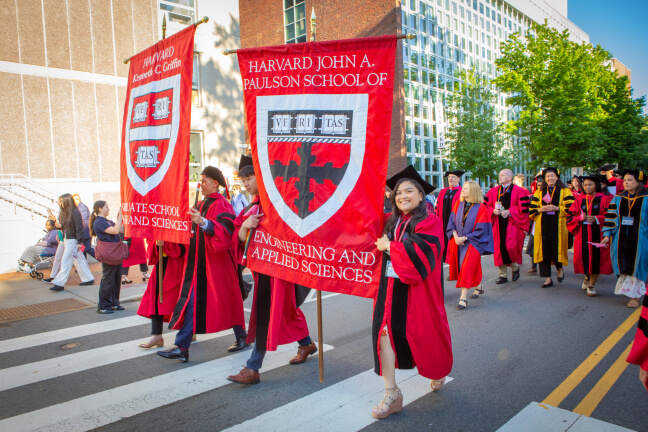
Harvard Kenneth C. Griffin Graduate School of Arts and Sciences Ph.D. and Master's students process down Oxford Street towards Tercentenary Theater. (Eliza Grinnell/Harvard SEAS)
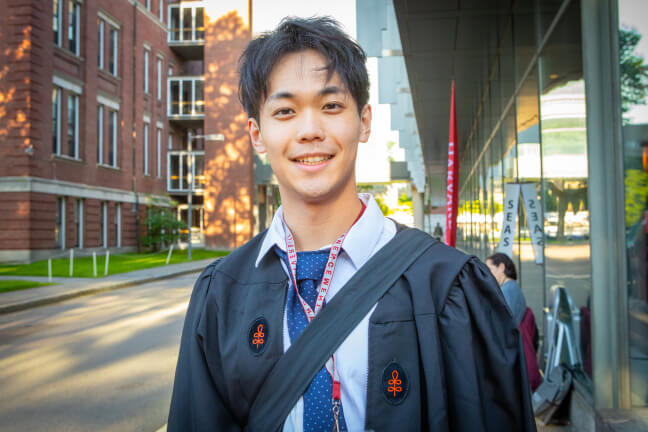
Zhilu Chen, S.M. in data science, will be working as a data scientist at Two Sigma Ventures. “I really liked the curriculum. It was very rigorous, especially with AI. I got really interested in machine learning and deep learning here.” (Eliza Grinnell/Harvard SEAS)
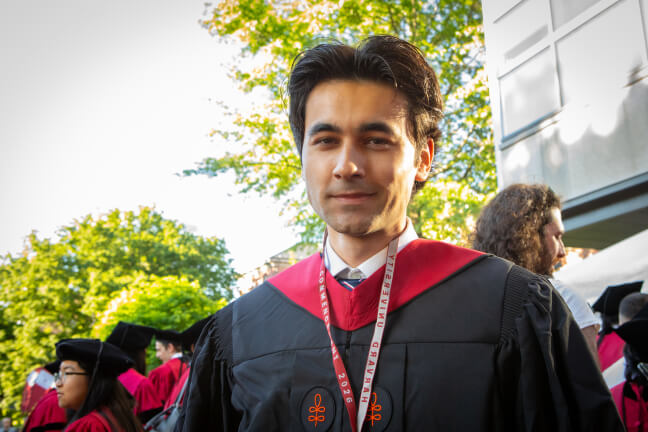
Victor Klippgen, M.E. in computational science and engineering, will be co-founding a company developing sensors to track and classify insects. “We’re selling early detection of crawling species such as bedbugs, cockroaches or moths. We’re hoping to start with the food processing and hospitality industries.” (Eliza Grinnell/Harvard SEAS)
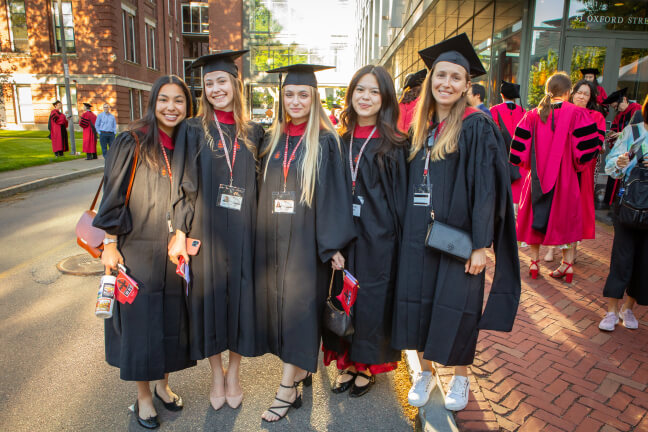
Five graduates celebrate earning their Master of Science in Data Science degrees. (Eliza Grinnell/Harvard SEAS)
If you’re working on air quality, this is the place to be. There are a lot of great minds in atmospheric science here. The fact that we all choose to come here and be Ph.D. students is a testament that we care a lot about what we’re working on and want to make an impact.
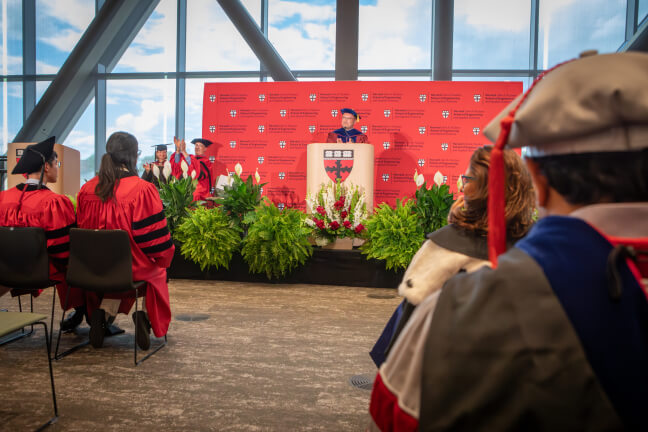
David Parkes, John A. Paulson Dean of the Harvard John A. Paulson School of Engineering and Applied Sciences, congratulates the new PhD graduates. (Eliza Grinnell/Harvard SEAS)
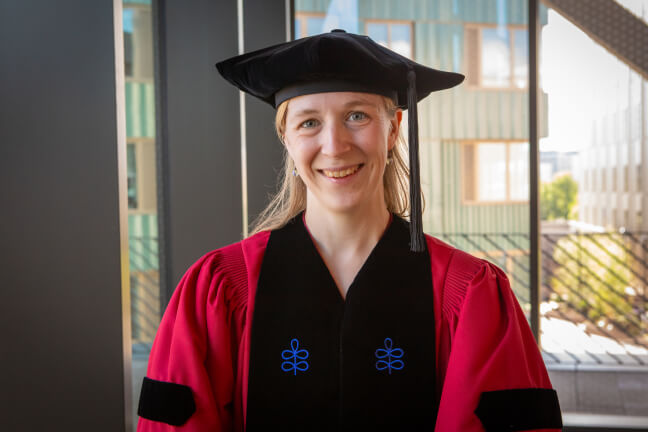
Elle Weeks, Ph.D. in applied math, has accepted a tenure-track assistant professor position in the mathematics department at Kenyon College in Ohio. “It’s been cool to see all the different ways you can use math to understand things like climate. I found an advisor, Eli Tzipperman, that I was really excited to work with, who was doing the most exciting math problems and most exciting problems in the climate space.” (Eliza Grinnell/Harvard SEAS)
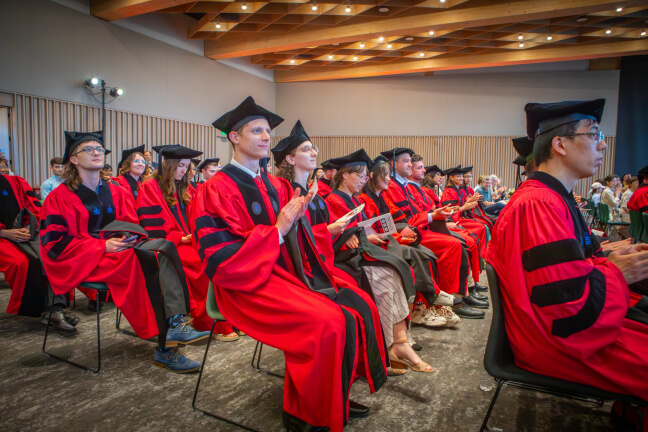
Graduating Ph.D. students are recognized during the Harvard John A. Paulson School of Engineering and Applied Sciences hooding ceremony. (Eliza Grinnell/Harvard SEAS)
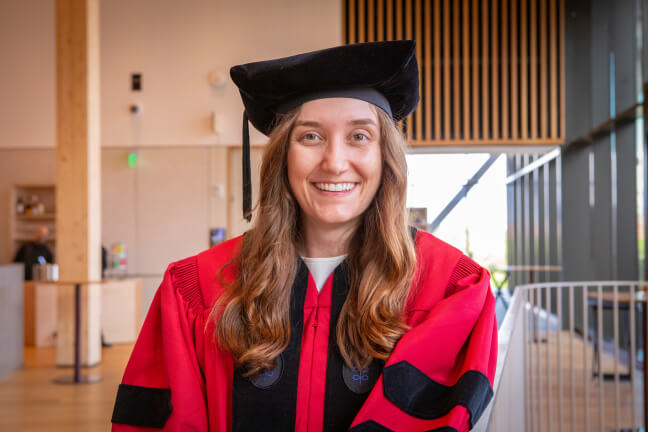
Sarah Hancock, Ph.D. in environmental science & engineering, will be continuing her methane emissions research with the Daniel Jacob’s Atmospheric Chemistry Modeling Group as a staff researcher. “I had researched air quality before coming here, and if you’re working on air quality, this is the place to be. There are a lot of great minds in atmospheric science here. The fact that we all choose to come here and be Ph.D. students is a testament that we care a lot about what we’re working on and want to make an impact.” (Eliza Grinnell/Harvard SEAS)
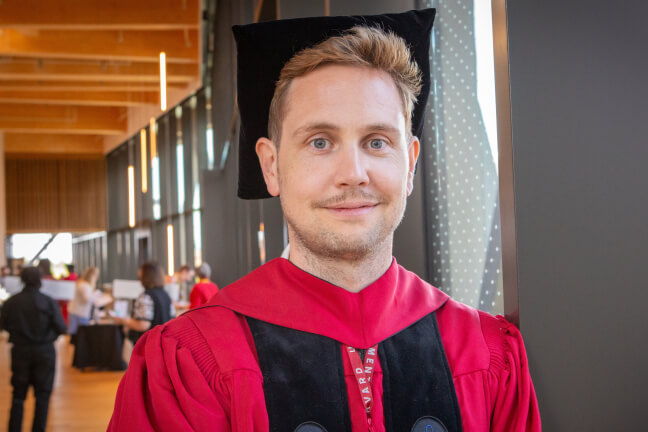
Philipp Arens, Ph.D. in electrical engineering, will be continuing in Prof. Conor Walsh’s Harvard Biodesign Lab as a postdoctoral researcher. “A lot of my research pertains not to designing devices, but deciding how we can assist users in the most optimal ways. Different users have different needs, different bodies, may or may not be impaired, and so they all have different requirements for what these systems need to know. Figuring out when to apply assistance, how much assistance to apply, and how to optimize and personalize the settings to each user was the focus of my Ph.D.” (Eliza Grinnell/Harvard SEAS)
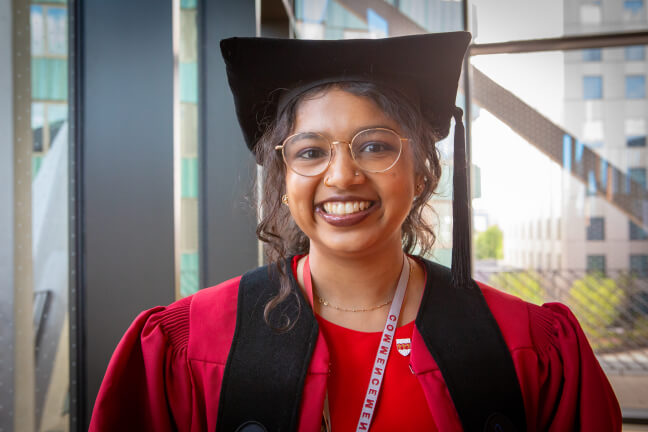
Kausalya Mahadevan, Ph.D. in materials science & mechanical engineering, will be staying in the Katia Bertoldi Group as a short-term postdoctoral student. “I have been a little obsessed for a long time with sewing, textiles and the way we put them together. The really obvious applications that I would’ve cited before I started my Ph.D. were fashion or clothing-related, but I really got to dive into home textiles, and think about things at a larger architectural scale or smaller biological scale. Those are things I’m really excited to expand on in the future.” (Eliza Grinnell/Harvard SEAS)
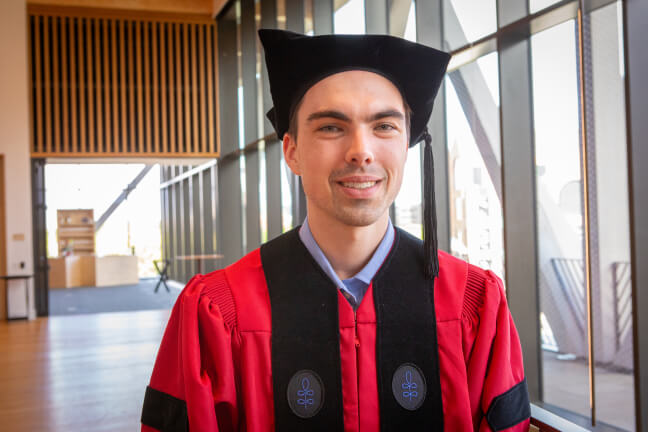
Nicholas Balasus, Ph.D. in environmental science & engineering, will take on a postdoctoral position at the nonprofit Carbon Mapper. “Prof. Daniel Jacob’s group is great,” he said. “It’s so large – a lot of Ph.D. students, a lot of postdocs, so you can be around a lot of people that know a lot about what you’re working on. We’re excited about it. It’s great that people care about your research.” (Eliza Grinnell/Harvard SEAS)
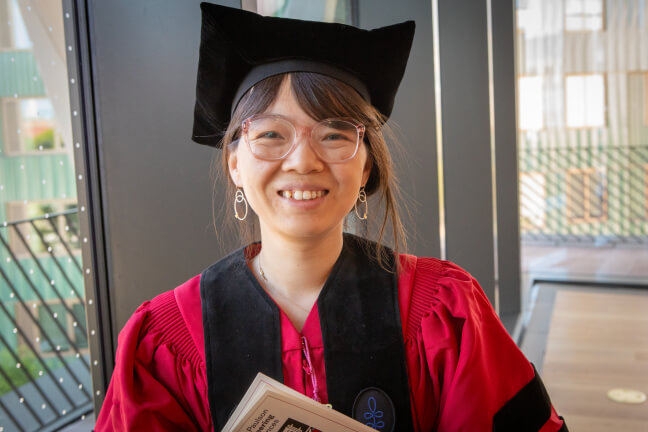
Xing Zhao, Ph.D. in bioengineering, will be continuing her research as a postdoctoral researcher. “SEAS doesn’t just teach you to think within one engineering field. In our lab we have people from not only engineering backgrounds, but also backgrounds in chemistry and physics. That allows us to brainstorm in a multidisciplinary way as we try to solve problems.” (Eliza Grinnell/Harvard SEAS)
Cutting-edge science delivered direct to your inbox.
Join the Harvard SEAS mailing list.
Press Contact
Matt Goisman | mgoisman@g.harvard.edu