News
By day, James Arnold and David Pont work in the Harvard Biodesign Lab (HBL), developing wearable robotics for shoulder mobility and artificial intelligence algorithms to improve data on the effectiveness of physical therapy regimens. By night, they perform in a band called Luigi’s Fishtank, named after a piece of equipment used in their lab at the Harvard John A. Paulson School of Engineering and Applied Sciences (SEAS).
“We’re researching two different technological interventions focused on upper limb assistance and recovery,” said Arnold, a computer science Ph.D. student. “One uses wearable sensors and algorithms to track patient arm use in daily life to enable a therapist to receive data from the past few weeks, for example a summary of how often the patient did their exercises. The other is a wearable robot since it’s hard for people to do a lot of things when they don't have a caregiver with them or the support of a therapist. The robot makes the patient more capable and able to do more independently.”
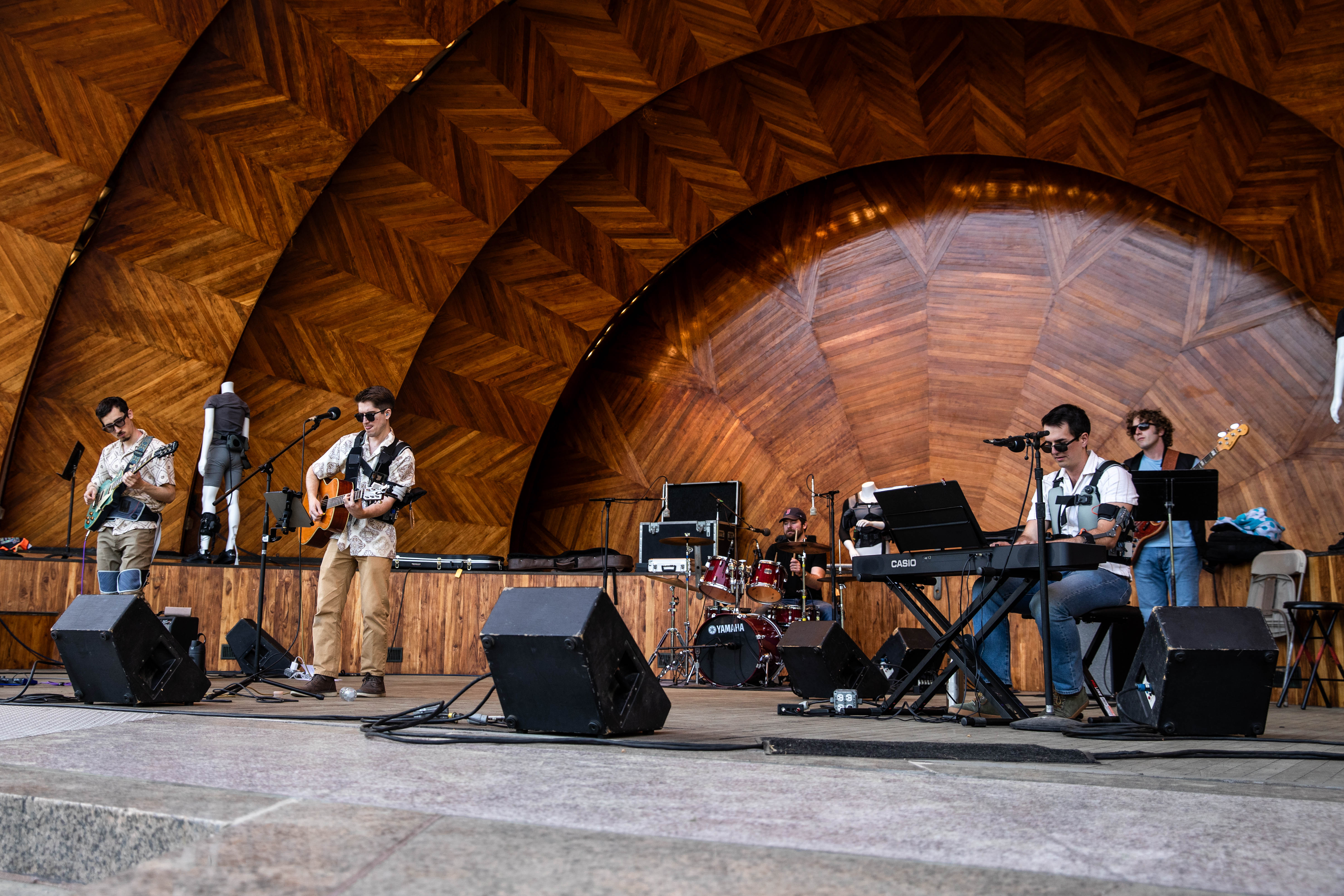
Luigi's Fishtank performs at "Abilities: Amplified" (Hannah Miller)
As researchers, Arnold and Pont are part of a National Science Foundation Convergence Accelerator project that supports engagement with end users and community. As musicians, they are always looking for opportunities to play. One night they discovered the Esplanade Association’s GroundBeat Concert Series, which organizes free concerts at the DCR Hatch Memorial Shell designed to showcase inclusivity and the Boston music scene.
“Since both of us interact with a lot of patients, we'd talked about how it would be super cool to have some kind of event where all the people that have tested with our devices could come together,” Arnold said. “The idea was that our band could be the musical hosts, and we would bring in artists with disabilities to also perform on stage. And then after discussing with our advisor, we thought that the grassy area in front of the Hatch Shell would be ideal to invite organizations to have tables to demonstrate technology for assisting people with many different kinds of disabilities, who people attending the event could connect with.”
That concept turned into “Abilities: Amplified,” a concert and community event that took place last month. Approximately 1,000 attendees got to watch Luigi’s Fishtank play alongside a jazz trio from the Berklee Institute for Accessible Arts Education, a cover band from the Massachusetts community group PluggedIn, and the award-winning blind musician Lachi. The event also featured tables demonstrating wearable technologies developed at the HBL, other Harvard labs and Boston-area biotech companies.
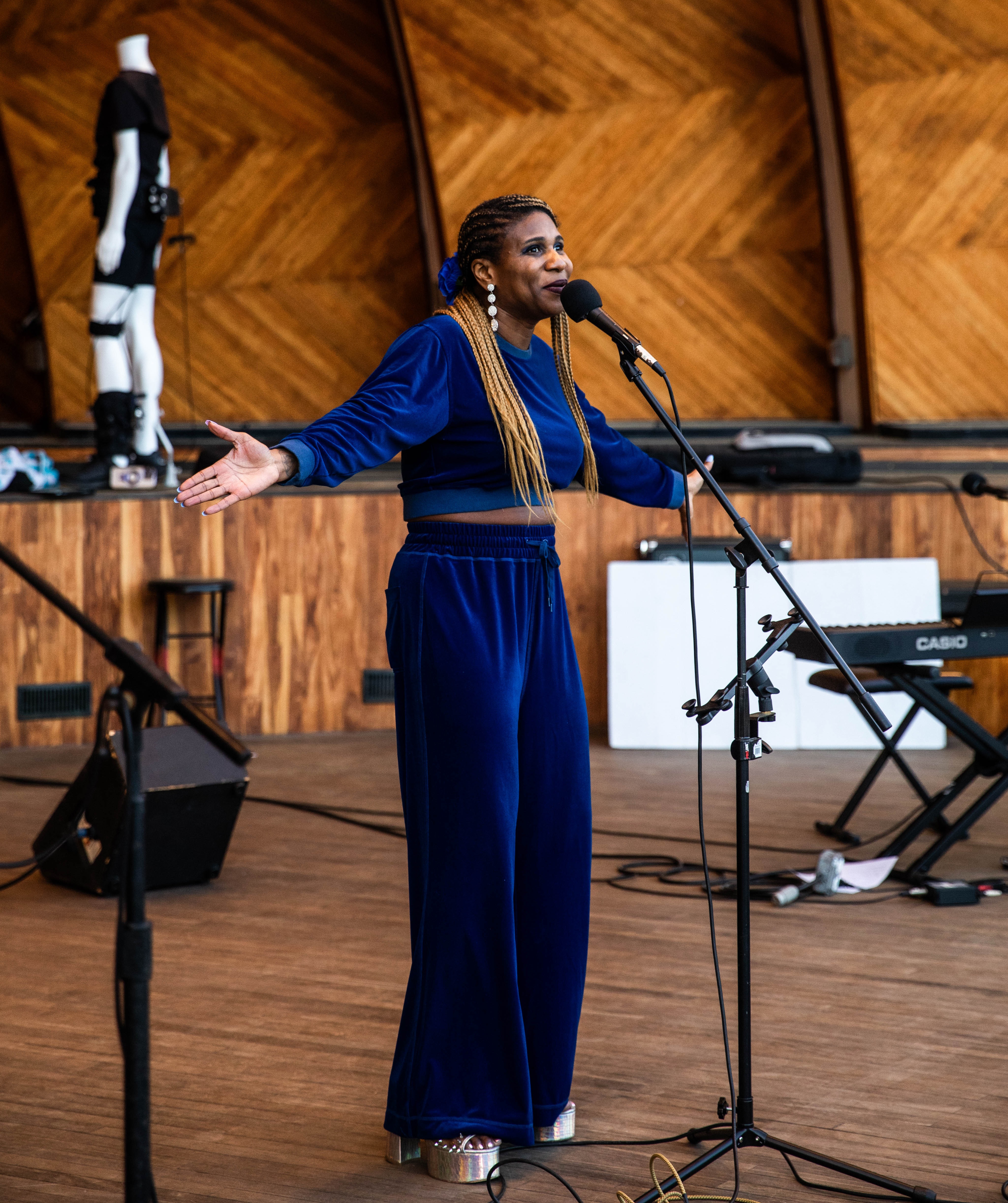
Lachi performs at "Abilities: Amplified" (Hannah Miller)
“The performers with disabilities that participated in the concert were super grateful and happy to be able to perform in this event, gain some visibility and show that they can still do music,” said Pont, a research associate at the HBL. “Even Lachi, who is a really great name in this ecosystem, was so grateful and happy to participate. We even met later with her manager because they were impressed, and they would like to do something more with us related to music, disabilities and technology in the future.”
The HBL, run by Conor Walsh, Paul A. Maeder Professor of Engineering and Applied Sciences, has a strong focus on collaborating with clinical partners and end users. For Abilities Amplified, the goal was to use performance as a way to bring community together, and the lab collectively reached out to musicians, researchers, start-ups, clinicians and individuals with disabilities to organize tables with tech demonstrations or other information. Twenty different organizations participated, including: start-ups Tactus, REEV and Dephy; the Slade Lab at SEAS, University of Massachusetts robotics hub, Boston University Center for Neurorehabilitation and Massachusetts General Hospital Lab for Translational Neurorecovery; and non-profit organizations such as the Boston Center for Independent Living, Cecropia Strong, Empower Spinal Cord Injury (SCI) and SCIBoston.
“These types of events only happen when people step up and lead, and James and David absolutely did that,” Walsh said. “This was a first for this scale of an event, and so many people within our lab and outside organizations contributed to bringing all these communities together. We really see it as an aspiration of what we hope we can do more of at SEAS and our lab under the theme of Health Engineering.”
Luigi’s Fishtank opened and closed the show, performing while wearing the technology they’re developing. Other lab members organized the tables and assisted the other performers backstage. The event was co-sponsored by the Massachusetts Technology Collective, which Arnold and Pont contacted with the help of Harvard Grid director Paul Hayre.
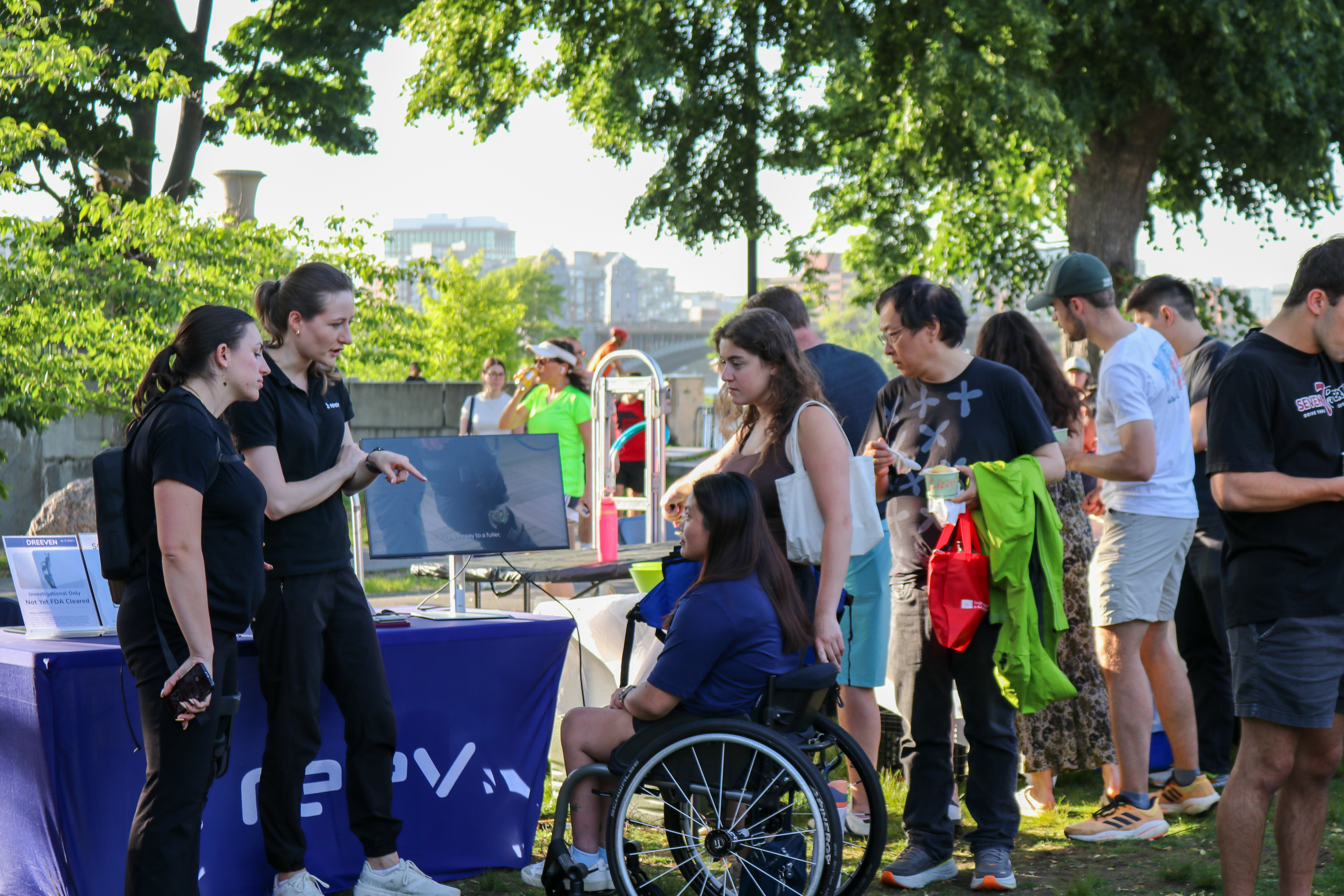
"Abilities: Amplified" attendees visit the REEV information table (Nancy Gong/Esplanade Association)
“Watching attendees try on different wearable technologies while enjoying free ice cream and vibing to the music was definitely the highlight of my summer," said Pat Puma, a Ph.D. student in HBL who helped plan the event and served as one of the event's MCs. “My labmates wearing high-viz vests coordinating logistics and hyping the crowds felt like a true show business production.”
Positive feedback from attendees included people describing seeing Lachi perform as “empowering.” The team hopes to host the event again next summer.
“It was also awesome from the stage to see all the people enjoying the event,” Arnold said. “The weather was beautiful, so it was just this picturesque scene where you have the Prudential Center and the beautiful trees and the river and all your friends from the lab and patients who’ve been in our studies. So it was super cool to see the vision come to life.”
“Abilities: Amplified” isn’t the first outreach event to come out of the HBL. The lab has repeatedly welcomed high schoolers for events connected to National Biomechanics Day, and developed a Soft Robotics Toolkit for youth education. Members of the lab have also participated in the Bionic 5K road race in Cambridge.
“The nature of our work is very human-focused,” Pont said. “We want to have impact, and impact is measured in how you affect people's lives. So the nature of our work already makes us do a lot of outreach.”
Topics: Community, Events, Materials Science & Mechanical Engineering
Cutting-edge science delivered direct to your inbox.
Join the Harvard SEAS mailing list.
Press Contact
Matt Goisman | mgoisman@g.harvard.edu
Related News

Applying AI to Accelerate Design, Test and Manufacture
University of Washington Mechanical Engineering
AI / Machine Learning, Applied Physics, Computer Science, Electrical & Computer Engineering, Materials Science & Mechanical Engineering, Meet Our Faculty, Research, Technology