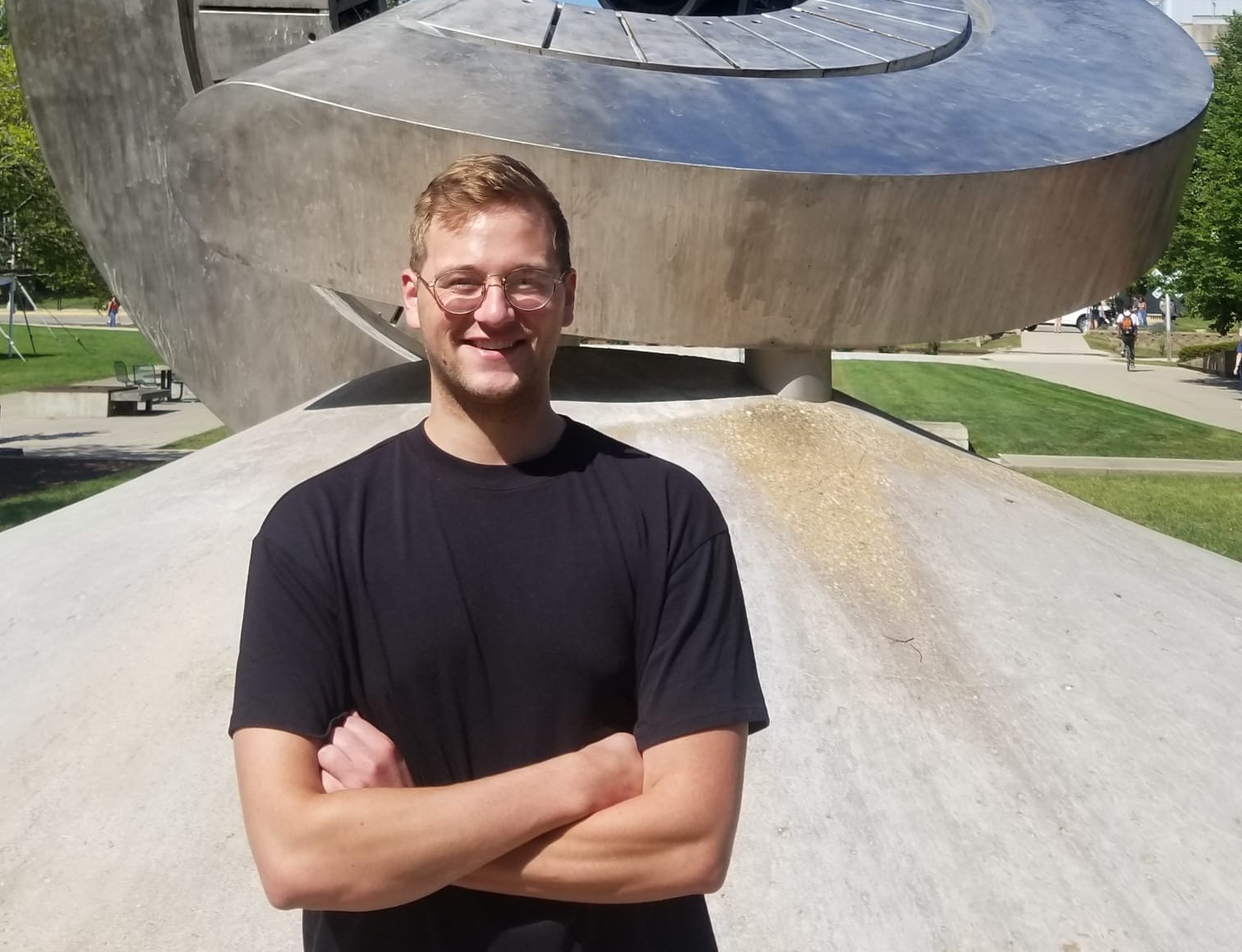
Adam Vareberg, S.B. '19
Scientists have known for decades that electricity can be a powerful tool for treating neurological conditions and movement disorders. Electroconvulsive therapy has been used to treat depression since the 1930s, and deep brain stimulation as a treatment for Parkinson’s disease is almost 30 years old.
One of the challenges with electric treatments is that it can require invasive surgery. Deep brain stimulation requires the insertion of tiny wires with electrodes into designated regions of the brain, which are then connected via extension wires to an electrical pulse generator implanted in the chest like a pacemaker. There’s also the risk of “off-target effects,” which is when the electric pulses target the wrong portions of the brain.
“You have a really long shank, and that can introduce some off-target effects, whether it's mechanical because you have this piece of metal that might be moving around into unwanted parts of the brain, or even electrical if you're just not in the right spot, or the field that you create is like a little bit too large,” said Adam Vareberg, S.B. ‘19. “You're not able to specifically target one part of the brain.”
Vareberg is trying to find a better option. An undergraduate bioengineering alumnus of the Harvard John A. Paulson School of Engineering and Applied Sciences (SEAS), Vareberg is now pursuing a Ph.D. in the same field at the University of Wisconsin-Madison. His research in the Aviad Hai Lab at UW focuses on the development of wireless devices that can be placed on the scalp without requiring the lead to be implanted directly into the brain.
“They’re about the same size as these traditional deep brain stimulators, but you don't have this shank leading down into them,” he said. “So you're only really targeting or affecting the region of the brain with this little wireless device. You could use a smaller electromagnet concealed on your scalp, and you could have a device that's implanted that produces a field that then turns these devices on to treat that region of the brain. You could then change how that acts depending on how well it's working or what condition you're trying to treat.”
Growing up in Fargo, North Dakota, Vareberg’s parents owned an engineering consulting firm, so he was immersed in the world of engineering and STEM from a young age.
Wanting different experiences, Vareberg looked beyond the Midwest for universities. Once he got in, he said, “It’s hard to say no to Harvard.”
“Where Harvard was exceptional for me, and where I know that it was the right choice, is that you get to interact with so many different types of people,” he said. “You're not at an engineering school. You are at a liberal arts school, and it gives you a better sense of the world that you're in, and a better sense of why you do engineering. I loved my time there, and I loved the education that I got.”
Summer internships at Protosthetics, a Fargo-based start-up offering 3D-printed orthotic and prosthetic devices, gave Vareberg his first taste of wearable technology. But his path to Wisconsin didn’t really begin until his final semester. Jia Liu, Assistant Professor of Bioengineering, had just joined the SEAS faculty that year, and Vareberg took Liu’s class on bioelectronics.
“It was the culmination of learning all this biology, taking all these physics courses and learning how to be an engineer, and getting to put it toward something that I really care about,” he said. “I got to really learn how to think academically about neurotechnology.”
Vareberg had already accepted a full-time position on the engineering staff at Lockheed Martin by the time he took Liu’s class. But he never forgot how much that class had ignited his interests, and while working began researching Ph.D. opportunities to study neurotechnology.
“Especially at the time, grad school was almost a prerequisite for building a career in neurotechnology,” he said. “I really reminded myself how much I love to learn. Even as a kid I was very curious, and so taking the opportunity to not just do a master's but a Ph.D. was a way to foster my childlike curiosity as an adult, and try to answer questions that haven't really been answered before.”
The Hai Lab at that time was developing wireless devices for sensing brain signals. This was during the early months of the COVID-19 pandemic, and Vareberg first reached out about helping with remote projects. He eventually joined as a Ph.D. student in the fall of 2021.
“One of the big takeaways that I had from Professor Liu's class was that when you're working with bioelectronics, specifically in neuroscience, there's a huge trade off,” he said. “Is it invasive? Do you have the spatial or temporal resolution that you need to either record signals or send signals to the brain? Can you really modify the brain or read brain signals to the fidelity that you want? And when you're doing it, is it introducing anything that might negatively impact the brain? What we're trying to do is remove some of these obstacles, remove the invasiveness, but also maintain the resolution that we need to interact with very specific brain regions.”
Now in his fifth year, Vareberg is starting to think about what comes after his degree. He plans to transition to working in industry – somewhere where he can research, develop products in a fast-paced environment, and help people on a larger scale.
“I love academia in the sense that you get to answer some pretty interesting questions, and it can act kind of like a startup if you're in the right environment, but I just love the actual environment of startups,” he said. “What I love about neuroscience and neurotech is that everybody's like working towards something similar, and 99.9% of the time, it's for a very noble reason. A lot of people have connections to neurotech, or have people living with Parkinson's disease or depression. It's a community that is really working to improve lives and coming at it from every angle.”
Press Contact
Matt Goisman | mgoisman@g.harvard.edu