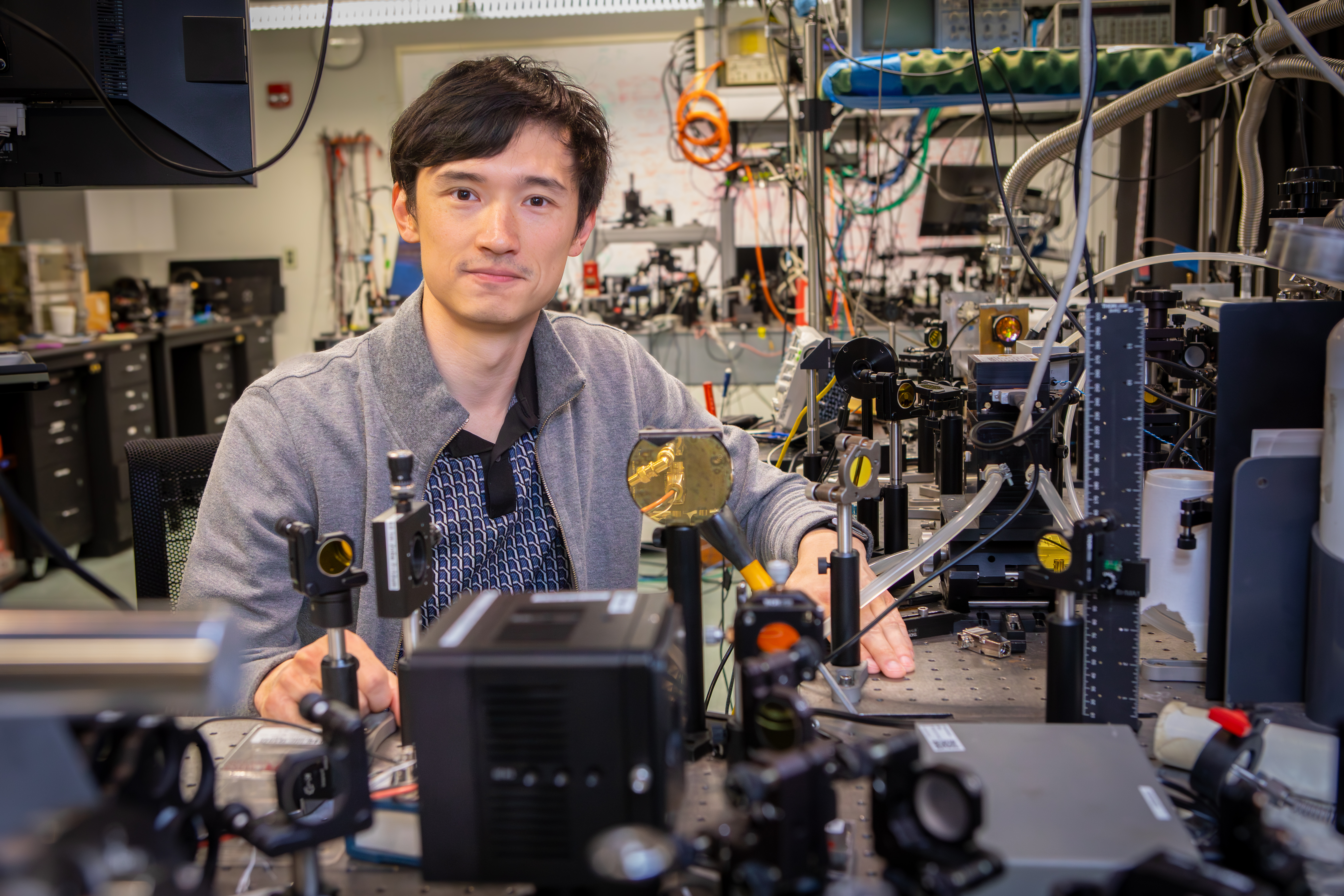
Arman Amirzhan, Ph.D. in applied physics (Eliza Grinnell/SEAS)
Arman Amirzhan chose to study materials science as an undergraduate at Imperial College in the United Kingdom thinking he’d learn about cutting edge technology like nanomaterials. Instead, he got ceramics and metallurgy – classical areas of the field, but not his area of interest. He was worried he’d picked the wrong field of study, and because of the U.K. educational system, changing majors would be much harder than in the U.S.
Fortunately, he met Mark Oxborrow, a professor in his department researching optoelectronics, the study and application of electronics that interact with light. Oxborrow offered Amirzhan a spot on a summer project developing a maser, a microwave-emitting device similar to a laser that works at room temperature.
“He really guided me very well,” Amirzhan said. “He gave all of the materials I needed to get into this field very fast, and that ultimately ignited my interest in scientific research.”
That summer project directed Amirzhan onto a path that eventually brought him to the Harvard John A. Paulson School of Engineering and Applied Sciences (SEAS), where he became a researcher in the lab of Federico Capasso, Robert L. Wallace Professor of Applied Physics and Vinton Hayes Senior Research Fellow in Electrical Engineering. Amirzhan’s research as an applied physics Ph.D. student in the Capasso Group has focused on the ongoing development of the next generation of lasers, which could eventually revolutionize communications, industrial imaging technology and astrophotography. Amirzhan defended his dissertation last summer and will be hooded at Commencement.
“What really appeals to me about physics is that it kind of explains almost everything,” Amirzhan said. “It explains how we see stuff, how we interact with things, how things work. And from a very early age, I always liked to tinker with stuff, build things and understand how they work. This is a continuation of that curiosity about the world.”
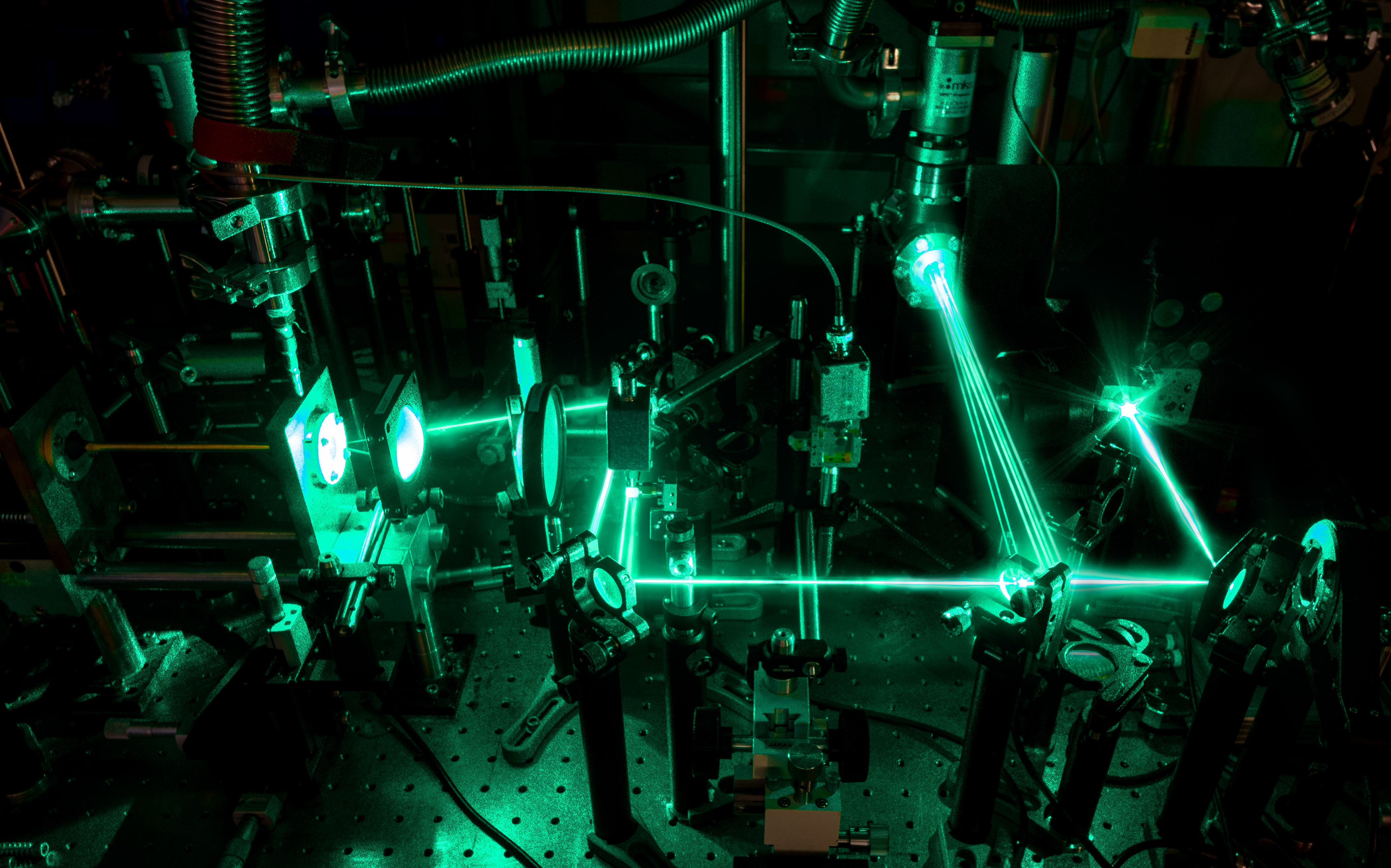
The terahertz frequency laser Arman Amirzhan helped develop for his Ph.D. dissertation (Arman Amirzhan/SEAS)
Amirzhan first came to Cambridge for a research internship. The Kazakhstan native had learned from friends and classmates about the possibility of doing internships at U.S. universities, and began reaching out to various labs in the Boston area about open positions.
“It was actually quite late in the school year, like April or May, when I started reaching out,” he said. “Most professors said my resume looked good, but it was too late to finish the administrative processes involved with joining their labs. Professor Capasso’s emails are always very brief. He told me, ‘I need two recommendation letters.’”
In the end, Amirzhan only needed one, provided by Prof. Oxborrow. He first joined the Capasso Group as an intern, then after six months applied and joined as a Ph.D. student.
“I’d never really actually worked with lasers so close up and to the extent required by working in the Capasso Group,” he said. “Eventually I just walked into his office and asked if it was possible to do a Ph.D. here. He said he’d be more than happy for me to stay.”
Amirzhan’s research focuses on what’s known as the terahertz frequency gap, a range along the electromagnetic spectrum between infrared and microwave radiation. The frequencies at this range can be thousands of times higher than the microwave radiation used for current wireless internet, and millions of times higher than FM/AM radio signals. This high frequency creates a much larger bandwidth, which is like adding extra lanes to a highway. Because of this massive increase in capacity, terahertz waves could theoretically transmit data thousands of times faster than current wireless networks.
“Historically we didn't have any widely tunable and compact human-made sources in this spectrum range that can operate without cryogenic cooling,” Amirzhan said. “We can easily produce microwave frequencies. We can easily produce visible light. We can even cover most of the infrared frequency range. But we just didn’t know how to efficiently generate terahertz radiation. In our lab we developed the first source that can be tuned across the entire terahertz frequency band all while operating at room temperature without any cryogenic cooling. The challenge right now is it's relatively low power, which is why it's still not on the market.”
The benefits of a source of such high-frequency radiation are numerous. Wireless communication would speed up far beyond current transmitters, which currently are at approximately 20 gigabits per second. Higher-frequency emissions would also increase the resolution of captured images, making it possible to detect far smaller leaks or defects in manufacturing, or scan for much smaller concealed items at airport security checkpoints. And much higher resolution images would revolutionize astrophotography and spectroscopy.
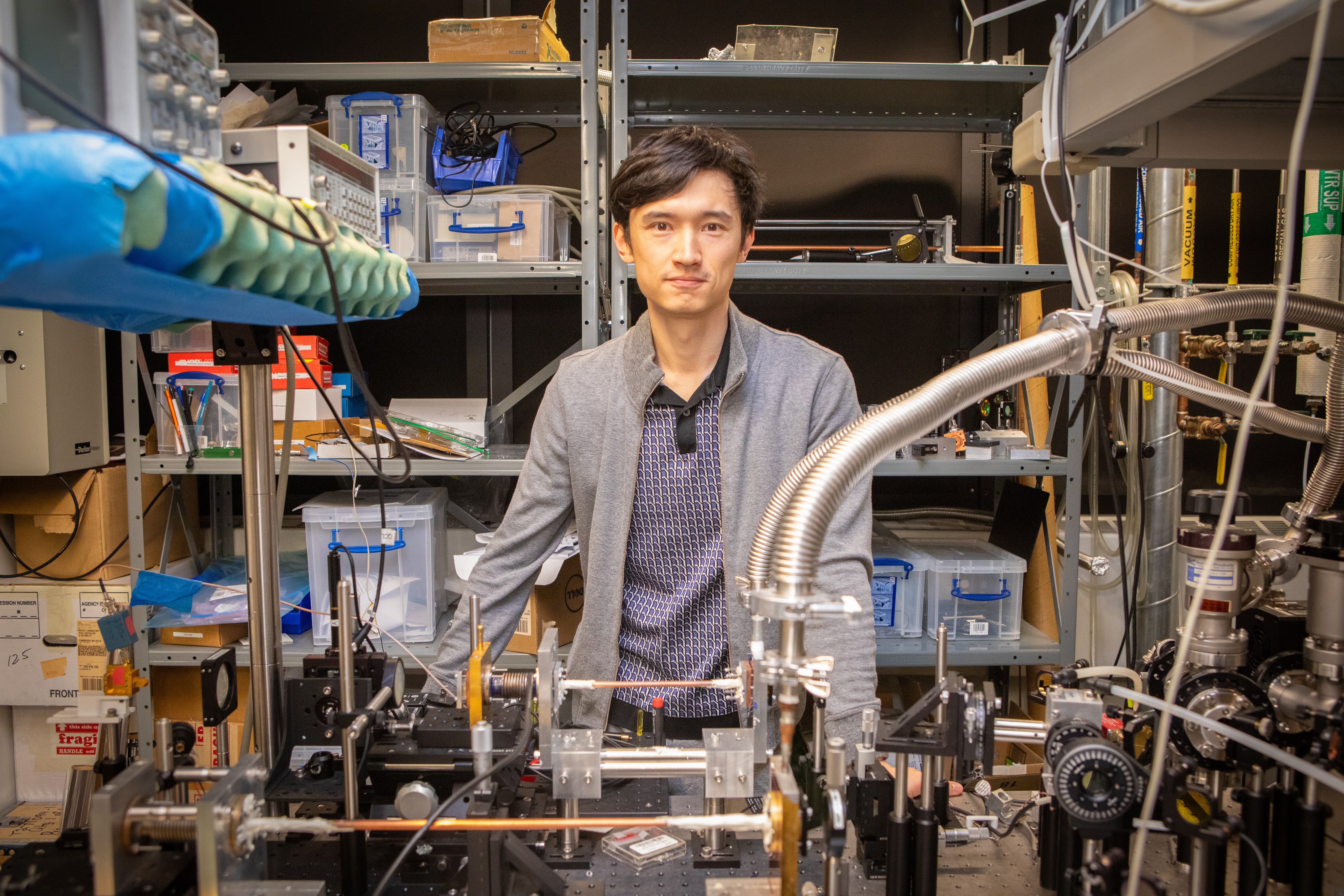
Arman Amirzhan started as a researcher in the Federico Capasso Group before becoming a Ph.D. student (Eliza Grinnell/SEAS)
“In 2019, the Event Horizon Telescope collaboration released an image of a black hole that looked like an orange donut,” he said. “This image was captured at 230 gigahertz. If you go higher in frequency, you can image different signals in the universe and increase image resolution. You can even visualize gases that are present in other galaxies or exoplanets. You can basically reveal new things in space at terahertz frequencies.”
Using terahertz lasers to reveal more about space - an area of research commonly referred to as submillimeter or far-infrared radio astronomy - is especially interesting to Amirzhan. Outside of his specific research, he helped adapt the Capasso Group’s signature metalens into a telescope, enabling high-resolution imaging of the sun, moon, nebulae and even a solar eclipse. He’s also been quite active with the SEAS-affiliated Student Astronomers at Harvard-Radcliffe club, even helping organize its astrophotography subgroup.
“Harvard has one of the strongest astronomy departments in the world, with really strong student-run astronomy clubs and observatories,” he said. “I really enjoyed that after a very hard day in the lab, I could just go on the observation deck and look at the stars through the telescope.”
Even after defending his dissertation, Amirzhan has stayed with the Capasso Group to finish a few more tasks related to his research. After that, he’s interested in working in space technology, especially with ongoing or upcoming experiments on the moon.
“The recent Artemis mission is one of the first human missions where they used laser transmission all the way from the moon to the earth,” he said. “That's why we could receive all of this high-definition video footage from people orbiting the moon.”
Press Contact
Matt Goisman | mgoisman@g.harvard.edu