News
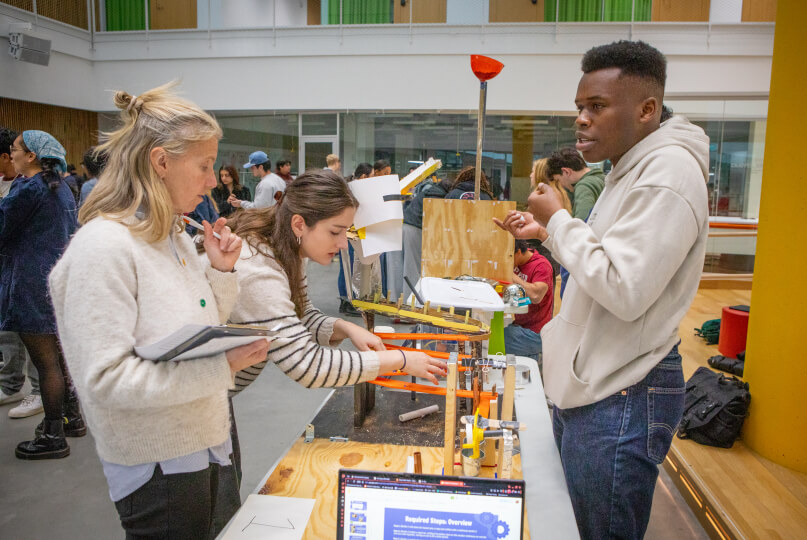
AP50 course instructor Kelly Miller, left, chats with "The Breakfast Club" co-designers Odera Arene and Carolina Samper (Eliza Grinnell/SEAS)
When cartoonist Rube Goldberg first began drawing the intricate devices that would eventually become known as “Rube Goldberg Machines” in the early 20th century, he probably didn’t think too much about the physics involved. Yet his machines, which rely on a sequence of elements precisely tuned so that each component triggers the next, utilize numerous physics fundamentals, such as projectile movement, collisions, conservation of energy or pulleys.
The fun is figuring out novel ways to demonstrate those fundamentals.
“The Rube Goldberg machine encapsulates all of the concepts that we’ve covered throughout the semester,” said Kelly Miller, Senior Lecturer on Applied Physics.
Miller is the course instructor for “AP50: Physics as a Foundation for Science and Engineering.” Students taking AP50 built Rube Goldberg Machines as the fall final project, recently displaying them at the Science and Engineering Complex of the Harvard John A. Paulson School of Engineering and Applied Sciences (SEAS). The requirements: have at least seven components that demonstrate at least five different physics concepts introduced during the fall, and design a sequence that takes at least 20 seconds to run.
How those sequences were displayed – a volcano, a bird feeder, an amusement park or a breakfast table – showed the creativity of Harvard’s undergraduates.
“I was blown away,” Miller said. “They exceeded all my expectations with respect to the building, creativity and explanation of the underlying physics.”
The award for Best Engineered/Built went to “The Bird Feeder,” designed by Ellie Wynkoop, Aiden Taylor, Carlos Garcia and Daniel Panganiban. In their machine, two metal ball bearings traversed a series of tubes, funnels and slides. When the second landed on a string of glued-together wooden popsicle sticks, it triggered a mousetrap that then opened a vertical tube filled with uncooked lentils, causing them to pour onto the table.
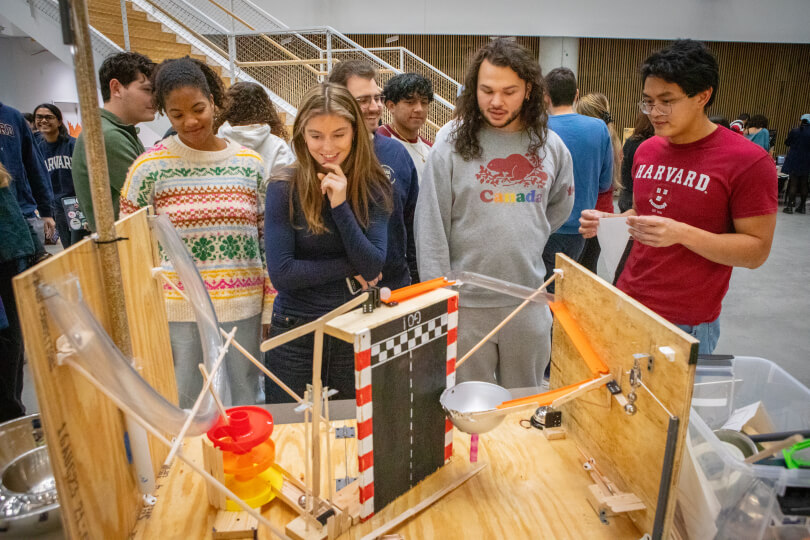
“The Bird Feeder,” designed by Ellie Wynkoop, Aiden Taylor, Carlos Garcia and Daniel Panganiban, won the award for Best Engineered/Built (Eliza Grinnell/SEAS)
“Problem-solving can be so frustrating, but when you get it right there’s nothing better,” said Wynkoop, a first-year student planning to study mechanical engineering. “The first time that the mousetrap triggered, we were celebrating for so long. Our group chat was just full of happy videos.”
Wynkoop added, “My peer advising fellow told me this class was amazing. Hardly any freshmen take it, so I was a little bit intimidated, but it turned out to be the best experience.”
The Most Creative Award went to “Mount AP50,” designed by Keira Adams, Esper Murray, Mirika Jambudi and Daniela Garcia-Garcia. Depicted as a mountain, their machine sent ball bearings and toy cars moving through a series of ramps and buckets before ultimately causing a Mentos candy piece to drop into a container of Diet Coke, triggering an eruption.
“I really enjoyed this project, because it allowed for a lot of creativity,” said Adams, a third-year premed student studying neuroscience. “Within that collaborative environment, we were able to bounce a lot of really fun ideas off each other. Someone mentioned we could build a volcano, and what other opportunities do you have to build a volcano in class?”
The award for Longest Running Machine went to “Rainbow Road,” designed by Neil Sash, Divangel Guerrero and Tiyana Mattox and named after the iconic course in the “Mario Kart” video game franchise. Other inspirations included the Emerald City from “The Wizard of Oz,” an amusement park where each element was named like an attraction, and a construction site called “Do Not Start This” whose name references the first letter of each of the four builders.
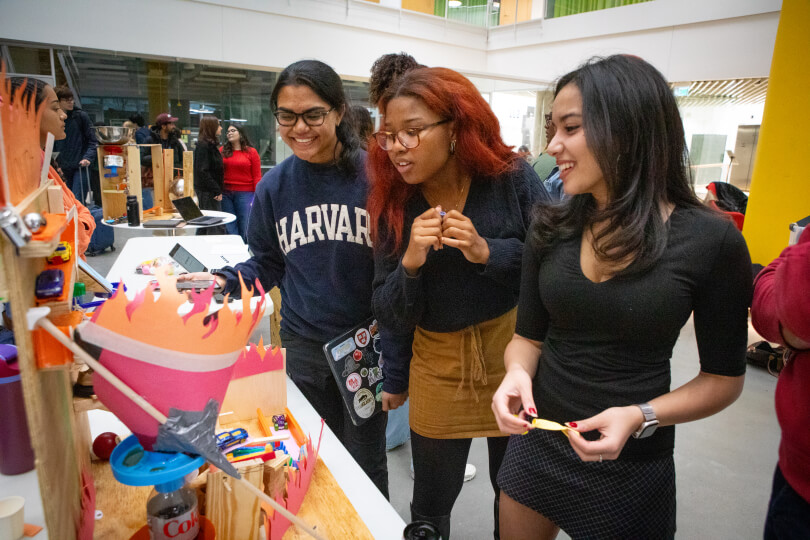
“Mount AP50” co-designers Mirika Jambudi, Daniela Garcia-Garcia and Keira Adams won the Most Creative Award (Eliza Grinnell/SEAS)
“We watched a few videos, saw what looks good and works, and then we just started drawing,” said “Do Not Start This” co-designer Nicole Cornell, a second-year electrical engineering concentrator. “This class is very collaborative, and you’re able to present your work a lot, which I think is a skill that a lot more engineers should start developing.”
AP50 not only teaches the fundamentals of physics – it teaches about SEAS. This year’s class included multiple students concentrating in life sciences disciplines who took the class to fulfill the physics requirement for Harvard’s premed program. This class was their introduction to the Science and Engineering Complex, REEF Makerspace and other facilities in which they 3D-printed, machined or otherwise produced the various elements of their machines.
“This is my first time being here,” said Odera Arene, a second-year chemical and physical biology concentrator. “It’s cool that we have all these spaces to create and build things.”
Topics: Academics, Active Learning Labs, Applied Physics
Cutting-edge science delivered direct to your inbox.
Join the Harvard SEAS mailing list.
Press Contact
Matt Goisman | mgoisman@g.harvard.edu
Related News
Applying AI to Accelerate Design, Test and Manufacture
University of Washington Mechanical Engineering
AI / Machine Learning, Applied Physics, Computer Science, Electrical & Computer Engineering, Materials Science & Mechanical Engineering, Meet Our Faculty, Research, Technology