News
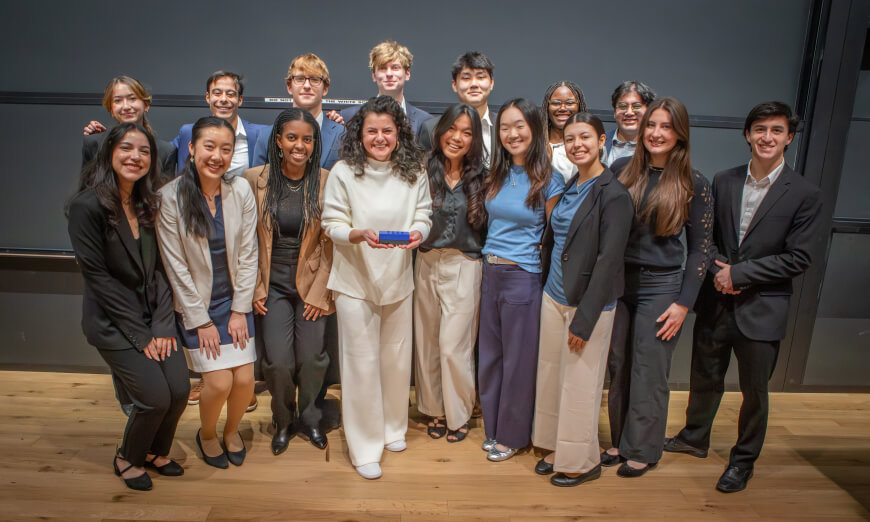
Third-year ES96 students with Irini Albanti, Harvard Humanitarian Initiative Executive Director (Eliza Grinnell/SEAS)
When it comes to humanitarian aid, simple data collection and counting is essential. If medical supplies are needed after a natural disaster, it’d be helpful to know how many people are sick or injured. If schools need to be rebuilt, it’d be helpful to know how many children there are. If food and water is in short supply, an accurate population count is critical.
KoboToolbox is a data collection and visualization platform developed by faculty now at the Harvard Humanitarian Initiative (HHI): Phuong Pham, Associate Professor in the Department of Global Health and Population at Harvard TH Chan School of Public Health (HSPH) and Associate Professor of Emergency Medicine at Harvard Medical School (HMS); and Patrick Vinck, Assistant Professor in the Department of Global Health and Population at HSPH and Associate Professor of Emergency Medicine at HMS. Today, the platform is used by tens of thousands of social impact organizations worldwide. However, data collection typically relies on smartphones, which are far more complex than necessary for simple counting tasks, and are harder to share, clean, secure, and control in the field.
Last fall, 15 students at the Harvard John A. Paulson School of Engineering and Applied Sciences (SEAS) worked with HHI to develop a low-cost, battery-powered and Bluetooth-enabled counting device called KoboClicker that humanitarian aid workers can use in conjunction with KoboToolbox in the field. The students developed it as their semester-long project in “ES96: Engineering Problem Solving and Design Project,” a core course for third-year S.B. engineering students at SEAS.
“It’s been a beautiful process working with so many amazing students and peers,” said mechanical engineering concentrator Anya Zhang, who co-led the overall project with Nathaniel Marinaccio. “There were a lot of moments where we had frustrations, things not working or breaking, but everyone has really pulled through for each other. People stayed for late nights working together, did things outside their respective teams, and to be able to see it all together and everyone keep showing up for each other has been really wonderful.“
To design the KoboClicker, students separated into three sub-teams – mechanical engineering, electrical engineering and software design – which then defined a set of criteria they had to meet. For the mechanical sub-team, that included a durable and moisture-resistant outer shell; eight buttons that could be used to differentiate counts in the field; and a drive for MicroSD chip data storage and USB cable port for charging.
“Most of our team had a lot of experience navigating the REEF Makerspace and machine shops,” said Jade Webb, a bioengineering concentrator who co-led the mechanical sub-team with Audrey Cheng. “I had a little less exposure because of my academic background, but we all ended up spending so many hours in the REEF that we became pros comfortable with 3D printing.”
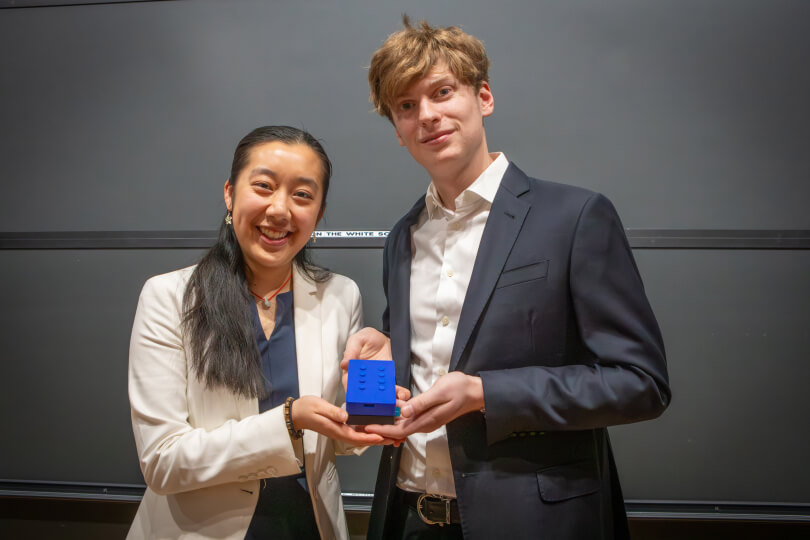
Anya Zhang and Nathaniel Marinaccio, project co-leaders for the Fall 2025 section of ES96, show off the KoboClicker
Electrical engineering concentrator Kieran McDaniel led the electrical sub-team, which designed the circuit board that registered button clicks, as well as the rechargeable lithium ion battery and charging process. McDaniel said his prior electrical engineering classes provided a strong foundation in the fundamentals of the discipline, but ES96 was a unique opportunity to implement those theories in a real-world setting.
“I’d done group projects in the past, but working with 15 people all part of one team, having a management structure with team leads and sub-team leads – that was very different from anything I’d done, but it was one of the aspects I enjoyed the most,” he said.
For most SEAS students, ES96 is the largest group project they undertake in their first three years. And even with so many students, often from all four engineering disciplines, there are still opportunities to learn new skills.
“I had no prior coding experience,” said software sub-team leader Justin Curcio, whose group built the software that timestamped and categorized the data, then synced it with KoboToolbox. “As opposed to a purely lecture-based class, this was definitely different in a good way. I’ve done a lot of projects in my time at SEAS, but being able to work with a client rather than building something just to meet course requirements was really nice.”
A typical semester of ES96 starts with weeks of research and client interviews, with actual ideation and design often not starting until the final six weeks. The course teaches an approach to problem solving as opposed to a solution to a given problem. Students are tasked with honing in on a clear definition of something the client needs, then building something that meets that need and can be delivered given the time and resource constraints of the semester at SEAS.
“In design in general, and certainly in ES96, you never have enough time, you never have enough money, so the question is what you can get done with the resources that you have,” said course instructor David Mooney, Robert Pinkas Family Professor of Bioengineering. “I thought they were able to really address a significant need in humanitarian aid, and develop a device that I think has tremendous potential to really make a difference in the field.”
This is the third time Albanti has worked with an ES96 class. With some more refinement of the design, KoboClicker could eventually become part of larger set of tools humanitarians can adopt. Irini Albanti, HHI Executive Director, said her organization runs a disaster relief simulation about an hour from Boston each year – a potentially perfect opportunity to test it in the field.
“Thousands of people and more than 32,000 organizations around the world are using KoboToolbox, so this new design can really optimize data collection on the ground and during crises,” said Albanti. “It was great to see how they built upon an existing platform and product. With one addition, you can exponentially improve data collection in the field. They really listened to us, which is amazing for the client-engineer relationship.”
Topics: Academics, Computer Science, Electrical & Computer Engineering, Materials Science & Mechanical Engineering
Cutting-edge science delivered direct to your inbox.
Join the Harvard SEAS mailing list.
Press Contact
Matt Goisman | mgoisman@g.harvard.edu