News
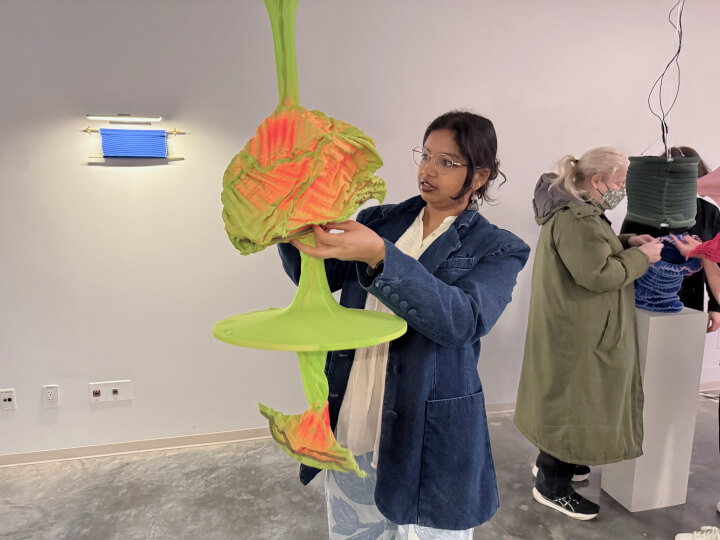
Ph.D. student Kausalya Mahadevan with a multistable fabric at the ArtLab (Matt Goisman/SEAS)
If you flip a light switch, the lights turn on. If you flip it again, the lights turn off. The light switch has two different configurations, and can maintain each configuration until its next interaction.
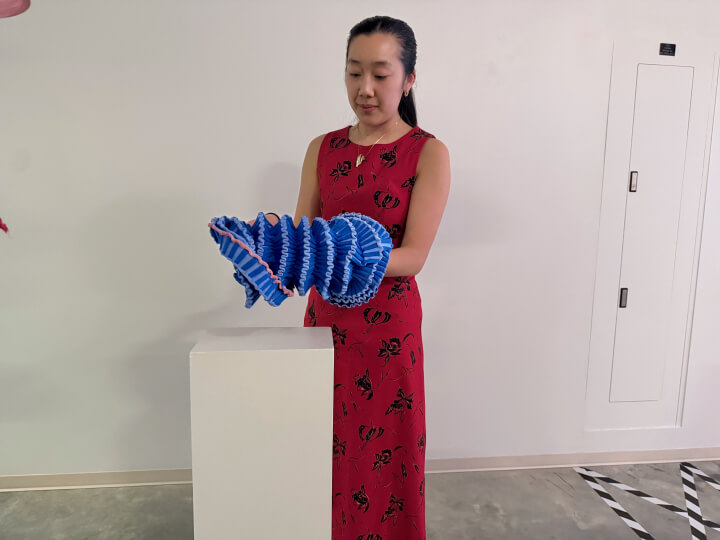
Undergraduate researcher Anya Zhang with a multistable fabric at the ArtLab (Matt Goisman/SEAS)
This property is known as “multistability,” and we see numerous examples of it in everyday life, from electronics to cars.
Fabrics, however, are normally not multistable – when you stretch them, they snap back to their shape. But three researchers in the Katia Bertoldi Group at the Harvard John A. Paulson School of Engineering and Applied Sciences (SEAS) have spent this school year developing multistable knit fabrics that can be folded, shaped and even illuminated when embedded with the proper circuitry.
Their work is on display in a new exhibition at the Harvard ArtLab. “Knitted Light and Responsive Textiles” features a variety of multistable fabrics, from wall hangings that can be pulled down to reveal text to vibrantly hued cloth polyhedra hanging in the air. It was designed by PhD students Kausalya Mahadevan and Helen Read and third-year mechanical engineering concentrator Anya Zhang.
Zhang led the ArtLab application process in September, though the Bertoldi Group’s research into multistable textiles predates it by years. A member of the Conflux Collective art-technology club, Zhang was already familiar with the ArtLab, which is located very close to the Science and Engineering Complex and features open studios designed to promote student projects like this one.
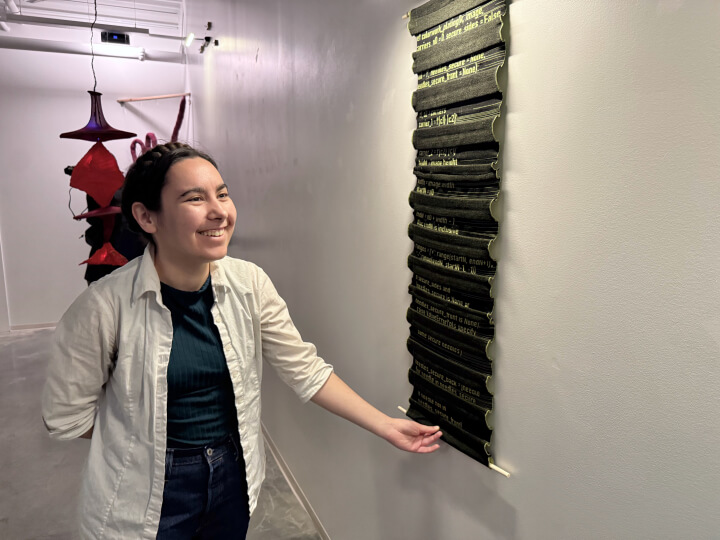
Ph.D. student Helen Read with a wall hanging at the ArtLab (Matt Goisman/SEAS)
“I'm especially fascinated with things like human object interactivity, and thinking about how functional purposes can be used as also an aesthetic and artistic means,” said Zhang, who first joined the Bertoldi Group as a first-year student. “As a mechanical engineer, I find it really fascinating to think about how these components interact on a holistic scale. I wanted to go down on a smaller scale to think individually about the yarns and the knitting, and how all these different combinations can create these interesting structural mechanics.”
“Being multi-stable and also looking nice is always like a nice bonus with textiles,” Read said. “But I think this is the first time that we're really thinking a lot about how these colors go together, or how people are going to see these four objects as a coherent whole.”
The ArtLab installation is based on a previously submitted paper, but the group is preparing for further research and a new manuscript. Their research could have applications in wearables, architecture, and furniture.
“This exhibition is a way to turn it into something that's maybe a little bit less applied, a little bit more artistic,” Mahadevan said. “We wanted to invite people to come and interact with it and try to learn something about those interactions.”
The exhibition will be on display throughout March. For viewing times, contact artlab@harvard.edu.
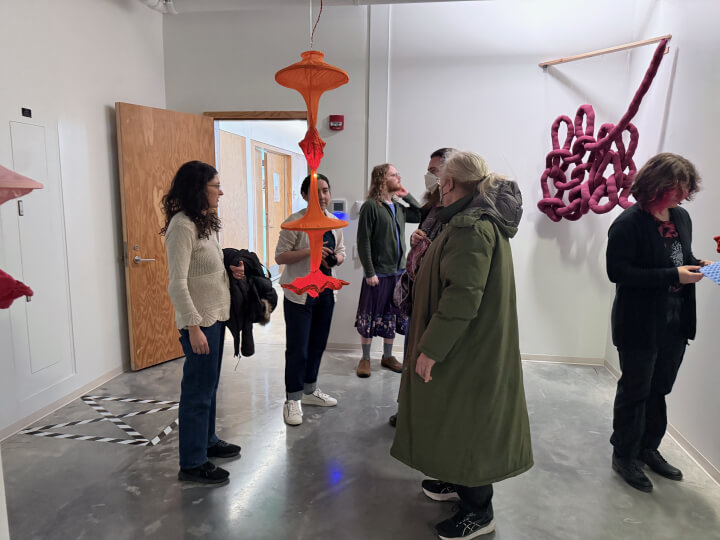
Visitors explore “Knitted Light and Responsive Textiles” at the ArtLab (Matt Goisman/SEAS)
Cutting-edge science delivered direct to your inbox.
Join the Harvard SEAS mailing list.
Press Contact
Matt Goisman | mgoisman@g.harvard.edu