News
Chris Prainito watched from NASA’s Operational Support Building 2 at Cape Canaveral as the Harvard Undergraduate Aerospace Collective (HUAC) made history. A senior mechanical engineering and physics concentrator at the Harvard John A. Paulson School of Engineering and Applied Sciences (SEAS), Prainito had spent the last four years taking the club’s cube-shaped satellite (CubeSat) from a grant proposal to a machine that was actually going to space – the first student-built satellite to do so in Harvard’s history. He’d gone from a general member to head of the payload subteam to chief engineer.
Prainito and his fellow HUAC leaders watched the CubeSat launch from a vantage point two miles away, where they felt the sonic boom seconds after seeing the rocket break the sound barrier. As livestreams from the International Space Station showed the SpaceX Falcon 9 rocket docking and astronauts bringing the satellite aboard, it finally sank in: this club of undergraduate engineers and computer scientists had really done it.
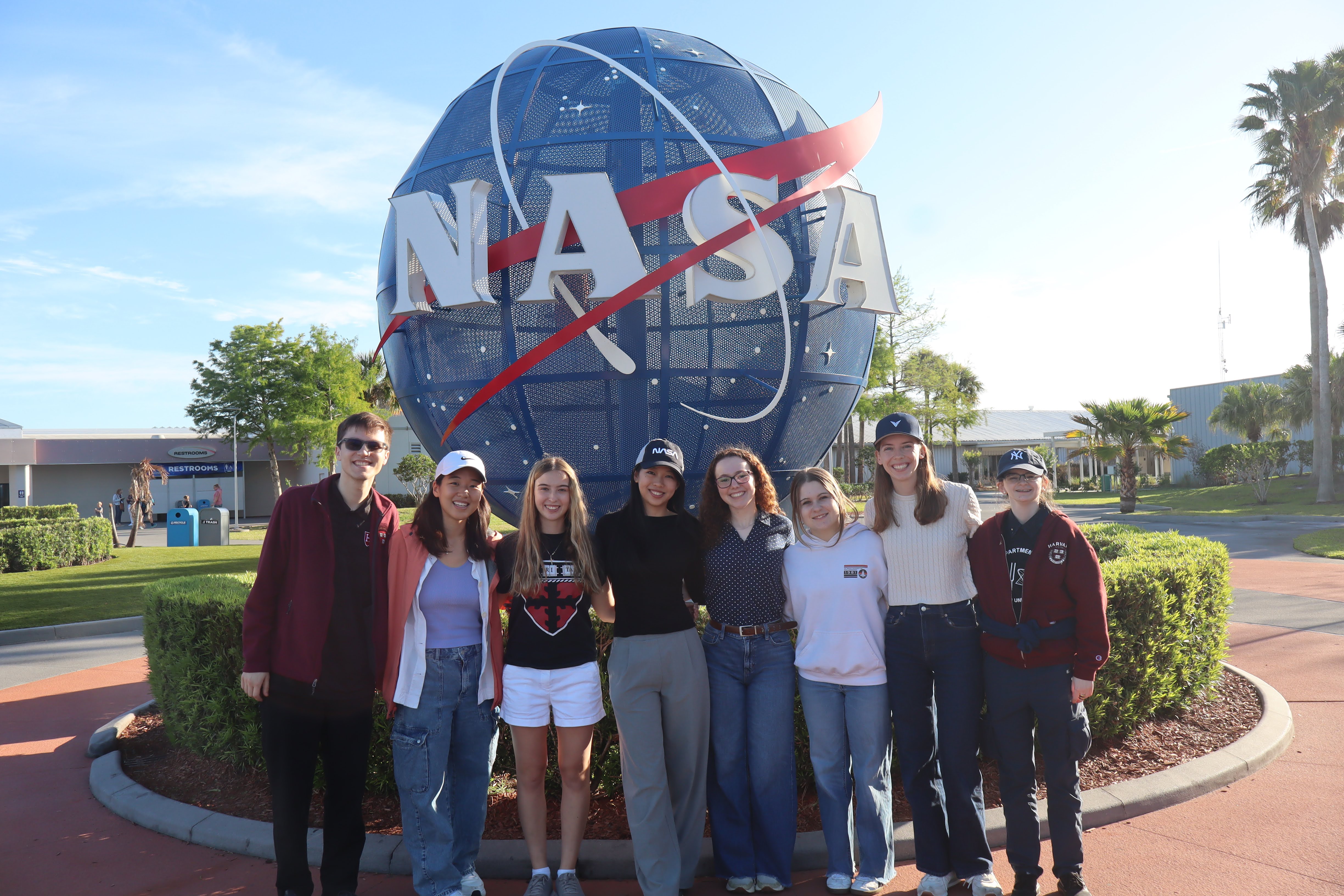
Members of the Harvard Undergraduate Aerospace Collective at Kennedy Space Center in Florida. From left are Christopher Prainito, Grace Kim (S.B. '23), Madison Davis, Kyra Mo (A.B. '25), Katelyn Miller, Sophia Gocan, Milligan Grinstead and Camryn Neches. (Harvard Undergraduate Aerospace Collective)
“It was pretty incredible,” Prainito said. “It's been such a valuable experience getting to see the whole project seen through from the idea phase all the way to actually building and then launching it. Building on all of these skills that I've developed at SEAS and actually sending something to space using them is pretty crazy. It's definitely something I'm going to remember.”
Getting a satellite into orbit has been the goal since the satellite group was founded in 2018 within the larger Harvard chapter of Students for the Exploration and Development of Space, the club’s name up until this school year. But the path really cleared in 2023, when the club was selected to the NASA CubeSat Launch Initiative, which provides launch opportunities for CubeSats built at U.S. educational institutions and non-profit organizations.
CubeSats are satellites that fit within specific dimensions, the smallest being 10 cubic centimeters and weighing under 2 kilograms. Harvard’s CubeSat is in the second-smallest category, or “2U,” which means it fits within a 10x10x22.7 centimeters and is also under 2 kilograms in weight.
To be selected, the club had to propose an experiment its satellite, which they named “HUCSat,” would run that could potentially benefit NASA and future space exploration.
The club based its experiment on nitinol, a so-called “shape-memory alloy”which changes shape when heated. The team wanted to test if nitinol could be shaped into springs that would effectively reposition solar panels, thus optimizing collection of solar energy aboard orbital stations or ships.
“This would be replacing more bulky and electronically expensive components like motors, which are a lot heavier to send up,” Prainito said. “In space travel, weight is very important. The heavier things are, the more expensive it is to launch them. Also they consume a lot of electricity, and electricity is also a commodity in space.”
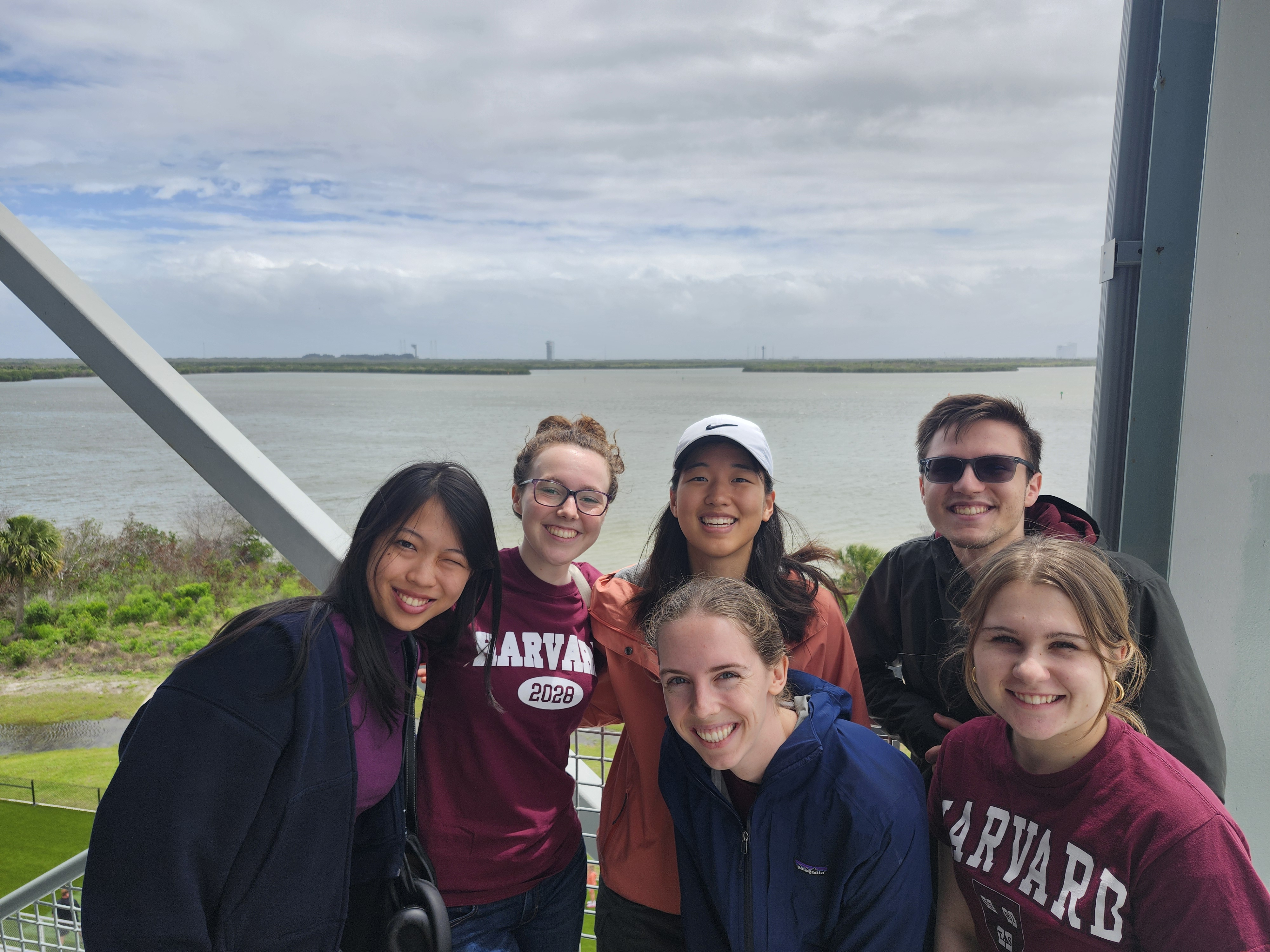
Members of the Harvard Undergraduate Aerospace Collective await their cube satellite's launch at Cape Canaveral in Florida (Harvard Undergraduate Aerospace Collective)
Building out the experiment itself was the responsibility of the payload subteam, one of five subteams alongside teams focused on mechanical engineering, electrical engineering, computing, and a communications team, which installed a ground station to receive satellite data in a SEAS building.
“I was designing and rapid prototyping for the actual scientific payload that we were putting on the CubeSat and figuring out how we make the science actually happen,” said Katelyn Miller, payload subteam lead and a second-year mechanical engineering concentrator. “It was literally just applied engineering, which was right up my alley.”
With the payload set, it then had to be housed. Senior computer science and math student Milligan Grinstead helmed the mechanical engineering subteam, where she was responsible for building both the HUCSat skeleton and the altitude determination and control system that keeps the satellite properly positioned in orbit. Once everything was set, the club handed off HUCSat to their launch provider in Houston in January.
“There was definitely a lot of energy in the club in the months leading up to our deadline,” Grinstead said. “We were really trying to get it done, and there was a lot to get done. But it was also very exciting because when you finally see it come together, it’s a very impressive thing. A year ago, this was a computer-aided design on someone's computer, and now I'm holding it in my hands.”
The launch took place on April 11, capping years of meeting multiple times each week. Subteam leaders provided weekly updates to chief engineer Prainito before scheduling their own build sessions, and all five subteams also gathered every Friday afternoon to build together. Those build sessions took advantage of the SEC’s makerspaces, Active Learning Labs and machine shops, using SEAS resources to simultaneously pursue their extracurricular interests and develop engineering skills that will benefit them in the classroom and workforce. The club’s faculty advisor is Robin Wordsworth, Gordon McKay Professor of Environmental Science and Engineering and Professor of Earth and Planetary Sciences.
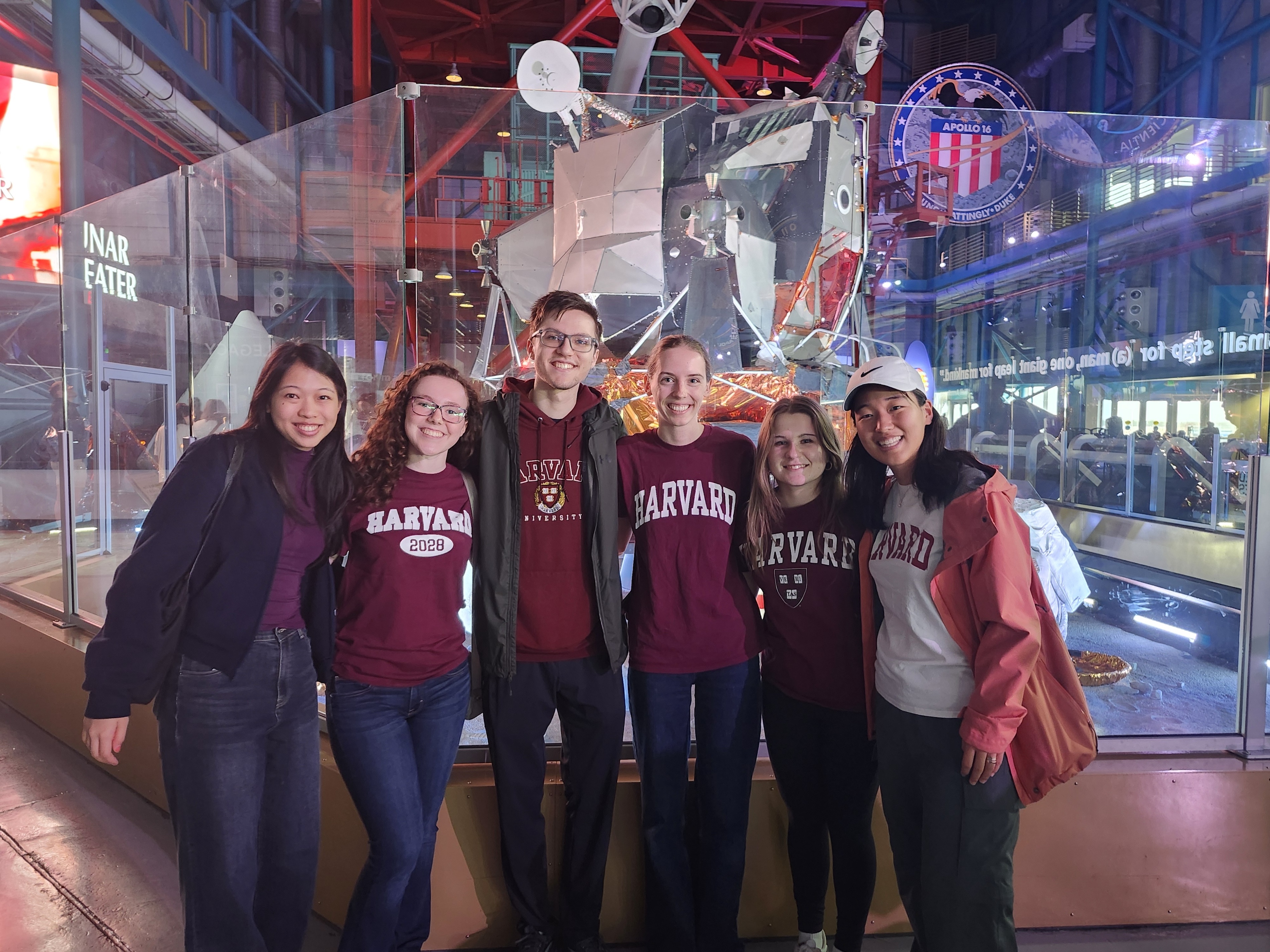
Members of the Harvard Undergraduate Aerospace Collective inside the Kennedy Space Center in Florida (Harvard Undergraduate Aerospace Collective)
“A lot of what we do is interdisciplinary, so sometimes the ground station team will need to work with computing to figure out how the software is gonna work, or mechanical will need to work with electrical to figure out how they're interfacing a component,” said Miller. “So it's a lot of interdisciplinary work, which is why I love this club so much.”
While this was a historic moment for HUAC, SEAS and Harvard University, the club’s mission isn’t over. Data collection at the ground station hasn’t even begun yet, as the satellite isn’t expected to be deployed from the International Space Station until June. In the meantime, Miller is already working on proper documentation of everything they’ve done, with the hope of easing the way for the next satellite – something the club fully intends to build.
“Our CubeSat's gonna be in orbit for a maximum of two years,” said first-year Sophia Gocan, who worked with Miller on the payload subteam and was recently elected vice president and satellite project lead. “Our goal is to get the next one up by 2028 – we just need to get funding. In theory it would basically be one out, one in, one out, one in. The goal is to just keep this continuing and growing both in the size of our membership and the size of our satellites.”
Topics: Computer Science, Electrical & Computer Engineering, Materials Science & Mechanical Engineering, Student Organizations, Undergraduate Student Profile
Cutting-edge science delivered direct to your inbox.
Join the Harvard SEAS mailing list.
Press Contact
Matt Goisman | mgoisman@g.harvard.edu