News
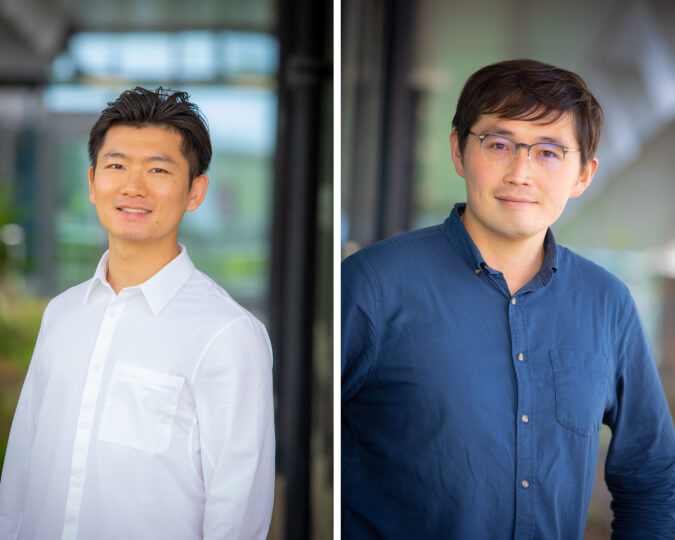
Professors Heng Yang and Kiyoul Yang.
Professors Heng Yang and Kiyoul Yang have received Faculty Early Career Development Program Awards from the National Science Foundation (NSF). CAREER awards support early-career faculty who have the potential to serve as academic role models in research and education, and to lead advances in the missions of their organizations.
Heng “Hank” Yang, assistant professor of electrical engineering in the Harvard John A. Paulson School of Engineering and Applied Sciences (SEAS), directs the Computational Robotics Group at SEAS. He is broadly interested in theory and practice around computational algorithms that are robust, efficient, and offer strong performance guarantees.
His CAREER project is focused on making autonomous systems safer and more reliable by giving them fast, provably correct optimization tools. The project will enable what is called certifiable decision-making: algorithms that return solutions alongside mathematical certificates so that users can verify when an answer is untrustworthy. The research is relevant to many areas including building 3D maps from images; planning robot motions; or choosing actions from raw sensor data. Today such tasks are typically handled by systems that can fail unpredictably.
“In my group, we pursue a dual mission,” Yang said. “On one hand, we work to popularize and democratize these techniques, expanding their reach to increasingly ambitious applications. On the other hand, we investigate deep mathematical questions in areas such as dynamical systems, algebraic geometry, and optimization theory. This tight integration of theory and practice is what makes the research especially compelling.”
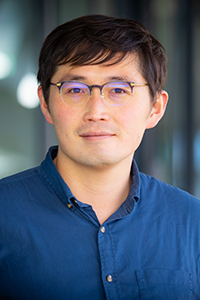
Kiyoul Yang is an assistant professor of electrical engineering at SEAS. He leads the Y-Lab, focused on building next-generation photonic systems for computation, sensing, communications, and metrology.
Yang’s CAREER project will focus on developing the next generation of large-scale, high-speed spatial light modulators, which are devices that control the intensity and phase of light and are typically used in atom tweezers, image projections, LiDAR, optical computing, and more.
Yang will lead the development of an integrated-photonics platform to generate and modulate large arrays of optical beams in free space, with each beam individually controlled by on-chip modulators; massively parallel laser arrays; and computationally optimized beam emitters and lens. The platform will work across new wavelength regimes, beginning with telecom and moving toward the visible spectrum, opening possibilities for quantum control hardware and high-resolution brain imaging. The research will also include new hardware components for photonic interconnects that support large-scale machine learning across data centers, an increasingly important national priority as AI models and datasets continue to grow.
Yang added, “Our team is grateful for the vibrant research community across SEAS, the Harvard Quantum Initiative, the Center for Nanoscale Systems, and our broader network of collaborators. This community has been instrumental in shaping our research vision and this research endeavor.”
Topics: Awards, Electrical & Computer Engineering, Meet Our Faculty, Quantum Engineering, Research, Robotics, Technology
Cutting-edge science delivered direct to your inbox.
Join the Harvard SEAS mailing list.
Scientist Profiles
Heng Yang
Assistant Professor of Electrical Engineering
Kiyoul Yang
Assistant Professor of Electrical Engineering
Press Contact
Anne J. Manning | amanning@seas.harvard.edu