News
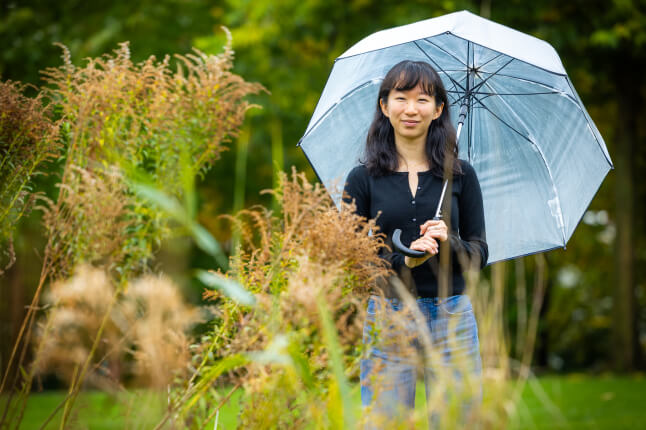
Beckett Yi saw the destructive power of the environment when wildfires tore through his community in Los Angeles. Yvonne Shen grew up exploring Idaho’s outdoors, developing a love for nature and a desire to protect the places that shaped her. Devi Kuscer witnessed the effects of climate change in her native Slovenia, including floods, deforestation and the melting of glaciers that were once national symbols. Aidhin Kaleem developed an acute understanding of the global energy crisis growing up in the Maldives, where diesel generates more than 90% of the nation’s electricity.
Meet the initial cohort of Harvard’s newest undergraduate concentration, Energy, Climate & the Environment in the Science and Engineering for Sustainable Solutions track at the Harvard John A. Paulson School of Engineering and Applied Sciences (SEAS).
“ENCE is a concentration where the community you're part of is a really important aspect, since we're going to be collaborating a lot and working on all sorts of projects together,” Kuscer said. “It's forming this community and coming up with solutions to these problems together, because we know we can't do it alone.”
Approved by the Faculty of Arts and Sciences (FAS) in April, ENCE is the first new concentration since environmental science and engineering was added in 2018. The Science and Engineering for Sustainable Solutions track is the only SEAS-based track, the other three forming within other FAS divisions: Nature, Ethics, and the Human Imagination; Markets, Politics, and Societies; and Climate and Biodiversity. Overall, 12 sophomores declared in the new A.B. concentration.
“They described it as ‘choose your own adventure,’ and I really liked that aspect,” Yi said. “And particularly with the engineering track, I found a lot of the braids really interesting, like sustainable computing and energy systems.”
Because the concentration taps into both engineering and the humanities, ENCE has the potential to bring a broader range of students into the SEAS community. Kuscer is doing a dual-concentration with physics, while both Shen and Yi said they hadn’t considered an engineering concentration before learning about this program. Kaleem arrived planning to study economics before switching to electrical engineering and then ultimately picking ENCE.
“I thought I was more interested in environmentalism from a policy or market perspective,” Shen said. “I got involved with some venture clubs on campus, became a lot more fascinated in having a bit more of a technical background, but not necessarily just doing engineering. What really makes ENCE stand out is the idea of being inherently interdisciplinary across the sciences, the arts and the humanities in a way that works alongside Harvard’s currently existing environmental programs. The concentration does it in a way that's a bit more intentional and broad. That breadth, as well as the technical depth, was exactly what I was looking for."
The new concentrators have also already begun to spread their ENCE interest outside of the classroom. Shen is part of the Phillips Brooks House Association’s Environmental Action Committee, while Kaleem is part of the SEAS-based Harvard Undergraduate Clean Energy Group. Prior to arriving here, Yi conducted coral reef research off the California coast.
“Over the summer I worked at a diesel power plant, which really showed me how energy is still really flawed, but is moving towards incorporating cleaner, more efficient types of energy,” Kaleem said. “ENCE is so important because we are also acknowledging what has come before us, but we're at a turning point of asking what comes next.”
The cohort is already taking “ENCE10: Gateway to Energy, Climate, and Environment,” the introductory course co-taught by Lene Hau, Mallinckrodt Professor of Physics and of Applied Physics, Joyce Chaplin, James Duncan Phillips Professor of Early American History, and Jason Beckfield, Robert G. Stone Jr. Professor of Sociology. The course is introducing the new concentrators to cases designed to show the complexity and need for multidisciplinary solutions to topics like climate change, global energy needs, and environmental degradation.
“Being the first group is exciting, but there's a lot of responsibility that falls on it,” Kaleem said. “It's obviously a new concentration, but it's one that actually gives us the opportunity to make a lot of impact. There's a lot of people who are really committed to this one project, and that's a golden opportunity for us to really make an impact and drive the course.”
Kaleem, Shen, Yi and Kuscer are among the 421 sophomores who declared a SEAS concentration this year. The Class of 2029, recently welcomed at Sophomore Convocation at the Science & Engineering Complex, is the largest class in three years. Applied math is the most popular concentration in the class, with 137 students (32.5%) declaring in the subject, followed closely by computer science with 131 (31.1%). The four engineering concentrations, which offer both A.B. and S.B. curricula, drew in 147 students, with mechanical engineering being the most popular with 52 declared concentrators (12.4%).
Topics: Academics, Climate, Environment, Undergraduate Student Profile
Cutting-edge science delivered direct to your inbox.
Join the Harvard SEAS mailing list.
Press Contact
Matt Goisman | mgoisman@g.harvard.edu