News
Key Takeaways
- Harvard bioengineers have developed a way to create customized synthetic vascular grafts in minutes.
- They use focused rotary jet spinning to assemble liquid polymers into ultra-thin fibers scaffolds that resemble natural blood vessels.
- The research could someday allow surgeons to perform time-sensitive, personalized medical treatments in the operating room.
Traumatic injuries, whether on a battlefield or in a car accident, often involve damaged blood vessels that require immediate repair. New research from Harvard bioengineers aims to make these critical, time-sensitive medical treatments faster and more personalized, with the potential to save lives and advance biomedical technology.
A team from the lab of Kevin Kit Parker, the Tarr Family Professor of Bioengineering and Applied Physics in the John A. Paulson School of Engineering and Applied Sciences (SEAS), has developed a way to quickly create customizable synthetic blood vessel grafts in just minutes – fast enough that surgeons might one day manufacture an implant right in the operating room.
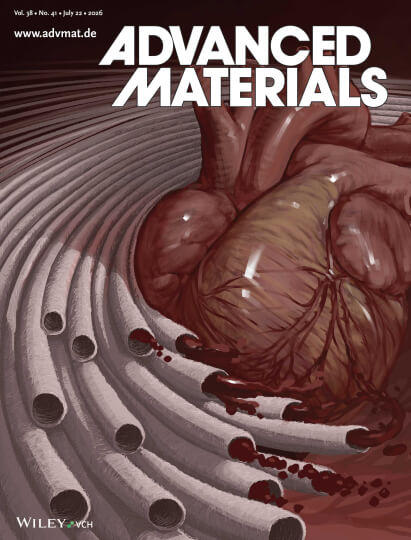
The research was featured on the cover of Advanced Materials. Image credit: Michael Rosnach / Harvard Disease Biophysics Group
The work, led by Michael Peters, a former Ph.D. student in Parker’s lab and now a visiting scholar at SEAS, is featured on a recent cover of Advanced Materials.
Vascular disease and trauma are major causes of death and disability worldwide, with surgeons often needing to replace damaged sections of blood vessels or bypass diseased segments. But for the smallest-diameter vessels commonly involved in such procedures, options are strikingly limited.
“Anything less than 6 millimeters in diameter, there are no clinically approved implants,” said Peters, who is now a research scientist at NTT Research, with whom Parker’s lab has had a longstanding research partnership and who supported the work. Existing practice for vascular surgery includes so-called autologous grafts taken from elsewhere in a patient’s body – an invasive procedure that may not match the size, shape, or quality required of the injured vessel.
New additive manufacturing platform
To address these limitations, the team used an additive manufacturing platform they call Focused Rotary Jet Spinning. Originally developed in Parker’s lab to build in vitro heart models, the technique involves high-speed spinning and focused air streams to turn liquid polymer solutions into ultra-thin fibers that get deposited onto a rotating collector, or mandrel. The fibers assemble into tubular scaffolds that resemble natural blood vessels.
The new study demonstrates that the jet spinning technique can rapidly produce small vascular grafts with precisely controlled diameters and wall thicknesses, so that in principle a graft could be custom-made on demand. In acute trauma situations, time is critical when arteries and veins are damaged and high blood pressure can lead to blood loss.
“We are trying to enable what we call ‘intraoperative manufacturing,’” Peters said. “The manufacturing speeds and customizability and flexibleness of our fabrication platforms can realize grafts that are made for a particular injury or a particular patient.”
Beyond trauma surgery, the team also foresees applications in pediatric heart surgery, where children born with congenital heart defects often face highly individualized and complex surgeries.
The vascular grafts in the study are made from a synthetic co-polymer of polylactic acid and polycaprolactone. The spinning process arranges this soft, flexible material into nanoscale and microscale fibers that closely resemble the body’s own extracellular matrix.
Patient’s own cells rebuild tissue over time
Once implanted, the grafts provide the mechanical strength needed to withstand blood pressure and maintain structure of the vessel. Over time, the synthetic scaffold degrades as the patient’s own cells rebuild the tissue. A key goal is rapid endothelialization, or having the inner wall of the graft become quickly covered with the specialized liner cells that promote smooth blood flow. Peters said the material and structure of the grafts are intended to limit clotting and other complications seen with existing synthetic grafts.
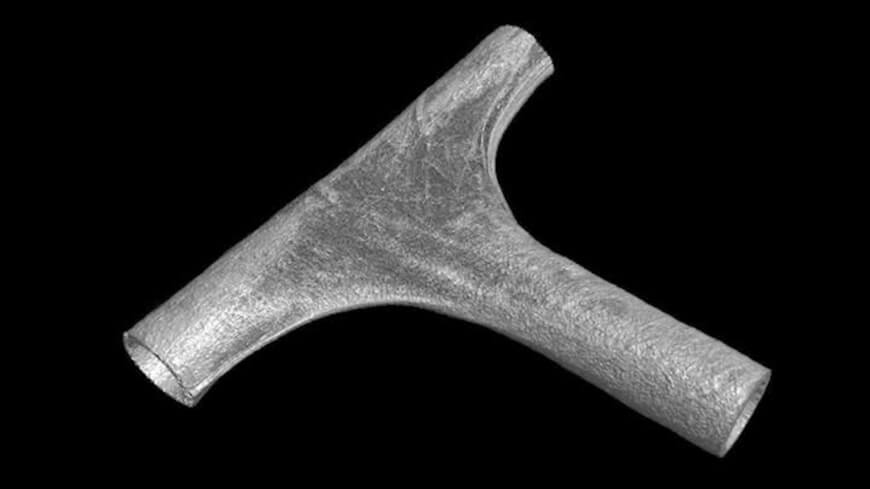
An example of a custom-designed vascular graft.
In the new study, the researchers used their platform to fabricate centimeter‑scale grafts suitable for small animal surgery, an effort led by Dr. Melanie Generali and Swiss collaborators at University of Zurich’s Institute of Regenerative Medicine.
“We want to scale up into larger animal models and see how these grafts perform, in different hemodynamic conditions at different pressures and volumetric flow rates over longer periods of time,” Peters said.
Parker said he envisions a day in which patients with specific medical needs are saved by implants custom-made in the hospital. “Dentists are doing it now with 3D printing,” Parker remarked. “In the case of our high-speed additive manufacturing platforms, if you are talking about limb salvage, or repairing a damaged or deformed heart, we are approaching a day where FDA-required Good Manufacturing Practices can be met in the operating suite while the patient is on the table.”
The work was supported by the Harvard Materials Research Science and Engineering Center under grant No. DMR-2011754. The research made use of the Center for Nanoscale Systems at Harvard, a member of the National Nanotechnology Infrastructure Network, supported by the National Science Foundation, under grant No. 1541959.
The Harvard Office of Technology Development has protected the intellectual property related to this project and is exploring commercialization opportunities.
Topics: Bioengineering, Health / Medicine, Industry, Materials, Materials Science & Mechanical Engineering, Research, Technology
Cutting-edge science delivered direct to your inbox.
Join the Harvard SEAS mailing list.
Scientist Profiles

Kit Parker
Tarr Family Professor of Bioengineering and Applied Physics
Press Contact
Anne J. Manning | amanning@seas.harvard.edu
Related News

Applying AI to Accelerate Design, Test and Manufacture
University of Washington Mechanical Engineering
AI / Machine Learning, Applied Physics, Computer Science, Electrical & Computer Engineering, Materials Science & Mechanical Engineering, Meet Our Faculty, Research, Technology