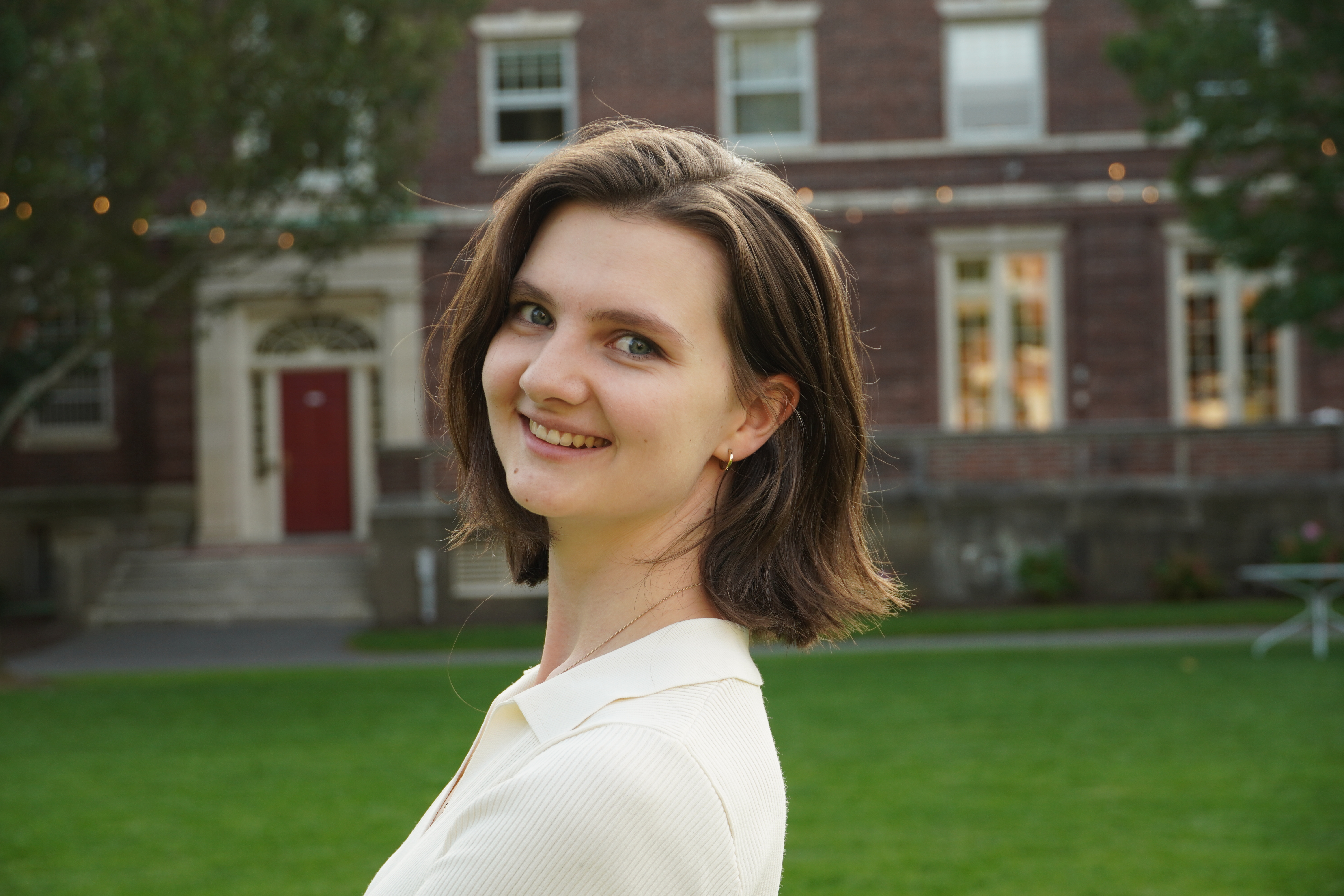
Daniela Shuman, A.B./S.M. '24
Over 90,000 people are on the national kidney transplant waiting list, and not everyone who wants to donate gets approved. Medical conditions such as high blood pressure or diabetes, cancer history, mental health challenges, even obesity can be enough to disqualify someone.
“Kidney disease is a very supply-constrained environment,” said Daniela Shuman, A.B./S.M. ‘24. “There are more than enough people who sign up to donate their kidney to a loved one, but only 2% actually make it through. Something is going wrong. If we're only converting 2% of people, there's a lot of room for improvement.”
After getting her bachelor's and concurrent master’s degrees in computer science at the Harvard John A. Paulson School of Engineering and Applied Sciences (SEAS), Shuman has spent the last two years helping increase the number of successful kidney donations. She’s the co-director of Project Donor, an organization based out of the Center for Radical Innovation for Social Change at the University of Chicago that connects potential donors with health programs that can help address the factors preventing them from donating.
“Most kidney disease interventions are geared toward care navigation or dialysis management,” she said. “We felt that a critically important and neglected area was increasing the supply of kidneys in the first place. If we can get someone a kidney, that’s far better than any improvement we can make to their dialysis experience.”
Growing up near Seattle and attending a science- and engineering-focused high school, Shuman was always surrounded by technology. She took her first computer science (CS) class as a high school freshman, and her teacher encouraged her to continue pursuing the subject.
“She saw that I liked the math and the algorithms,” Shuman said. “It felt very versatile. It felt like I could do many things with this skill, and it turns out that's exactly the case.”
Shuman considered several universities with strong CS departments, but ultimately chose Harvard for its diversity of students and ideas. Once she got to SEAS, she was immediately drawn to professors like Ariel Procaccia, Alfred and Rebecca Lin Professor of Computer Science, Milind Tambe and eventual thesis advisor Jim Waldo, both Gordon McKay Professors of Computer Science. By doing the concurrent master’s program, she was able to learn both CS fundamentals and real-world applications.
“Ariel Procaccia's ‘CS2380: Optimized Democracy’ class was basically math for making the world a better place, particularly in voting schemes and democracy,” Shuman said. “There are many people in the CS department that are dedicated to making the world a better place and using CS to do it, and I was quite inspired by all those people.”
Shuman sought ways to make an impact throughout her time at Harvard, co-founding and serving as president of the Harvard Undergraduate Urban Sustainability Lab, working as communications director for the Harvard College Effective Altruism club, and being part of SEAS-affiliated Harvard Data Analytics Group and Women in Computer Science clubs. As a summer intern at Bridgewater Associates, an investment firm in New York, she was part of a sustainability group. By the time senior year came around, she looked for places where her CS education could do the most good.
“Project Donor was exactly the kind of place I was looking for,” she said. “Someplace that wasn't a traditional impact role, but that gave me the opportunity to leverage my skills in service of doing good. I was especially drawn to the chance to work on neglected, but solvable problems that could meaningfully make the world a bit better.”
Project Donor had plenty of room to grow when Shuman joined the University of Chicago center and took over the project. She immediately put her SEAS education to use, coding much of the software infrastructure needed to interface with hospitals, case managers and potential donors.
“There's a lot of AI integrated in the system, but the main leaps here were just the basics of getting a functional dashboard in place,” she said. “Having a CS background made those kinds of improvements feel much more achievable.”
Shuman’s tools had a profound impact on the organization.
“When I joined, Project Donor had saved 30 lives,” she said. “Now we're at 185 lives. In the span of a year and a half, we've really dramatically improved the systems, and grown in a way that I'm really proud of. Part of that growth was because I can code and build out systems that make it easier and more efficient.”
As co-director, Shuman typically splits her day between coding new software tools and solutions and communicating with case managers, hospitals, grant committees and the media. She’s also starting to look towards the next step in her journey, leaving the organization in a far stronger place than she found it.
“I'm very interested in the data space in AI, and how we can make AI better at science, at government, at everything,” she said. “I think that my role here is wrapping up very nicely. I've put in a lot of systems in place to feel like it's in a good place to hand off.”
Press Contact
Matt Goisman | mgoisman@g.harvard.edu