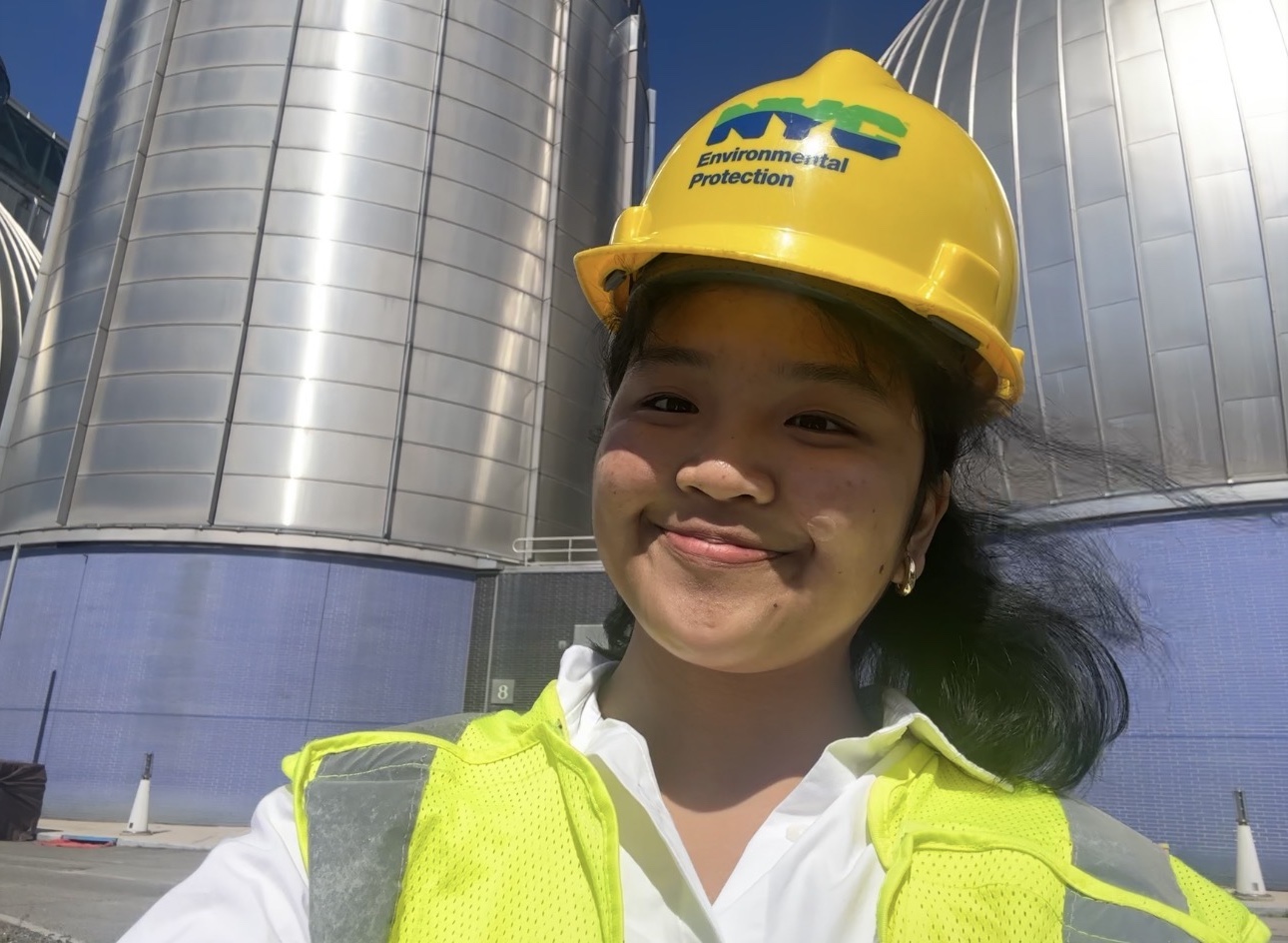
Aryenne Ysabelle Rodrigo, S.B. '27, in environmental science & engineering
When Typhoon Pablo struck the Philippines in 2012, flooding destroyed Aryenne Ysabelle Rodrigo’s home. Watching her community rebuild, and also her country’s mismanagement of flood control projects in the ensuing years – a scandal that led to widespread protests in 2025 – showed Rodrigo how essential it is for communities to have well-designed and properly inspected flood control systems in place.
“It’s very important for me to understand how connected we are to our environment, and how it affects communities,” she said.
Rodrigo, a fourth-year environmental science and engineering concentrator at the Harvard John A. Paulson School of Engineering and Applied Sciences (SEAS), spent her summer as an intern on the stormwater team at the New York City Department of Environmental Protection (DEP). She got to experience first-hand how a major metropolitan area handles stormwater permitting, from mapping the geographic region to reviewing project designs to conducting on-site inspections.
“With stormwater management practices in New York, I think one of the differences I see is that everything is digitized,” she said. “There’s also great cooperation between developers, not just public but also the private sector. There are clear criteria: if you disturb an amount of land, or if you make a place more impervious than it was before, then you have to submit a storm management practice design that would meet the water quality volume requirements.”
Rodrigo found her internship with the help of Harvard’s Mignone Center for Career Success. Her first month consisted mostly of reading manuals and attending meetings in the DEP’s office in Queens, but from there she transitioned to shadowing inspectors during stormwater management practice (SMP) inspections and visiting wastewater treatment facilities. She also used Python to develop a tool that could help optimize pipe configuration and size for upcoming stormwater drainage projects based on factors such as design constraints, excavation depth and cost.
“What we’re trying to avoid is an excess of piping,” she said. “Based on the parameters you input, the tool spits out the ideal diameter size and arrangement of those pipes to optimize the cost.”
The internship showed Rodrigo what can happen when a community properly manages its water infrastructure.
“The DEP has emphasized that historically, New York City’s harbor and waterways are the cleanest they have been in over a century,” she said. “I really see how important the job that they’re doing is to making the city habitable for people.”
As soon as her internship ended, Rodrigo turned her attention to another water-based project: Harvard’s chapter of Engineers Without Borders. She’s one of the team leads for the newest initiative, a project focused on improving water access in Mirador in Guatemala. Having previously worked on the water distribution project in the Los Sanchez community in the Dominican Republic, which was completed in August 2025, Rodrigo’s team wrapped up the summer with their initial assessment trip to Guatemala.
“The first interactions I had in Los Sanchez were interviews with local households,” she said. “It was really interesting to hear so many stories, especially of how this decade-long project changed their lives after getting access to water. I saw so many similarities from back home in the Philippines, and the stories really inspired me to continue working on the project. After Typhoon Pablo, my house was completely destroyed. A lot of volunteers from all around the world came in and helped rebuild our community. That showed me what it was like to be in a nonprofit organization giving back.”
Rodrigo’s ultimate goal is to someday use her experiences at SEAS to help her community. She’s devoted much of her time here to water-related challenges, but knows there are many aspects of environmental engineering that she hasn’t explored, such as remediation of toxic materials. After graduating, she hopes to immerse herself in these new areas, thus making her best suited to address the range of challenges her community faces.
“I find solving water problems very interesting, but I don't want to hold myself back,” she said. “Back home, I'm from a rural province in the Philippines. We still use groundwater and hand pumps for both primary and secondary water sources. It’s very important to me to continue gathering all the expertise and the knowledge that I need, and go through the development stages so I can help communities like the one I grew up in.”
Press Contact
Matt Goisman | mgoisman@g.harvard.edu