Forests play a critical role in capturing carbon from the atmosphere and storing it for long periods of time. A plant's physical structure — the trunk, branches, leaves and roots, collectively known as "biomass" — is key to this process. In order to understand how much carbon a forest can store, researchers need to be able to model a forest's biomass but traditionally those models have worked on the assumption that tree growth rate is similar everywhere in the forest. It’s only more recently that researchers have begun to differentiate the growth rate on the edge of forests from the growth rate in the interior.
“There are a lot of different conditions that could cause the edges to grow differently,” said Luna Yin, a third-year environmental science and engineering concentrator. “There's extra sunlight exposure. They're having to deal with the wind coming right at them. Sometimes if they're right next to a field or a farm, maybe they're getting fertilizer runoff.”
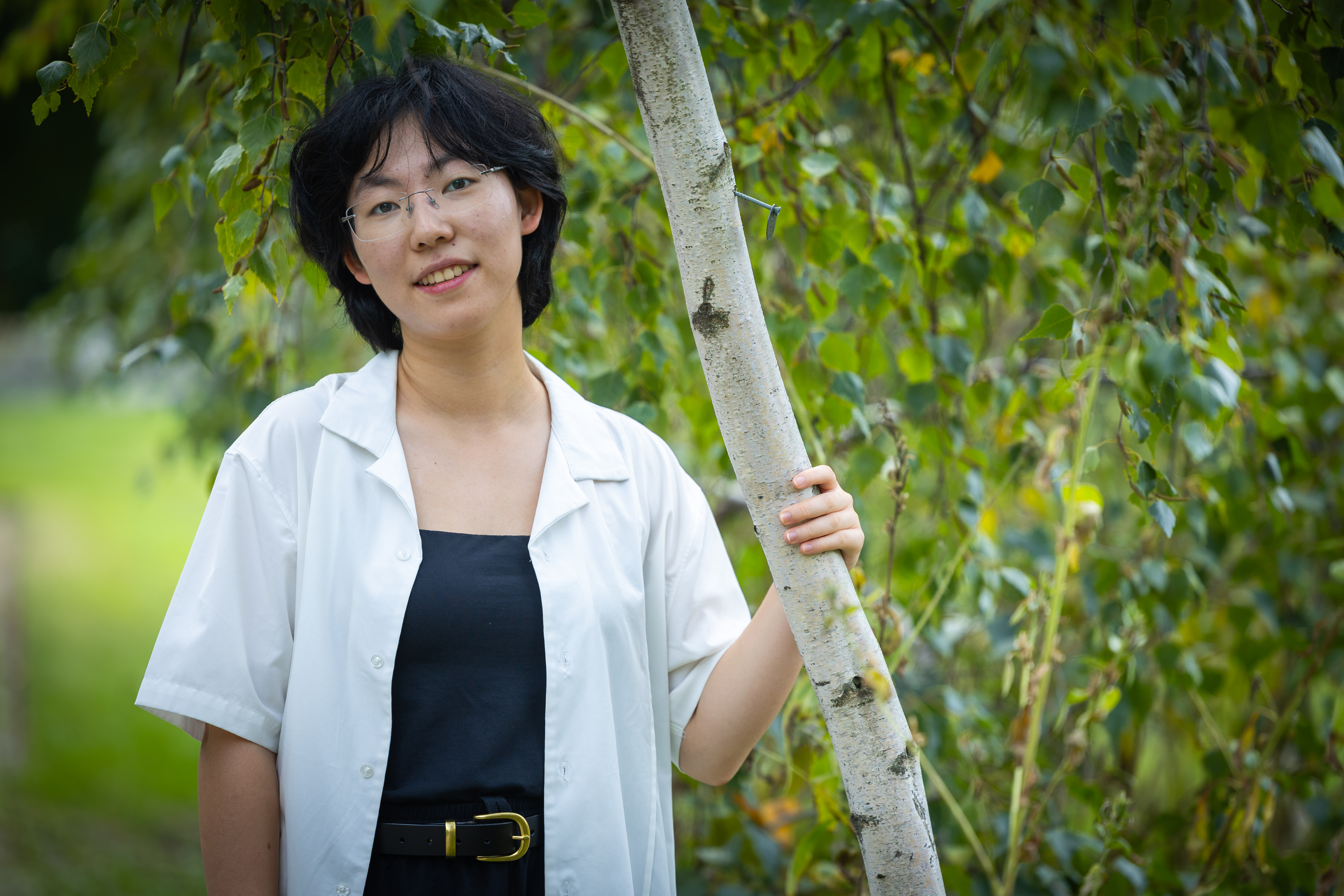
Luna Yin, S.B. '28, in environmental science and engineering (Eliza Grinnell/SEAS)
Yin spent 11 weeks in the Harvard Forest Summer Research Program in central Massachusetts, researching the differences in tree growth rates on edge plots. Using sensor data from airplane LIDAR – a light-based scanning technology similar to radar – she helped develop a model that replicates existing biomass models, then measures for accuracy against her field measurements. This could improve carbon capture predictions by identifying biases that should be corrected in existing models.
“The final result with our model that we made was that it underestimated the biomass in our edge plots by 12%, which is a pretty significant amount,” she said. “It was a really exciting result to get, and it was really cool to see how my own measurements had measured up against a model that's very similar to what's being used now. I got to see at face value what kind of flaws and errors might be existing in these systems that we're using to gauge carbon capacity at this moment.”
The Harvard Forest research experience differed from much of Yin’s previous coursework at the Harvard John A. Paulson School of Engineering and Applied Sciences (SEAS). She learned about climate observation and sensing in “ESE166: State-of-the-Art Harvard Climate Observatory and Associated Instrumentation,” run by Jim Anderson, Philip S. Weld Professor of Atmospheric Chemistry, and last summer studied methane emissions in the lab of Steven Wofsy, Abbott Lawrence Rotch Professor of Atmospheric and Environmental Science. Those experiences introduced her to sensor technology and modeling, but this was her first time applying it outside of the atmosphere.
“This was really cool for me to get to do something that's a little bit of a departure from my atmospheric background, and to also get to be on the ground and traipse around the forest that I was going to be modeling,” she said. “Half of my work was field work, where I was out hiking and measuring tree biomass near the edges of forests. But the other half of my work was very coding-based.”
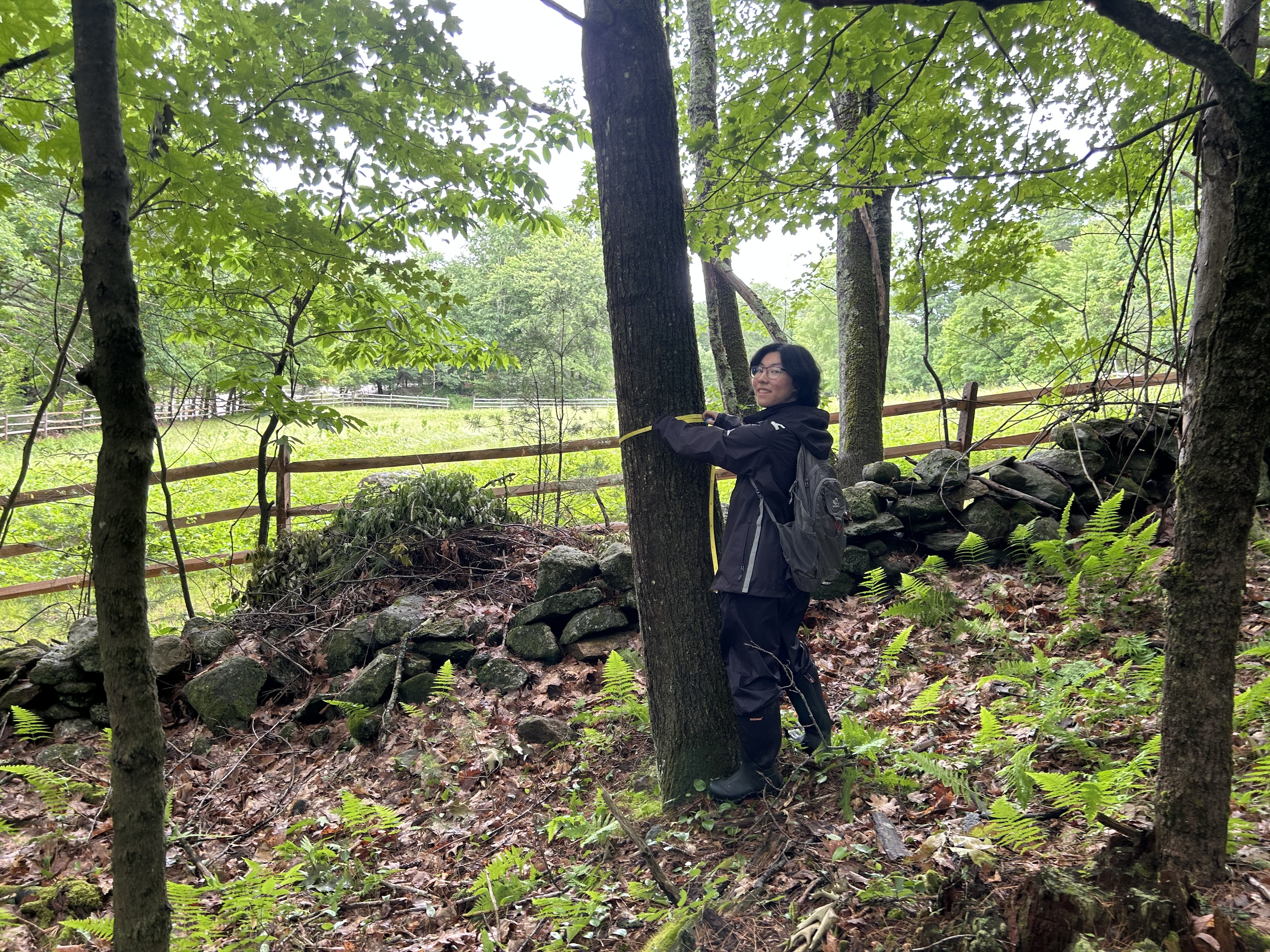
Luna Yin measures a tree in the Harvard Forest in Petersham, Mass.
Alongside the academic benefits, the Harvard Forest program also offered a unique environment to build connections with other students interested in ecology and the environment. Participants all lived together in one house, becoming a close-knit social group outside. It was also a chance for Yin to immerse herself in nature.
“I saw a black bear during field work once near the beginning of the summer,” she said. “I also almost lost some equipment because we got chased by some angry turkeys during another hiking trip.”
Now in her third year, Yin is already seeing ways to apply her summer experience to her coursework. She’s taking “ES55: Fundamentals of Engineering Design,” a new required course for students on S.B. engineering tracks, which partners students and clients to work on challenges that often require modeling. She’s in a class on photonics and electronics, learning how the sensor technology she used throughout the summer actually works.
“It's really cool that I have the experience to look at the things that I'm learning now and see how it applies to the real lasers and sensors that planes and satellites might use,” she said. “Having this experience under my belt, and having worked on a real project that looks at errors and flaws in certain systems that already exist is really helpful. I feel like maybe that gives me a little edge in my engineering coursework.”
Press Contact
Matt Goisman | mgoisman@g.harvard.edu