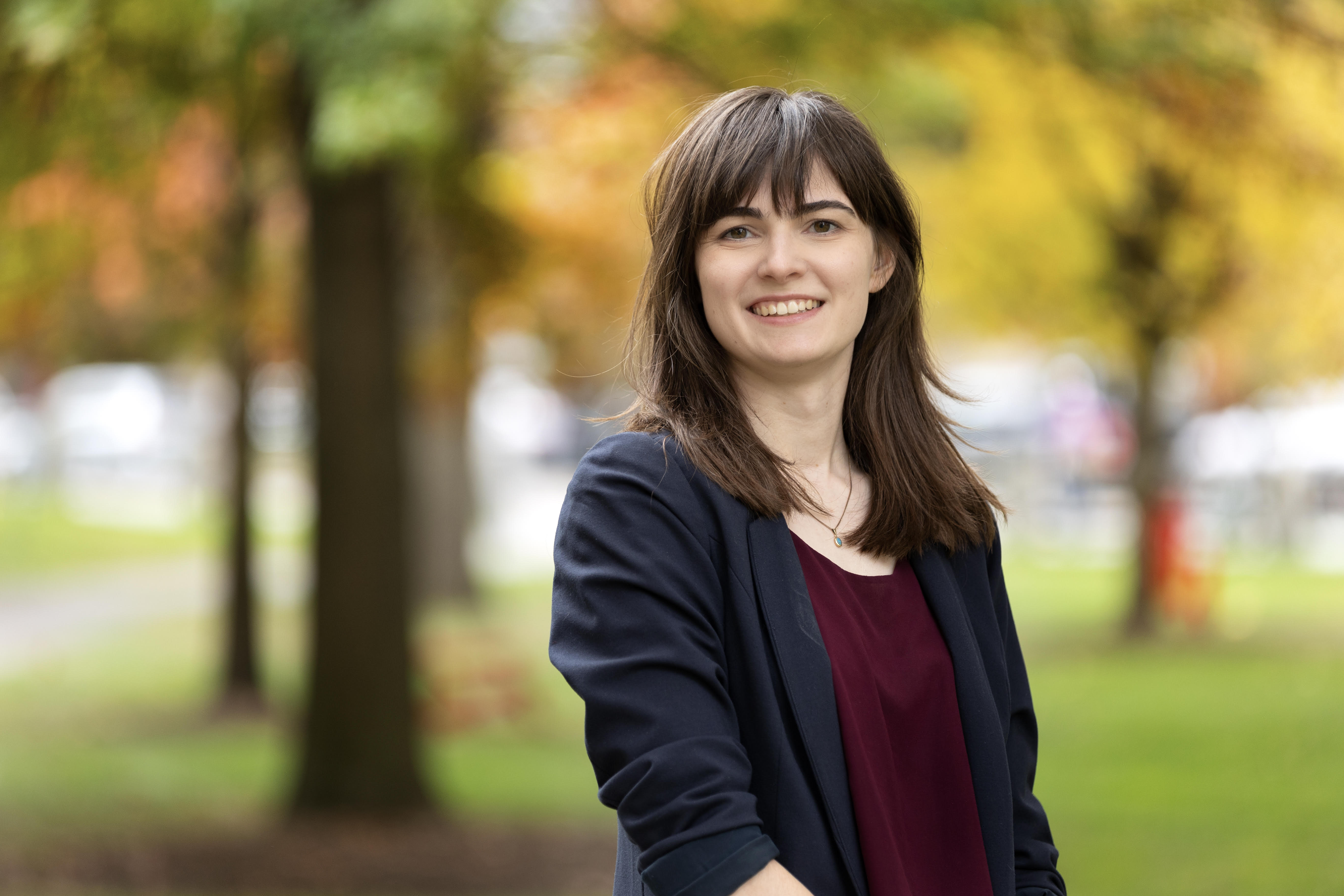
Elise Penn, S.M. '24, Ph.D. '25
As a researcher in the Atmospheric Chemistry Modeling Group at the Harvard John A. Paulson School of Engineering and Applied Sciences (SEAS), Elise Penn learned many of the traditional methods of studying atmospheric chemistry, climate modeling and environmental science and engineering. But she also took classes in fields such as artificial intelligence, machine learning and applied mathematics. She realized AI has the potential to greatly improve our ability to accurately forecast weather and climate conditions.
“The weather modeling field has been very successful in creating AI models that are just faster,” she said. “I get to pull in that expertise and combine it with the atmospheric chemistry work that I'm interested in.”
Penn, S.M. '24, Ph.D. '25, has spent the last year combining AI and atmospheric chemistry as a research scientist at Zeus AI. The Cambridge-based start-up uses AI to create weather modeling data based solely on observable conditions and satellite data, as opposed to what’s known as numerical weather prediction, which bases forecasts on mathematical equations and physics models.
“We're trying to see how far we can push pure observation modeling,” she said. “We’re taking federal technology such as satellite data, and we are trying to turn that into products for commercial use cases. And then we also develop technologies which can then be used by the federal government to impact policy decisions. What attracted me to Zeus is that the two co-founders started at NASA. They're really serious weather modeling researchers, but they also have a ton of experience in AI. So I felt like it was a place where I could do research and work on applications at the same time, which was really cool.”
Penn arrived at SEAS after receiving her bachelor’s in geological engineering and applied math at the University of Wisconsin-Madison. At Wisconsin, Penn worked with Professor Tracey Holloway on research preparing for the Tropospheric Emissions: Monitoring of Pollution (TEMPO) satellite project, which is co-led by the Harvard-Smithsonian Center for Astrophysics. That research eventually brought her to the Atmospheric Chemistry Modeling Group and Daniel Jacob, Vasco McCoy Family Professor of Atmospheric Chemistry and Environmental Engineering. Penn pursued a master’s in environmental science and engineering, then completed her Ph.D. in atmospheric chemistry.
“I liked math and I liked science, and I was interested in atmospheric chemistry because it seemed like I could use my applied math skills to work on a very applied problem that could help people,” she said.
At SEAS, she developed an expertise in satellite data and observational research that would later give her the skills needed to succeed at Zeus AI. Her dissertation focused on a molecule called hydroxyl radical (•OH), which is known as the detergent of the atmosphere because of its ability to break down not only methane, but also multiple other common air pollutants.
“If we want to know how much methane is being emitted, we have to understand how much is being lost,” she said. “I was trying to use satellite observations of methane as a proxy to estimate concentrations of •OH. It’s really hard to measure because it just reacts with everything and has a very short lifetime.”
Penn also worked as a research assistant at non-profit organization Carbon Mapper while still at SEAS. She switched from corporate to non-profit research following a six month internship at Tesla. Her research at Carbon Mapper focused on using satellite observations to quantify methane plumes and estimate emissions from coal mines.
“The question was whether you could estimate the coal mine emissions in the entire country from just taking a few individual plumes,” she said. “The answer there was that it actually worked pretty well. If you know how much coal is being produced in each basin and you have a few observations, you can estimate emissions.”
Penn joined Zeus AI in 2025 because she wanted a job where she could continue to research AI and machine learning.
“I really like working with Zeus,” she said. “I like working in a small startup just because you have a lot more control of the outcome. It's a lot faster paced, and you have more resources than you would have in academia. I get to work on AI models, I get to learn new things, and I get to do research. That's pretty perfect.”
Press Contact
Matt Goisman | mgoisman@g.harvard.edu