News
Engineering Design Projects (ES 100), the capstone course at the Harvard John A. Paulson School of Engineering and Applied Sciences (SEAS), challenges seniors to engineer a creative solution to a real-world problem.
Building a Universal Microgrid Controller for Unstable Electrical Power Systems
Ellen Caraballo, S.B. '26, Electrical Engineering
Advisor: Isaac Traylor
• Please give a brief summary of your project.
My project was on creating an adaptable controller for a microgrid system to be able to provide backup power generation for places that have a lot of outages.
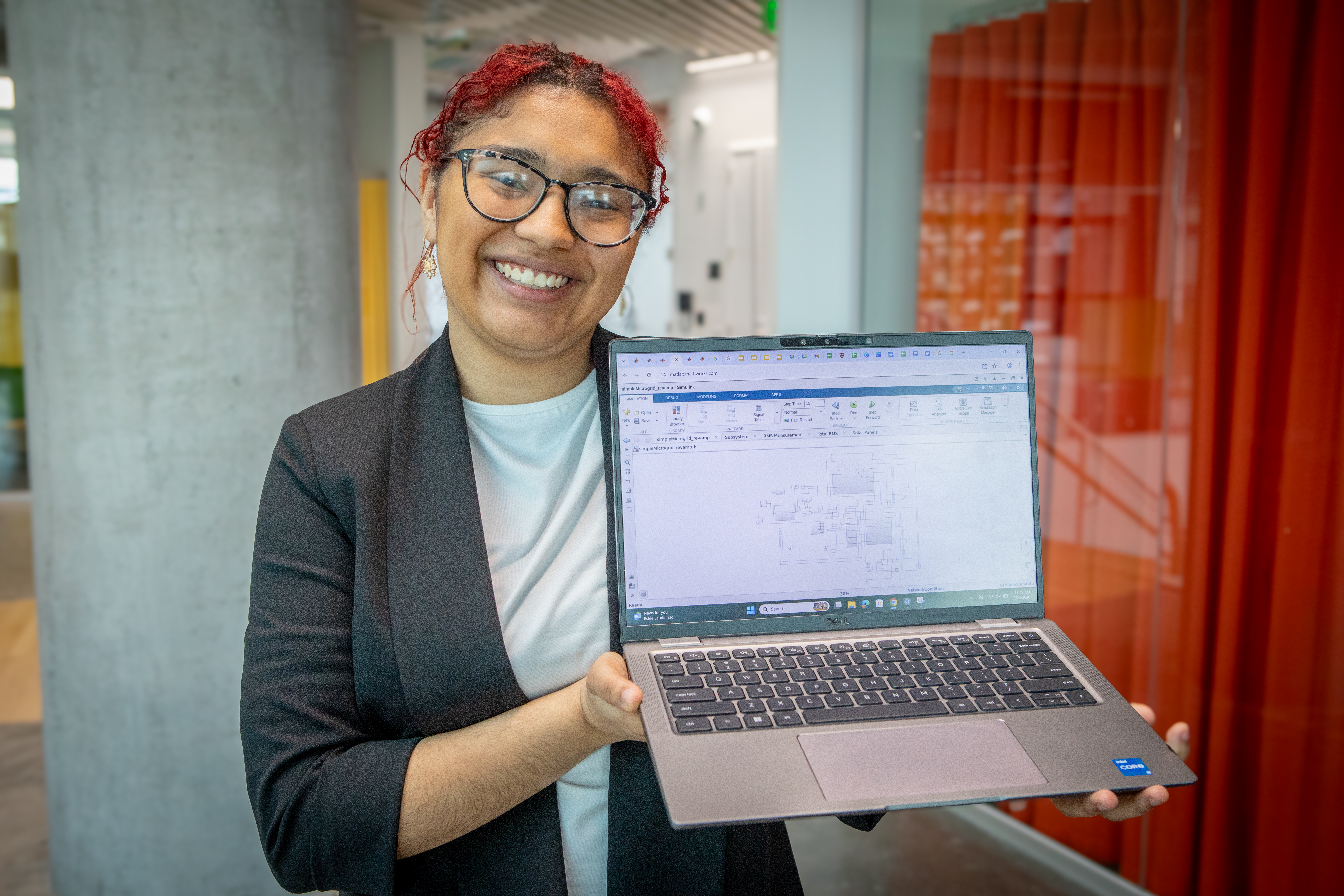
For her senior capstone project, Ellen Caraballo devised a controller for neighborhood electric microgrids (Eliza Grinnell/SEAS)
• What real-world challenge does your project address?
In places like Puerto Rico, which faces a lot of constant power grid outages, this controller would help to be able to implement a widespread solution to different environments and neighborhoods, and be able to adapt and scale them in order to reduce cost while still providing reliable power. There are people that have their backup solar power already or have backup generators, but these are expensive. Installing an entire solar power system, or even just managing the fuel cost of a generator, not everyone has access to that. But if, for example, you have a central neighborhood generator or solar power system that could provide, for example, 100 households, that can significantly bring down costs for each residence, so that they can have reliable, affordable power with shared generation and shared accessibility.
• How did you come up with this idea for your final project?
I'm from Puerto Rico, so I've seen firsthand some of the issues that are still happening even now, nine years after Hurricane Maria. I actually surveyed a bunch of residents, and just hearing their struggles, hearing things they go through, and their frustrations at constant outages or constant load-shedding that they have to deal with without having power really inspired me to find a way that maybe this solution could be solved.
• What part of the project proved the most challenging?
What I needed to test my project wasn't actually available. I actually had to build my own model in order to test my actual project, which wasn't part of my original scope. It took all of last semester and half of this semester, so that was definitely a challenge. But it really opened my eyes to how this sort of modeling works, especially in the industry, and how you can model a system like this, and how you can control a system like this.
Cutting-edge science delivered direct to your inbox.
Join the Harvard SEAS mailing list.
Press Contact
Matt Goisman | mgoisman@g.harvard.edu
Related News

Applying AI to Accelerate Design, Test and Manufacture
University of Washington Mechanical Engineering
AI / Machine Learning, Applied Physics, Computer Science, Electrical & Computer Engineering, Materials Science & Mechanical Engineering, Meet Our Faculty, Research, Technology