News
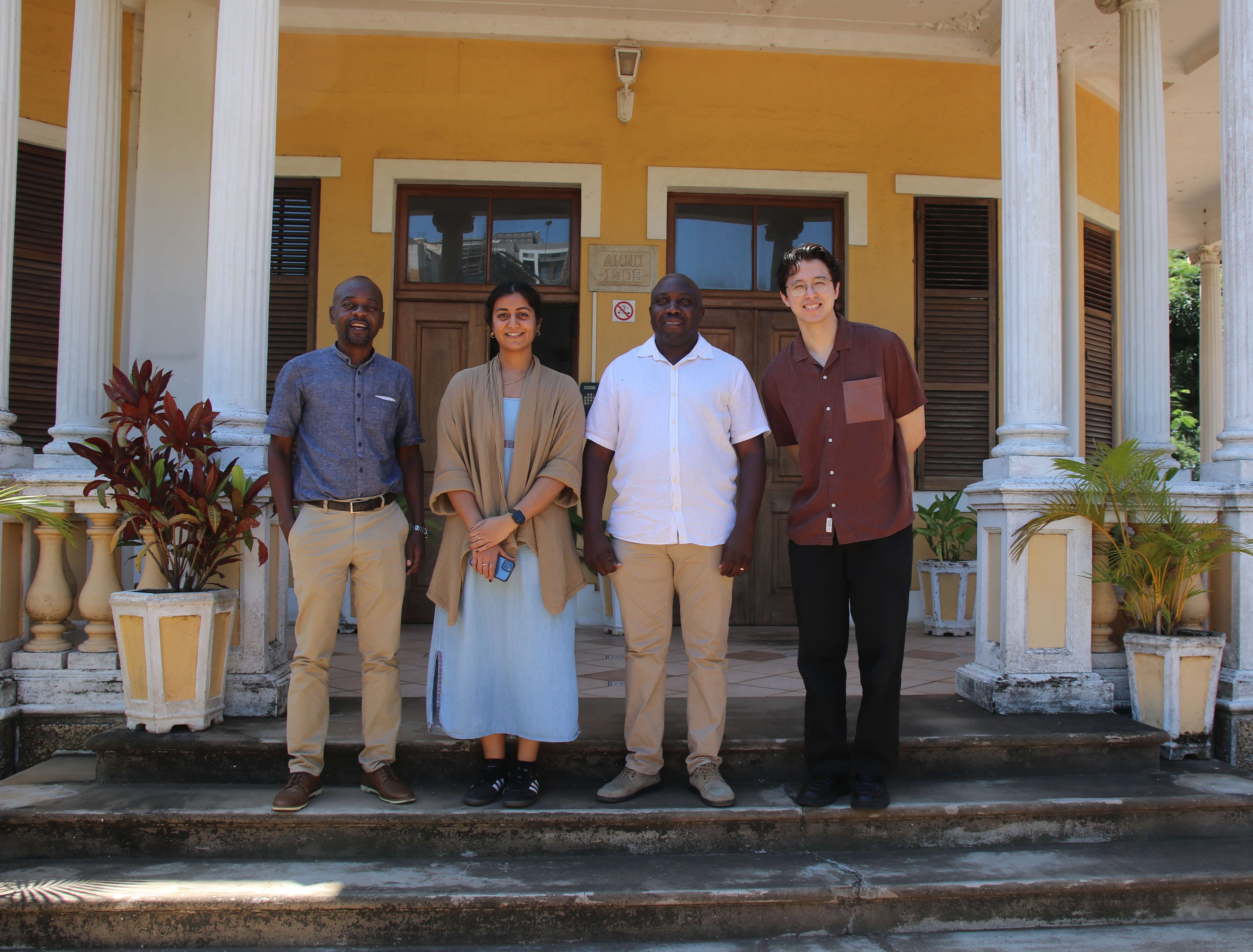
Mitul Iyengar and Luke Fiorante, MDE '26, with meteorologists at the National Institute of Meteorology in Mozambique
More than 80 countries face chronic drought, yet only a third have systems in place to act before a drought arrives rather than after. The gap is costly. According to the United Nations Food and Agriculture Organization, every dollar invested in anticipatory action can save up to seven dollars in averted losses, while also helping protect lives and livelihoods before crisis conditions take hold. Acting early works. So why don't more countries do it?
That question was at the core of Mitul Iyengar and Luke Fiorante’s Master in Design Engineering (MDE) thesis. The MDE program, a joint degree between the Harvard John A. Paulson School of Engineering and Applied Sciences (SEAS) and the Harvard Graduate School of Design, trains its students to diagnose a problem before solving it – to identify, in a tangle of technology, institutions and incentives, the real bottleneck, and then build a solution.
For Iyengar and Fiorante, MDE ‘26, that meant traveling to Mozambique, home to one of the most institutionally developed government-led drought anticipatory action systems in the world. What they found helped them reframe the problem of drought preparedness entirely.
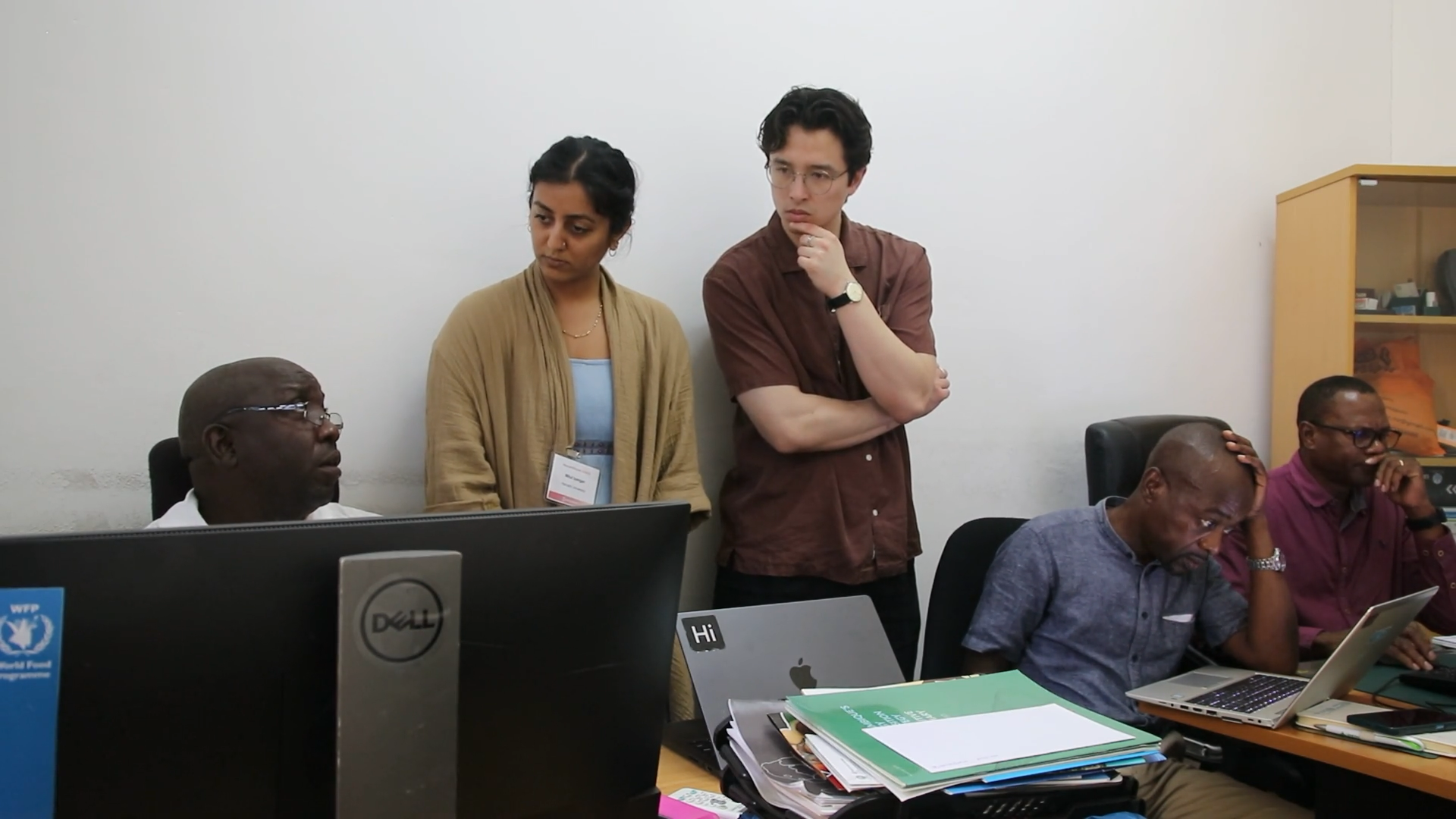
Mitul Iyengar and Luke Fiorante, MDE '26
Iyengar and Fiorante traced the full path of drought preparation from forecast to decision, mapping it against more than 100 conversations with the meteorologists, disaster managers, data scientists, and humanitarian practitioners.
“The hard part is not predicting drought,” said Iyengar. “Reliable seasonal forecasts exist, and global predictive models are multiplying. The hard part is deciding when a forecast justifies action.”
Act on a 20% probability of drought, and a country risks mobilizing millions for a rainy season that turns out fine, burning trust and budget. Wait for near certainty and the window to act has closed. Somewhere in between, a threshold must be determined. That threshold is called a trigger, and setting it is one of the most consequential decisions a country makes about disaster response – equal parts statistics, politics, and local expertise.
The stakes are not abstract. The 2023–24 El Niño brought southern Africa its worst drought on record, affecting more than 30 million people and pushing five countries to declare national disasters. A severe El Niño is now developing again in the Pacific, and the countries most exposed have a narrow window to prepare. The forecasts exist, but the greatest challenge is in deciding when to act.
In Mozambique, the researchers found that the decision works because it is owned collectively. Triggers are set by a national technical working group spanning meteorology, disaster management, agriculture, water resources, and humanitarian agencies, with the National Institute of Meteorology (INAM) leading the analysis. That working group sets the trigger by analyzing decades of climate data, verifying forecast reliability, and testing hundreds of thousands of candidate thresholds against 25 years of drought history.
“This whole process lives in spreadsheets, scripts, and the working memory of a few experts,” said Fiorante.“It is rigorous, but it is hard to see, hard to teach, and hard to replicate. We thought, what if we could build something that any nation can run on its own?”
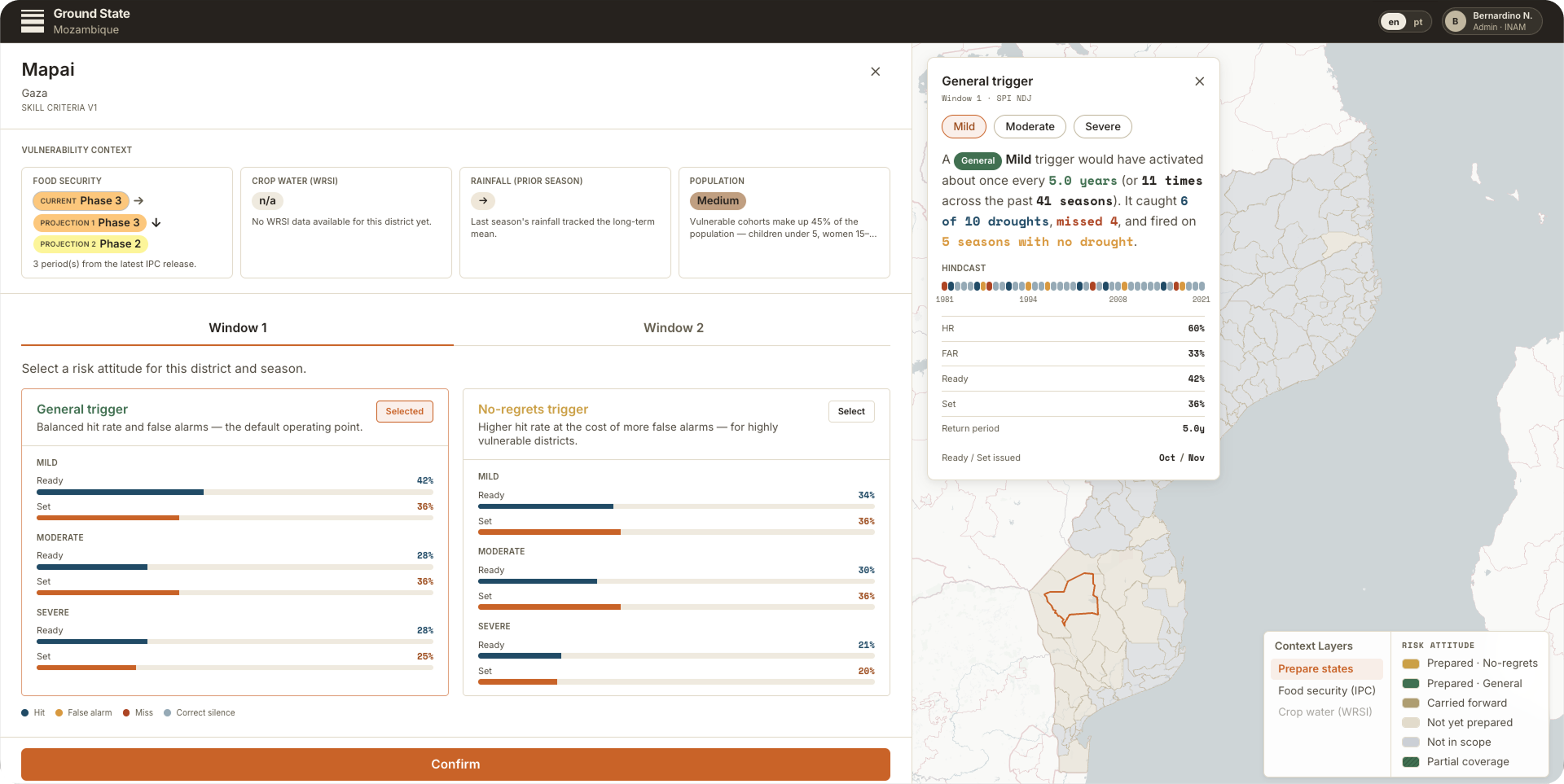
Ground State helps nations predict and prepare for droughts
The result is Ground State, a platform that turns trigger calibration from a specialist‑dependent exercise into a repeatable workflow that national meteorological services can operate independently.
Iyengar and Fiorante designed a research-grade analytical pipeline robust enough to operate without a specialist and legible enough to a user with no statistical training. Ground State builds on the peer-reviewed methodology developed by the World Food Programme (WFP) and INAM and surfaces it through an interactive map of a country's own drought history. An analyst drags a threshold and the system recomputes against a quarter-century of records in real time, showing which droughts that setting would have caught and which alerts would have been false alarms, district by district, year by year. It carries a team through the full annual cycle — calibration, in-season monitoring, after-season review — and the entire stack deploys on a single machine, with no cloud account or dedicated IT team required. It is designed for release as open-source software, so a government can stand it up, inspect every line, and own it outright.
Iyengar and Fiorante ran working sessions to refine the product with INAM meteorologists in Mozambique and WFP's analytics teams in Rome.The tool doesn’t make recommendations, rather it surfaces evidence and leaves the judgment to human decision makers. Iyengar and Fiorante are in talks with INAM to pilot Ground State in new districts in the coming drought season.
“The science to see drought coming is already here; what each country needs is its own way to decide what to do about it,” said Iyengar.
Ground State was developed as a Master in Design Engineering thesis by Mitul Iyengar and Luke Fiorante in partnership with the World Food Programme and Mozambique's National Institute of Meteorology, and was advised by Justin W Cook and Monique Fuchs.
Topics: Climate, Design, Environment, Master of Design Engineering
Cutting-edge science delivered direct to your inbox.
Join the Harvard SEAS mailing list.