News
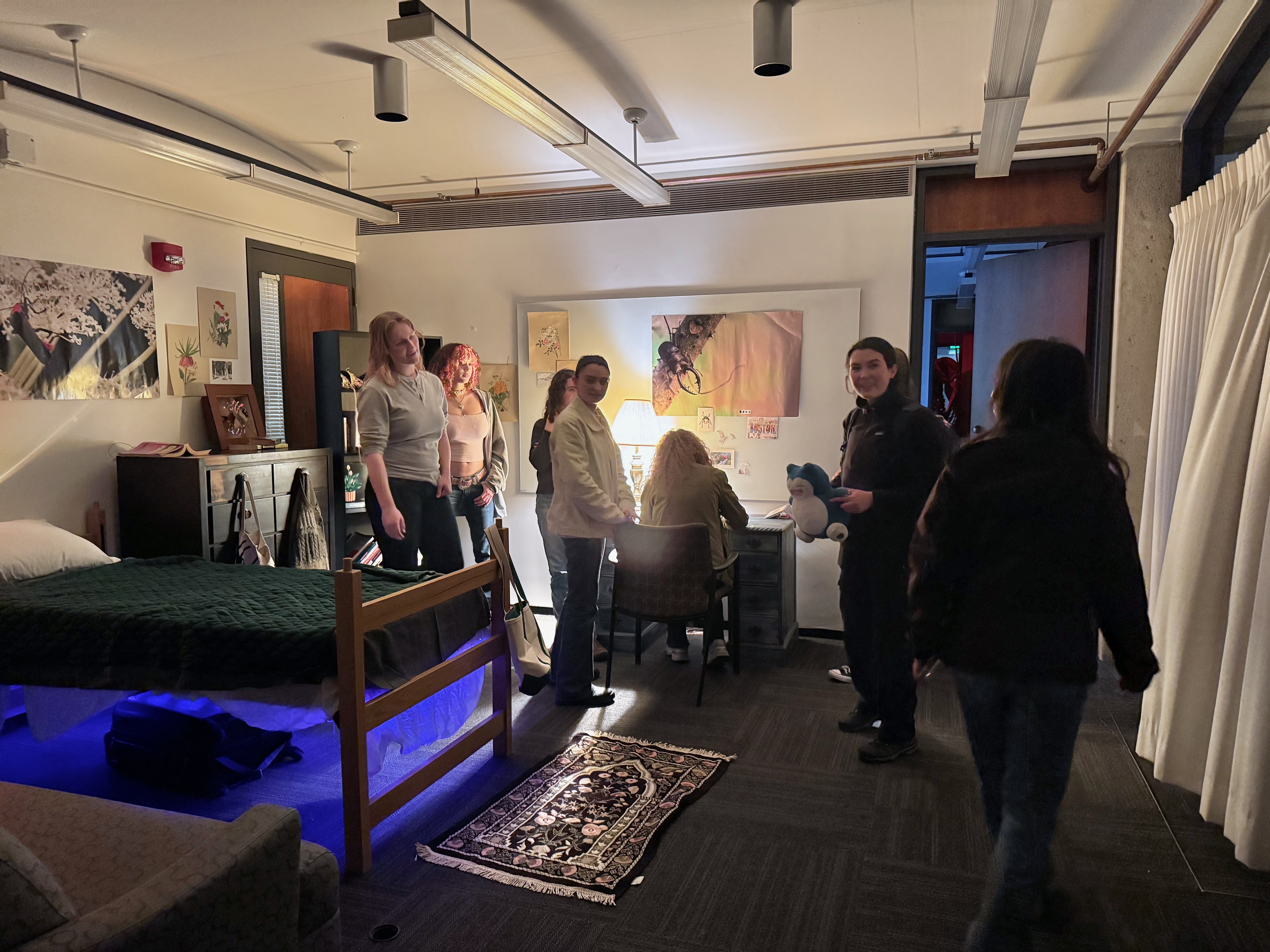
Students explore "The Magic Room," co-designed by Sara Tomas, Allen Garcia and Sophia Zhang, at Conflux's winter residency exhibition (Conflux Collective)
What makes art into art? Is it the object itself, such as a painting or marble sculpture? Or is the object just an object, and the true artistry comes from the interaction between the object and the audience? And when artificial intelligence can create artistic images in a matter of seconds, could the response be to slow down and find meaning in the rituals and habits we already do every day?
These questions are explored in “Habitual Devotion,” the 2026 winter residency for Conflux, an art-technology fusion student organization at the Harvard John A. Paulson School of Engineering and Applied Sciences (SEAS). The 10 resident fellows spent their winter session attending technical and artistic workshops, then designed four rooms meant to explore the ways in which technology can enhance how humans interact with their environment, creating artistic meaning from everyday activities and experiences. The rooms were recently on display at the Student Organization Center at Hilles Penthouse.
“We form attachments to objects and art in our lives when there’s repeated exposure and you live alongside it,” said Conflux director Ida Chen, a third-year history of art and architecture concentrator. “Humans create meaning through repetition, ritual and rhythm. The winter residency is when students can break away from the hustle and bustle of everyday life to devote time to making art and building community.”
THE MAGIC BEDROOM
Think back to the first time you went home after leaving for college. Your old bedroom might’ve been exactly as you left it, but didn’t it still feel different? Like it belonged to an older version of you, before college introduced you to new ideas and new people and new ways of life?
“The Magic Bedroom,” the first room in the exhibition, explores how familiar rooms can feel different as the person who inhabits them changes and grows. Decorated like a standard bedroom – bed, desk, bookshelf, posters on the walls – the room feels static when you first enter. But by carrying a sensor-infused stuffed animal around the room, different pieces of furniture light up with rhythmic blinking lights.
“When the person that decorated and lived in a bedroom isn’t in it anymore, it’s almost like a husk or shell,” said sophomore Sara Tomas, an electrical engineering concentrator. “And when a person returns to their room, it brings life back into it. As you walk around with the stuffie, it makes the furniture glow, which is almost like the room breathing again. I even made the lights ripple rhythmically, which is meant to evoke the room living with you.”
Tomas co-created the room with second-year electrical engineering concentrator Allen Garcia and his classmate Sophia Zhang, a statistics and comparative literature dual-concentrator. Tomas said she drew heavily on her electrical engineering coursework when designing the lighting system for her room, in particular “ES152: Circuits, Devices, and Transduction.”
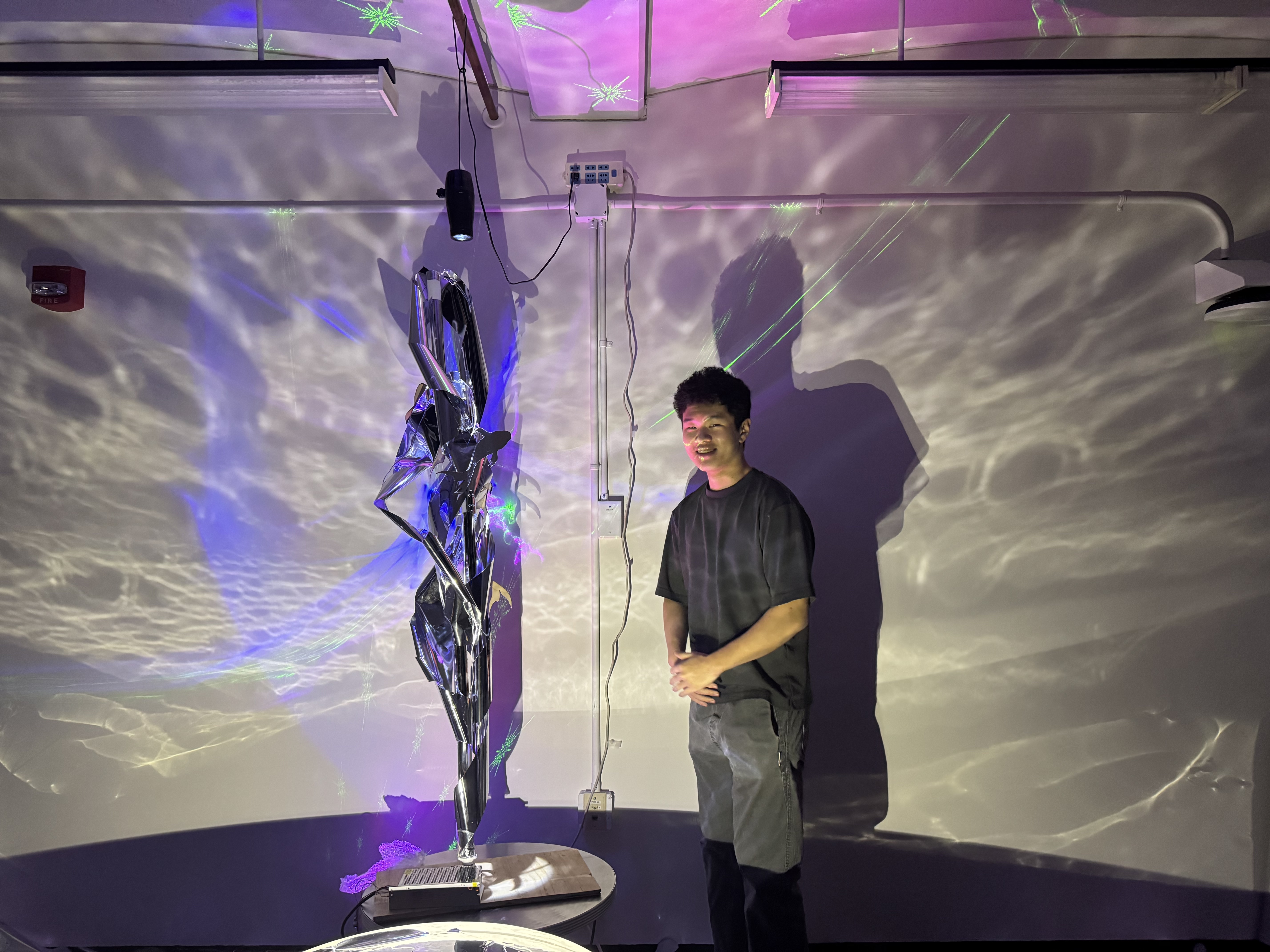
"The Meditation Room" co-designer Roger Zhu (Conflux Collective)
“Whenever I make something, I try to imbue a sense of magic in it,” Tomas said. “I think with well-designed technology, we can make something that almost evokes magic.”
THE MEDITATION ROOM
While the exhibition’s first room evokes a feeling of nostalgia, “The Meditation Room” focuses more on tranquility. Designed by Roger Zhu, a University of Virginia first-year student planning to study engineering, and Harvard Graduate School of Design student Nara Huang, the room focuses on a slowly rotating sculpture made of silver reflective siding. Lights reflected off the sculpture and a pool of water at its base, illuminating the ceiling into a moving pattern that evokes the surface of the ocean from a submerged perspective. As people move throughout the room, the speed of the sculpture’s rotation changes.
“We wanted to focus on movement, and in particular slowing things down,” Zhu said. “When you get used to things or develop habits, it almost becomes monotonous, always done at the same speed. We wanted to have the movement of the person affect the speed of the surroundings. In order to appreciate your world, you have to embrace variation and not live the same way every day.”
THE HEART ROOM
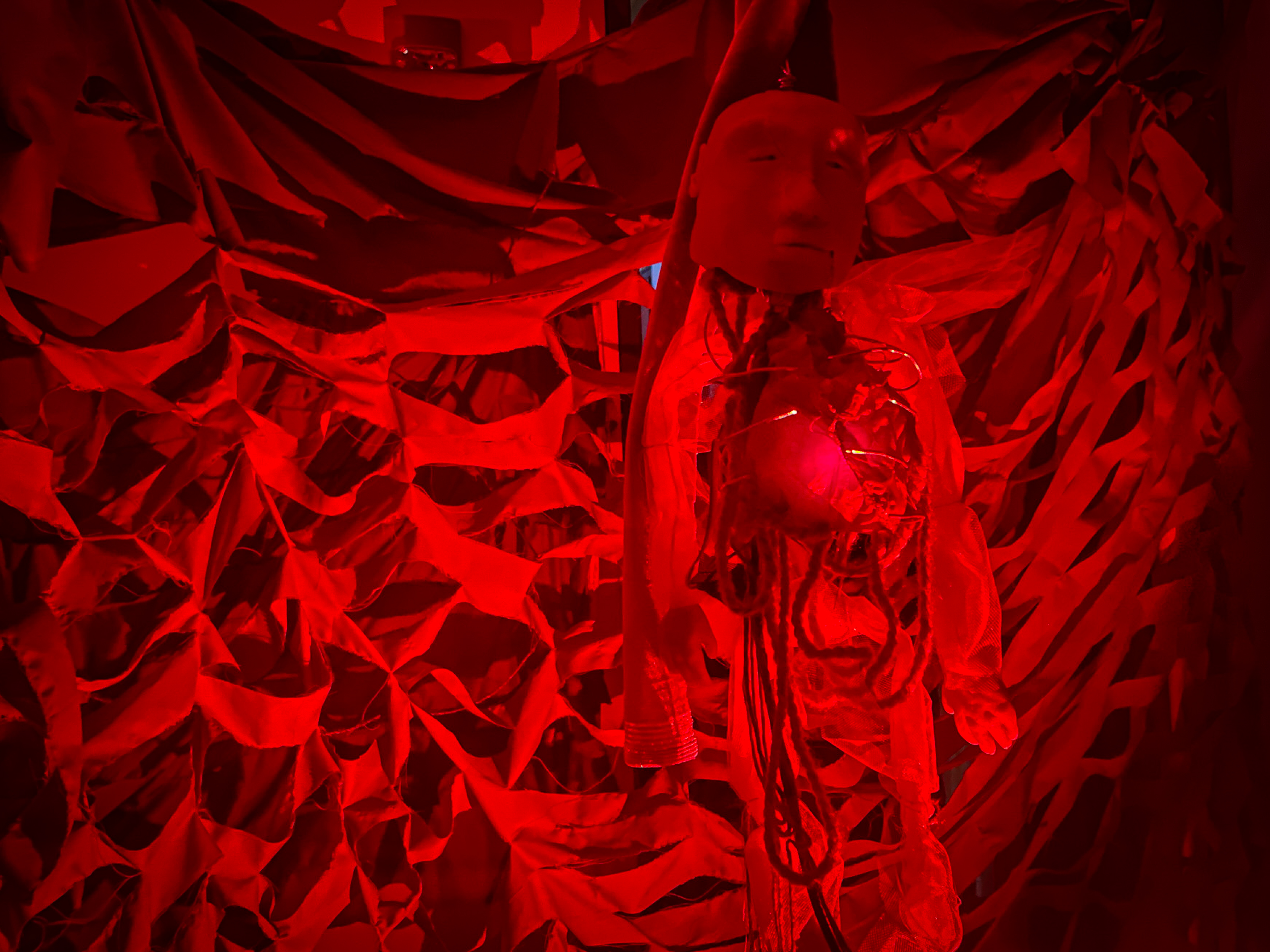
"The Heart Room," designed by Alyssa Ao, Chi Le and Carlos Salais (Eliza Grinnell/sEAS)
The openness of the first two rooms stands in stark contrast to “The Heart Room,” which feels like moving through an artery in the human body. Walls of slashed curtain create a constrictive, almost organic-looking tunnel from one end to the other, and a steady percussive sound fills the red-lit room like a heartbeat. Looking through the curtains, one can even see a doll with its miniature heart exposed.
Co-creators Alyssa Ao, Chi Le and Carlos Salais, all SEAS concentrators, used technology to make the doll’s heart beat in rhythm with the sound playing through speakers. Ao studies bioengineering while Salais studies environmental science and engineering and Le studies computer science.
“We wanted to create a contrast between the static and the dynamic, using movement and light to direct the viewer's attention toward the doll and make them wonder why it is the only thing alive in the space,” Le said. “The light was placed beneath the doll, making it the sole source of illumination in the room, which naturally pulls the eye and gives the centerpiece an almost ritualistic quality. The sound is monotonous, which feels unsettling at first but over becomes oddly soothing. We wanted to juxtapose elements that are meant to calm with a situation that feels viscerally intense, so that the viewer is never quite sure whether they are being comforted or unsettled, and whether the two feelings are even that different from each other.”
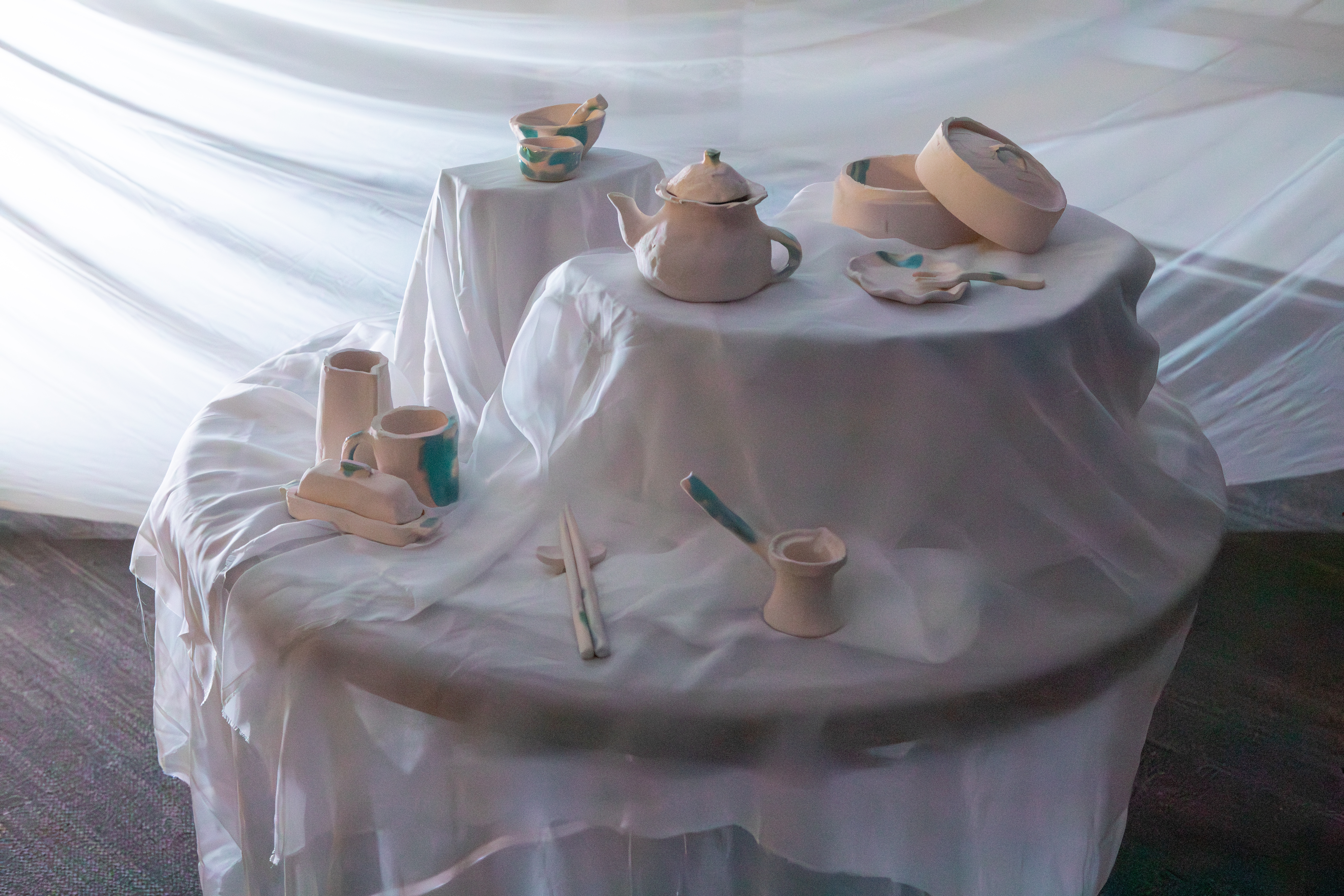
"The Dining Room," designed by Kiana Pan and Sheridan Liew (Eliza Grinnell/SEAS)
THE DINING ROOM
After the intensity of the Heart Room, the exhibit ends with the calm ritual of sharing a meal. Co-designed by Kiana Pan (Architecture and Economics) and Sheridan Liew (History of Art and Architecture and Folklore and Mythology), “The Dining Room” focuses on a table filled with hand-made ceramic dining objects such as plates, teapots and mugs. The sounds of people eating, passing plates and clinking glasses fill the room, and the creators utilized camera vision and sound extraction algorithms to make the ambient noise change depending on the location of people in the room. It’s a juxtaposition of modern technology with an ancient art form that shows the timeless ritual value of activities such as sharing a meal or cup of tea.
“I think tech has a place in art, and by combining physical media with something like audio, you can have both without one replacing the other,” Pan said. “We were interested in the idea that as the presence of technology increases, as a lot of daily processes become easier, we tend to spend the extra time with people that we love. We very deliberately block out time to get coffee, drink tea, eat dim sum, and these shared spaces for eating are common all around the world.”
Topics: Student Organizations, Technology
Cutting-edge science delivered direct to your inbox.
Join the Harvard SEAS mailing list.
Press Contact
Matt Goisman | mgoisman@g.harvard.edu