News
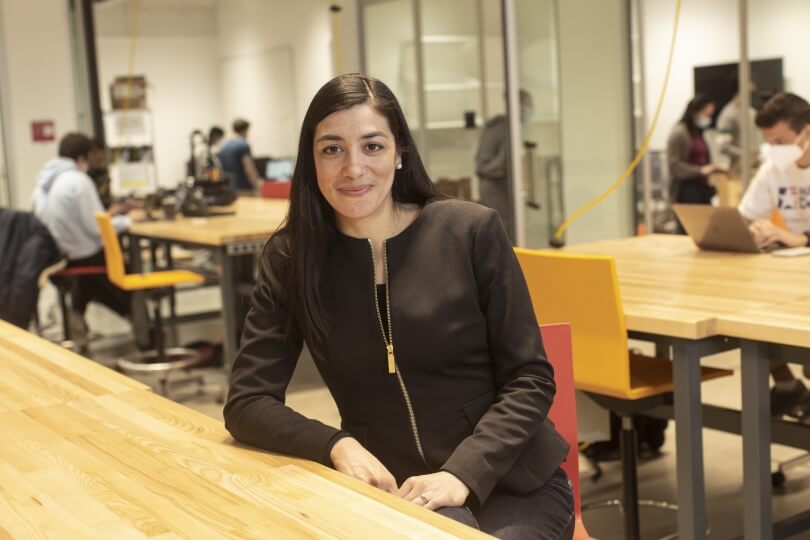
Assistant Professor of Computer Science Stephanie Gil
Stephanie Gil, Assistant Professor of Computer Science at the Harvard John A. Paulson School of Engineering and Applied Sciences (SEAS), researches how robots, drones, autonomous vehicles, and other physical agents can make decisions, coordinate with one another, and act effectively in complex real-world environments.
Much of her recent work focuses on how advances in artificial intelligence and machine learning can help autonomous systems move from controlled settings into the physical world.
The following Q&A was developed from interviews with Gil. It has been edited for clarity, length, and context.
Q: Why is it difficult to get autonomous systems, like autonomous vehicles, to work well in real-world environments?
A: One of the biggest barriers is uncertainty. When you put robots or autonomous systems into the real world, they do not have perfect information. There may be parts of the environment that are simply unknown. The data they sense directly may be incomplete. The data they receive from another robot or from the network may not be trustworthy.
But even with all of that uncertainty, the system still needs to make decisions that are helpful and useful. If it is a drone working with a search and rescue team, it needs to decide where to go next. If it is an autonomous rideshare vehicle, it needs to coordinate with other vehicles and respond to requests around a city. If it is working with marine biologists, it needs to be in the right place at the right time to collect useful data.
That question — how do you make good decisions under uncertainty — is central to a lot of the work in my group.
Q: This problem has been partly solved, right? Autonomous vehicles have been deployed for ridesharing in major cities.
A: If you think about autonomous rideshare vehicles as agents in a city, the question is not only whether each vehicle can drive safely on its own. The next phase is coordination. Can these vehicles coordinate with each other so they are in the right place at the right time? Can they reduce wait times across the city? Can they anticipate where demand will appear after a major event or during peak hours?
Seeing autonomous rideshare deployed in cities is exciting because it is an example of autonomy in the wild. But I am especially interested in the next phase, where these agents can start to coordinate with each other, with infrastructure such as intersection cameras, and with other vehicles.
We are all used to mobile networks now. We have phones and laptops that are connected to the internet all the time. The next phase is mobile systems that are also connected to each other, but that can act physically in the world: robots, drones, autonomous vehicles, boats. That could change urban mobility. It could support emergency responders. It could help us explore parts of the environment that are hard for humans to reach, from the deep sea to outer space. It could also help scientists gather data in ways that would be difficult or impossible for people to do alone.
Q: What are the risks or challenges of bringing networked robots into the physical world?
A: There is a very big upside to autonomous systems, but we also have to be responsible as researchers and understand their vulnerabilities. If an internet system is hacked or its data is poisoned, there can be negative consequences. But if the system is physical and acting in the world, the bar is even higher. We need to make sure the data has integrity, and we need decision-making algorithms whose vulnerabilities are understood and mitigated as much as possible.
One of the big questions in my group is how to make decision-making algorithms work well even in settings where there is high uncertainty and where some of the data may not be trustworthy.
We need to know what the limitations of these systems are, how they break, and how we can make sure they break gracefully. That is very important before we deploy autonomy more widely in the world.
Q: How does AI change what is possible for robots and autonomous systems?
A: I think we are at a very exciting moment because AI is starting to move from the digital world into the physical world. In robotics, we already have a lot of mathematical and algorithmic frameworks for decision making, coordination, and control. What AI and machine learning bring to the table is the ability to extract patterns and structure from data in powerful new ways.
For physical systems like robots and drones, collecting data can be expensive and difficult because the system has to interact with the physical world. So the question becomes: can we exploit as much as possible from the data we do have? Can we combine data-driven intelligence with more classical decision-making frameworks?
That combination is powerful. You can start with a model of how you expect the world to work, but the real world will never match that model exactly. AI gives us a way to supplement those models with information and patterns extracted from data. That is what could allow autonomous systems to reach their potential as part of a new mobile, networked, physical world.
Topics: AI / Machine Learning, Community, Computer Science, Electrical & Computer Engineering, Materials Science & Mechanical Engineering, Meet Our Faculty, Research, Robotics
Cutting-edge science delivered direct to your inbox.
Join the Harvard SEAS mailing list.
Scientist Profiles
Stephanie Gil
John L. Loeb Associate Professor of Engineering and Applied Sciences