News
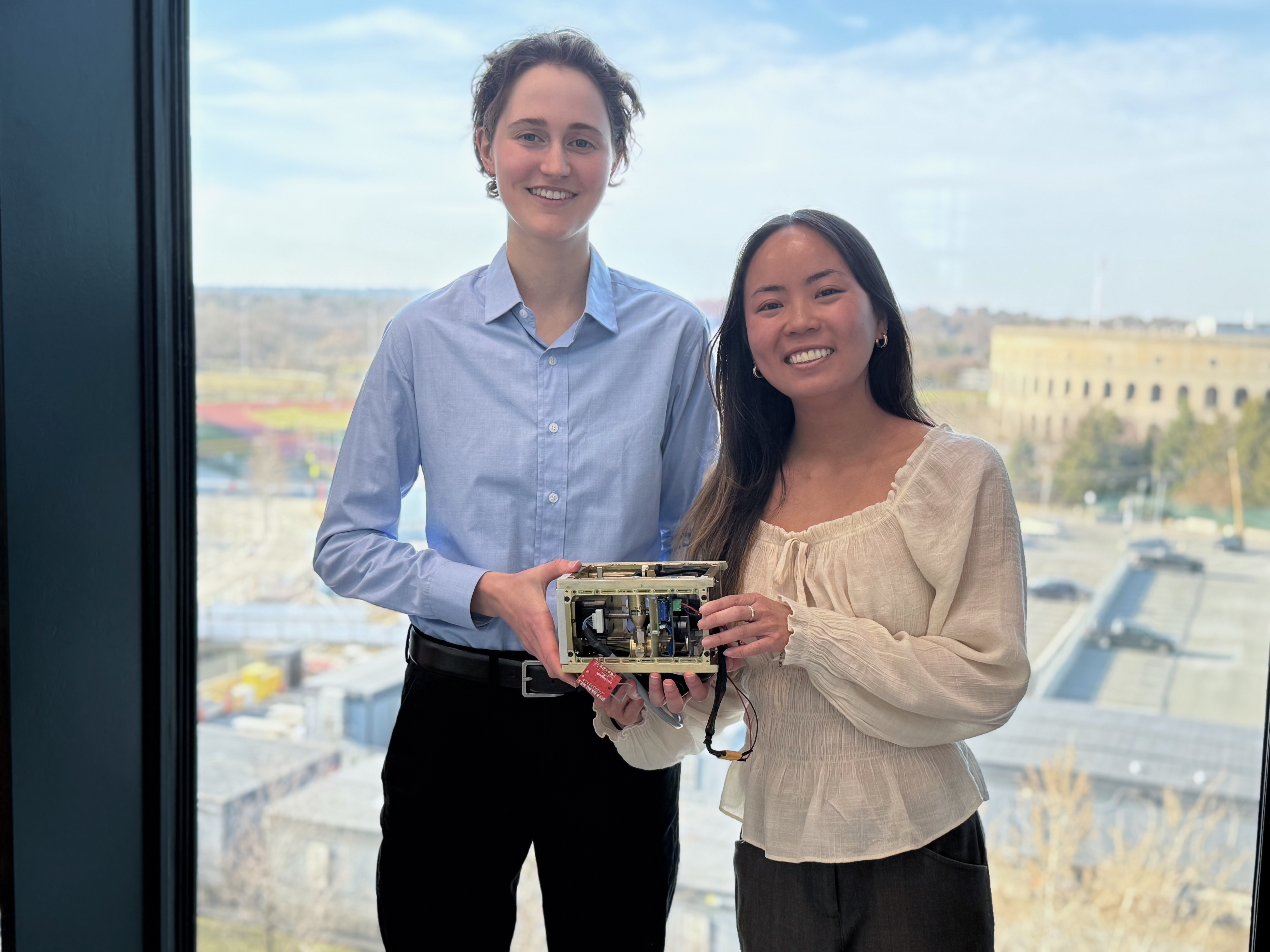
For their senior capstone project, Isabel Laguarda and Jennifer Nguyen designed a high-altitude balloon–compatible capsule for analyzing stratospheric aerosols (Matt Goisman/SEAS)
Engineering Design Projects (ES 100), the capstone course at the Harvard John A. Paulson School of Engineering and Applied Sciences (SEAS), challenges seniors to engineer a creative solution to a real-world problem.
Advancing Accessible Stratospheric Climate Research: Design of a High-Altitude Particle Exposure Analysis Pod
Jennifer Nguyen and Isabel Laguarda, S.B. '26, Mechanical Engineering
Advisor: Frank Keutsch
• Please give a brief summary of your project.
Stratospheric aerosols play a critical role in Earth’s climate system, yet controlled experimental study of their long-term behavior remains limited by the cost, complexity, and contamination potential of existing platforms. This project presents the design and prototyping of the Particle Exposure Analysis Pod (PEApod), a compact, high-altitude balloon–compatible capsule engineered to expose aerosol samples to stratospheric conditions and preserve them for post-flight laboratory analysis. The PEApod is a self-contained system that integrates with weather balloon platforms, autonomously senses its environment, and enables controlled exposure of aerosol samples to stratospheric conditions, enabling more accessible and scalable stratospheric climate research.
• What real-world challenge does your project address?
There is currently a lack of accessible, low-cost platforms for controlled, in situ study of stratospheric aerosols. Existing methods are often expensive and complex, and can introduce environmental contamination, while also being limited in their ability to both expose and preserve samples, restricting broader research in this area.
• How did you come up with this idea for your final project?
As junior mechanical engineering students, we both worked in the Keutsch Lab, an interdisciplinary group focused on understanding how atmospheric emissions impact climate and human health. Through this group, we were first introduced to the PEApod, where we initially contributed to the design of motor-driven sealing mechanisms for sample containment. With guidance from our mentors, our roles quickly expanded as the project matured, eventually leading us to our thesis project where we were able to fully flesh out the design of a modular, compact, high-altitude particle exposure device.
• What was the timeline of your project?
We familiarized ourselves with the PEApod during our junior year, immersing ourselves in atmospheric research literature and laying out our system requirements. Our fall semester of senior year was spent focusing on system design and component layout, along with initial benchmark testing where we were able to meet about half of our technical specifications. Our spring semester was dedicated to intensive testing and iteration, where we spent most of our time doing pressure leak tests and working with vacuum and temperature chambers, allowing us to meet the majority of our remaining requirements. We are now preparing for a full flight test later this spring to validate the system end-to-end.
• What part of the project proved the most challenging?
The most challenging part was working at such a small scale. Meeting the size constraint seemed like it would be the easiest requirement compared to things like pressure sealing or environmental testing, but we quickly learned that finding components that could fit within a 10 cm x 10 cm footprint – especially coming from experience with much larger mechanical systems – was difficult, and assembling and troubleshooting such a compact design often made even simple tasks more complex.
• What part of the project did you enjoy the most?
We most enjoyed the testing and data collection phase. There’s something really satisfying about predicting how the system should behave, imagining what the data curves will look like, and then pulling data from the SD card and seeing it match those expectations. There were, of course, many many iterations that did not align, which made the final iterations when everything began to fit even more rewarding.
• What did you learn, or skills did you gain, through this project?
We learned so much through this project, both from the work itself and from the guidance of our mentors and advisors. Beyond the core requirements, our team was great in enabling us to grow as engineers in areas such as GD&T (Geometric Dimensioning and Tolerancing) drawings, FEA (Finite Element Analysis) simulations, and electrical schematics. Additionally, designing for and working within the constraints of the stratosphere was a completely new and valuable experience for us.
Topics: Academics, Environment, Materials Science & Mechanical Engineering
Cutting-edge science delivered direct to your inbox.
Join the Harvard SEAS mailing list.
Press Contact
Matt Goisman | mgoisman@g.harvard.edu
Related News
Applying AI to Accelerate Design, Test and Manufacture
University of Washington Mechanical Engineering
AI / Machine Learning, Applied Physics, Computer Science, Electrical & Computer Engineering, Materials Science & Mechanical Engineering, Meet Our Faculty, Research, Technology