News
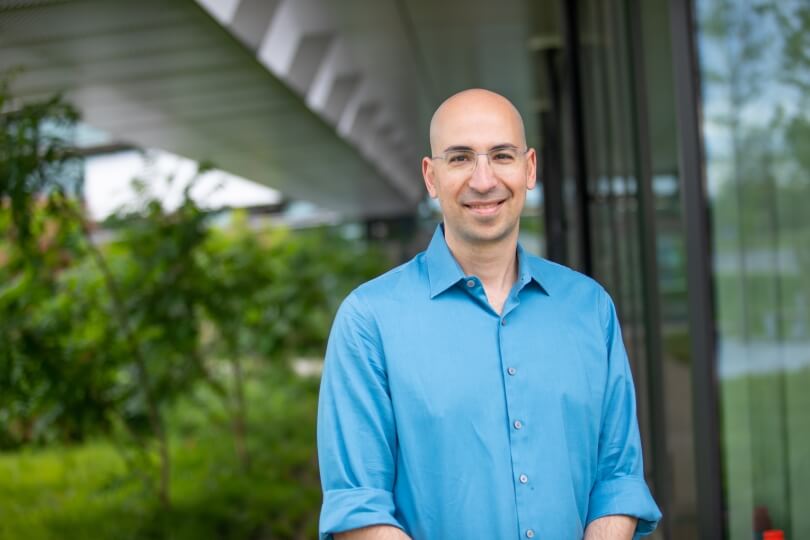
Ariel Procaccia, the Alfred and Rebecca Lin Professor of Computer Science in the Harvard John A. Paulson School of Engineering and Applied Sciences (SEAS), has been named a Harvard College Professor.
The professorships, which were awarded to five senior faculty members across the Faculty of Arts and Sciences and SEAS, recognize excellence in undergraduate teaching and helping students “develop their intellectual passions.”
Procaccia investigates “broad and dynamic problems” related to artificial intelligence, economics, and society, and has made substantial contributions to “undergraduate understanding of these increasingly impactful intersections through such topics as matching and exchange, fairness in machine learning, and the algorithmic foundations of democracy.”
He is part of the EconCS Group, a theoretical and experimental group at the intersection of economics and computation, with a personal focus on problems related to AI, algorithms, economics, and society. When he thinks about the areas that most excite him — as well as the ones he shies away from — they trace back to the best and worst teachers he encountered as an undergraduate or even in high school.
It’s why he takes both facets of his job so seriously.
“Research always takes a lot of time, but teaching is a big part of why we’re here, and it’s really important to me,” Procaccia said. “It’s pretty amazing to see the impact teachers have.”
Procaccia devotes much of his attention to questions of fairness, and he helped develop a not-for-profit online tool called Spliddit to enable people to harness the power of computer science, mathematics, and economics to fairly divide everything from Halloween candy and taxi fares to artwork and rent.
At Harvard, he has taught three courses: “Artificial Intelligence,” “Economics and Computation,” and “Optimized Democracy.” He had previously taught the introduction to AI at Carnegie Mellon University before coming to Harvard in 2020, and he inherited the “Economics and Computation” course here from colleague David Parkes, after Parkes became dean of SEAS.
But the third class — officially a graduate offering but perennially popular with undergrads, who fill half the seats — has become Procaccia’s signature course, tapping his interest in fairness and applying mathematical and algorithmic tools to the tenets of democracy, such as voting rules, redistricting, delegating, and representation. He appreciates the discussion afforded by the relatively small size, with the class capped at 45 students, though as many as 230 a semester have petitioned for admission.
“The first time I did it, I was awed by the quality of the discussion. It’s something I think can only be done at an institution of this caliber. The students are exceptionally gifted at communicating, and they’re incredibly broad, so they can bring insights from many different areas,” he said, marveling at the diverse perspectives of double-concentrators and of international students relaying the different forms of governing in their home countries. “It’s something that’s really special about Harvard.”
Hopi Hoekstra, Edgerley Family Dean of the FAS, announced this year’s Harvard College Professors at the May 5 meeting of the faculty. Besides Procaccia, they are:
Daniel Carpenter, Allie S. Freed Professor of Government
Jeff W. Lichtman, Jeremy R. Knowles Professor of Molecular and Cellular Biology and Santiago Ramón y Cajal Professor of Arts and Sciences
Hannah Marcus, Professor of the History of Science
Samantha Matherne, Professor of Philosophy
Read more at the FAS Current.
Topics: Academics, AI / Machine Learning, Computer Science, Meet Our Faculty
Cutting-edge science delivered direct to your inbox.
Join the Harvard SEAS mailing list.
Scientist Profiles
Ariel Procaccia
Alfred and Rebecca Lin Professor of Computer Science
Press Contact
Anne J. Manning | amanning@seas.harvard.edu