News
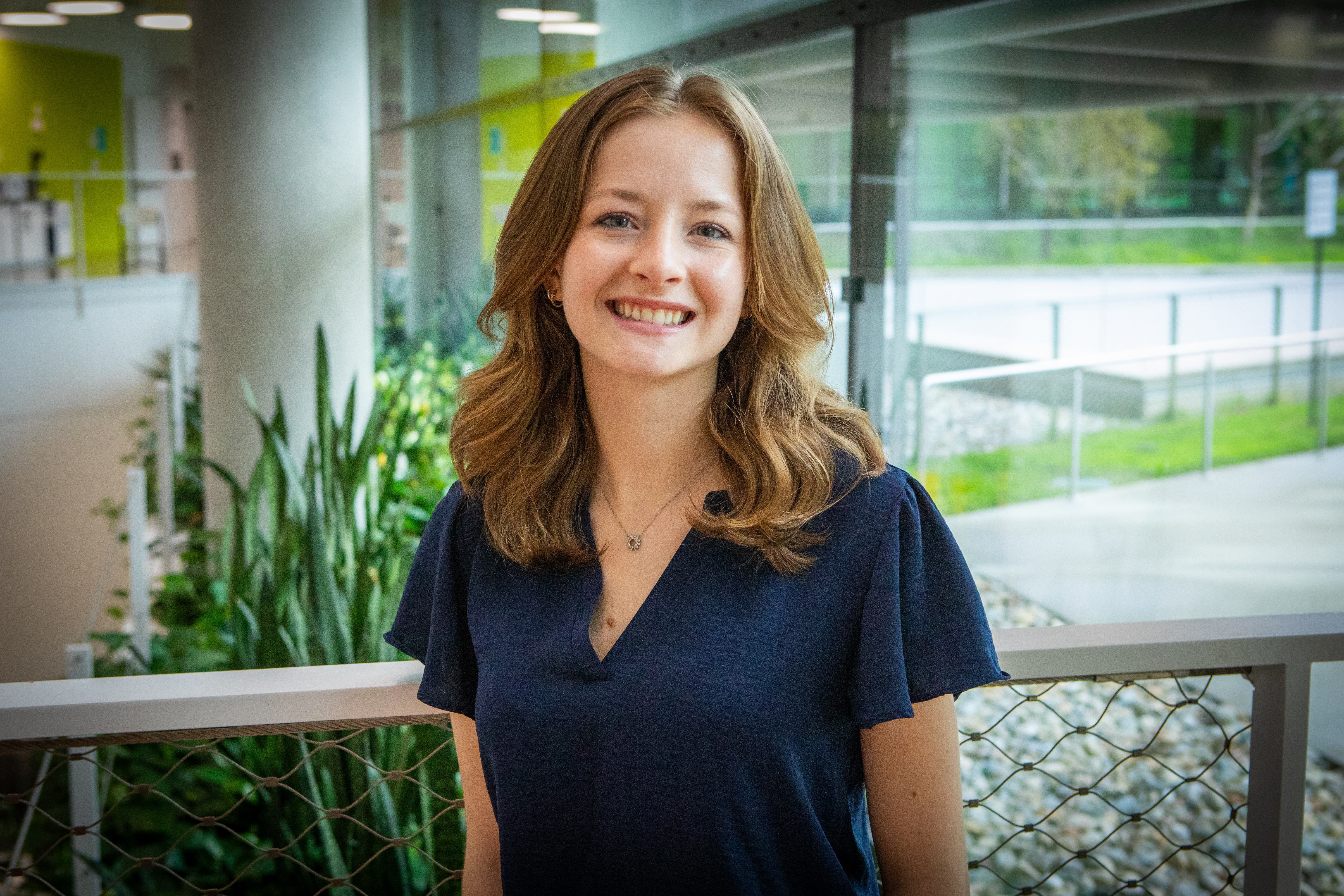
For her senior capstone project, Leah Lourenco developed a system for manufacturing immune cells for inflammatory bowel disease (Eliza Grinnell/SEAS)
Engineering Design Projects (ES 100), the capstone course at the Harvard John A. Paulson School of Engineering and Applied Sciences (SEAS), challenges seniors to engineer a creative solution to a real-world problem.
Microgel-Based Expansion of gamma delta T-cells with Tissue-Healing Bias for Inflammatory Bowel Disease Research
Leah Lourenco, S.B. '26, Bioengineering
Advisor: David Mooney
• Please give a brief summary of your project.
Inflammatory bowel disease, or IBD, is characterized by immune cells that attack the patient’s own tissue, and millions of people worldwide are impacted. However, many patients continue to experience symptoms despite the medications currently available. My project focuses on gamma delta T-cells, a type of immune cell that naturally resides in the gut and has strong potential as an off-the-shelf IBD cell therapy. However, current platforms for manufacturing gamma delta T-cells do not support the expansion rates and phenotype control necessary for researchers to develop treatments. To address that, my design utilizes a 3D alginate microgel system to leverage the impact of a mechanical environment on gamma delta T-cell behavior. Furthermore, biochemical signals like cytokines and embedded antibodies are used to control the gamma delta T-cells. My project aims to enable gamma delta T-cell manufacturing, making them a more accessible and feasible option for researchers developing IBD treatments.
• What real-world challenge does your project address?
Over 40% of IBD patients continue to experience symptoms even while taking available medications. The ultimate goal of the project is to address the staggering population of patients who continue to experience symptoms by introducing a new, adaptive therapeutic to the IBD market.
• How did you come up with this idea for your final project?
My interest in this project came from both my personal connection to IBD and my passion for immunoengineering. I was diagnosed with Crohn’s Disease, a subtype of IBD, the summer before I started college, and I was personally impacted by medication not being effective. During my undergraduate research, I became fascinated by immunoengineering, and the idea that researchers can use a variety of different signals to influence immune cells in clinically useful ways. When I joined the Mooney Laboratory, I was exposed to the potential of gamma delta T-cells for IBD and I knew that I wanted to explore how those cells could be used as a novel therapeutic option for IBD patients.
• What was the timeline of your project?
I began learning about gamma delta T-cells in the spring of 2025 and continued throughout the summer, eventually leading me to focus more on the potential design of the manufacturing platform. From September to November, I spent a significant amount of time troubleshooting the fabrication of my microgel system. In the spring of 2026, I was focused on optimizing my system design to best meet my expansion and phenotype control goals, before testing my final prototype in February and March.
• What part of the project proved the most challenging?
The most challenging phase of my project was the period where I was troubleshooting my fabrication technique for several months. Scientifically, it was difficult because I had to figure out exactly what was causing the problem. Mentally, it was also challenging because I was really excited to move into the optimization and testing process, but I felt stuck at an early stage. In the end that experience became a really useful lesson in persistence and problem solving. Eventually, after making some modifications to the original design, the microgel system was fabricated successfully.
• What part of the project did you enjoy the most?
The deeper I got into my project, the more I enjoyed it, and before I knew it the project timeline was coming to a close! As I tested different iterations of my design, I started seeing experimental groups that produced unexpected results and I was imagining new parameters to vary. Those moments were the most meaningful and exciting because I truly felt myself thinking like a scientist. I began to wish I had another year just to explore all of the new possibilities that I had imagined.
• What did you learn, or skills did you gain, through this project?
I have never had the experience of directing a research project to the extent I was enabled with my ES100 project. Each week it was my responsibility to determine my next steps as the project became more and more my own. Through that process I learned how to take charge in a research project by conducting literature reviews, planning experimental designs, and iterating thoughtfully. Overall, I learned how to take ownership of scientific questions and independently direct an engineering design project. I look forward to carrying these lessons into my future career as a scientist!
Topics: Academics, Bioengineering, Health / Medicine
Cutting-edge science delivered direct to your inbox.
Join the Harvard SEAS mailing list.
Press Contact
Matt Goisman | mgoisman@g.harvard.edu