News
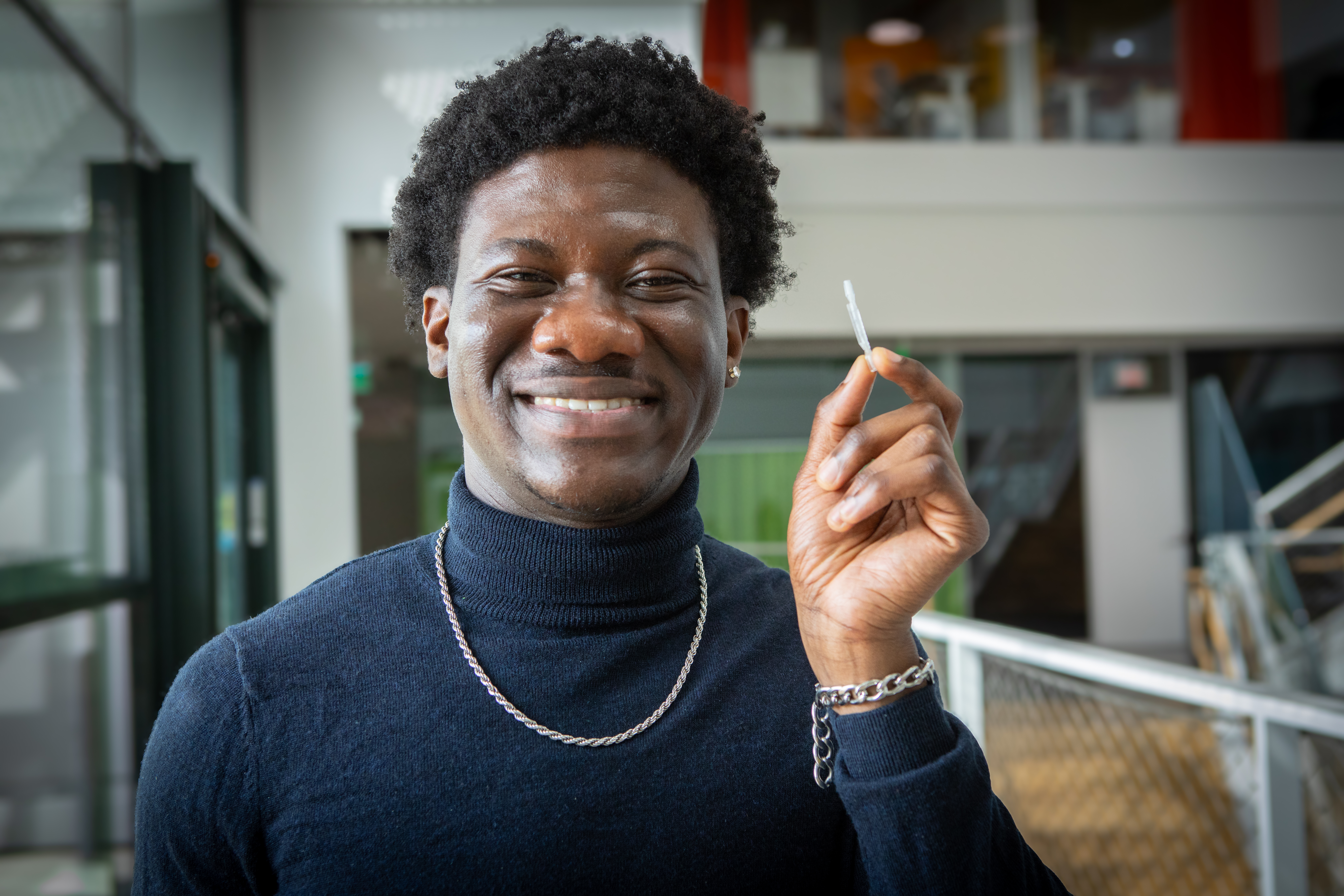
For his senior capstone project, Kow Simpson designed an in vitro system for modeling chronic kidney disease (Eliza Grinnell/SEAS)
Engineering Design Projects (ES 100), the capstone course at the Harvard John A. Paulson School of Engineering and Applied Sciences (SEAS), challenges seniors to engineer a creative solution to a real-world problem.
Engineering A Perfusable Tubuloid-on-a-Chip Model of Kidney Fibrosis
Kow Simpson, S.B. ‘26, Bioengineering
Advisor: Joseph Bonventre
• Please give a brief summary of your project.
Chronic kidney disease (CKD) is characterized by a progressive loss of renal function driven by maladaptive cellular responses and fibrosis. While injured kidney cells are known to secrete profibrotic factors that activate fibroblasts, the specific mechanisms governing the transition from recovery to chronic disease remain poorly understood, and targeted mechanistic treatments are currently lacking. My project proposes the development of an in vitro system designed to use differentiated kidney proximal tubule cells to provide a physiologically relevant and consistent framework. This platform aims to reduce reliance on animal testing and accelerate the investigation of tissue-level mechanisms essential for developing effective CKD interventions.
• What real-world challenge does your project address?
Fibrosis of major organs is implicated in approximately 50% of all deaths, so it was surprising to me that so few platforms existed for studying it using differentiated cells. This gap motivated my project, as patients, researchers, and clinicians would all benefit from the development of a more physiologically accurate research tool capable of better modeling disease progression and identifying potential therapeutic targets.
• How did you come up with this idea for your final project?
My project is directly related to research I was already conducting on the relevance of the biomarker Kidney Injury Molecule-1 (KIM-1) in 3D tissue culture methods in the Joseph Bonventre Lab at Brigham and Women’s Hospital. It serves as a practical application of discoveries already made in the lab, translating those findings into a more structured and reproducible experimental platform and going further for application to CKD.
• What was the timeline of your project?
The ideation process for my project began in the summer of 2025. Of the subsequent phases, design and fabrication took the longest, as numerous components required iteration and informed redesign. However, the investment of time in the build and design phase were validated in the testing phase, as there were less problems by then.
• What part of the project proved the most challenging?
The most challenging aspect of my project was defining the technical specifications. This was difficult not because setting standards was inherently hard, but because it was critical that each specification remain meaningfully tied to the project's overarching goal. If the specifications are arbitrarily set, then it is possible that you can complete the entire project without meaningfully solving the original problem.
• What part of the project did you enjoy the most?
I most enjoyed presenting my project. Communicating my work to an audience pushed me to articulate complex ideas clearly and defend my design decisions, and I found the critical feedback from peers and evaluators genuinely valuable. Engaging with questions also helped me identify aspects of the project I had not fully considered, which I see as an important part of the scientific process.
• What did you learn, or skills did you gain, through this project?
I learned an enormous amount over the course of this project, spanning cell culture techniques, device fabrication, and mechanical characterization. My favorite newly acquired skill is rheometry, which is the measurement of how materials flow or deform under strain. It helped me better understand all the other projects involving hydrogels.
Topics: Academics, Bioengineering, Health / Medicine
Cutting-edge science delivered direct to your inbox.
Join the Harvard SEAS mailing list.
Press Contact
Matt Goisman | mgoisman@g.harvard.edu