News
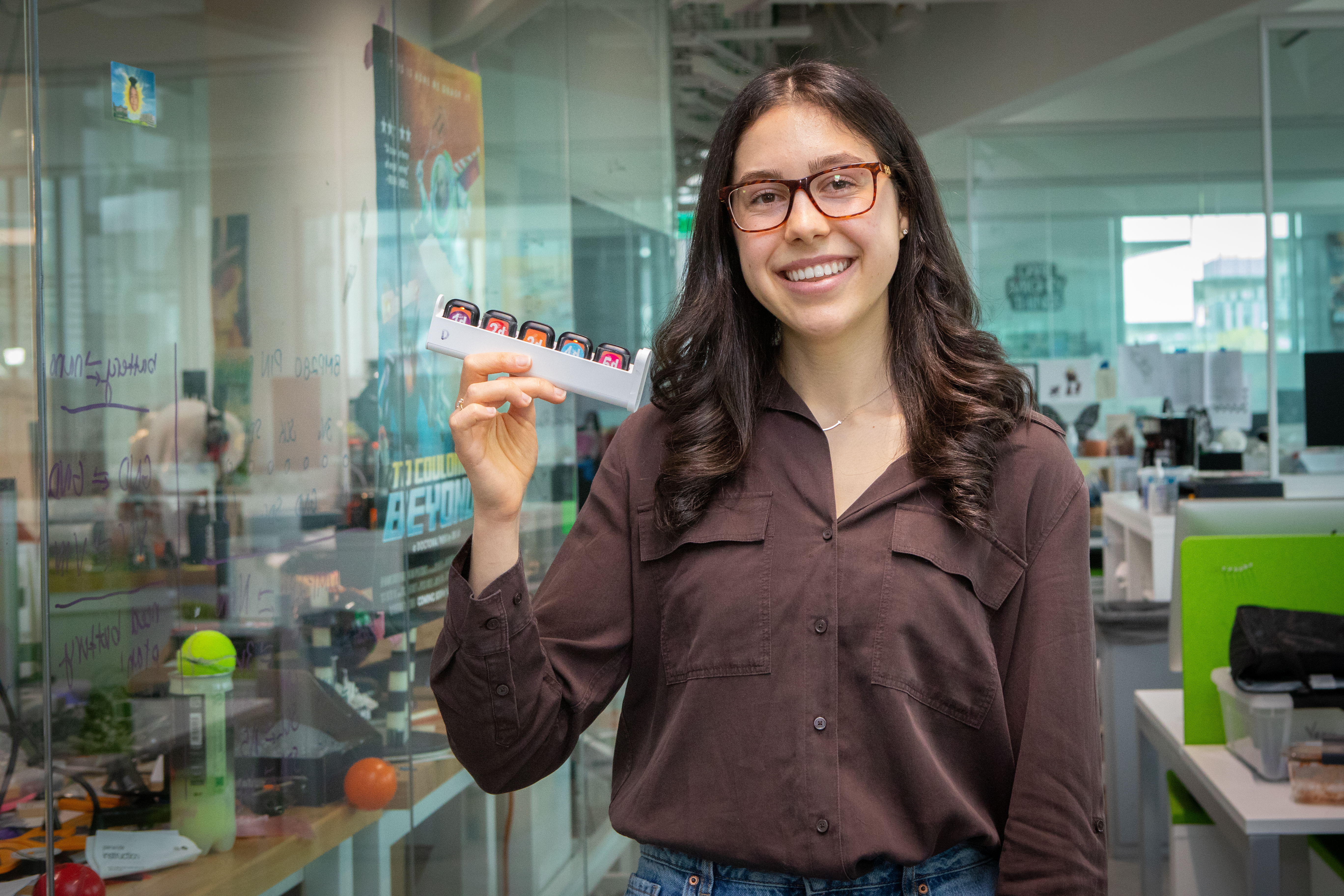
Alissia Di Maria, S.M. '26, in data science (Eliza Grinnell/SEAS)
As a neuroscience major and computer science minor at McGill University, Montreal native Alissia Di Maria approached human health from a range of lenses. She analyzed health biometric data from older adults to identify profiles associated with early-onset dementia; decoded brainwave recordings of mice navigating their environment to better understand our own spatial memory systems; and classified stages of sleep from raw brain signals to uncover the biological patterns hidden within them.
From those three experiences, Di Maria came to a clear realization: understanding human health starts with understanding data.
“That process of going from a raw signal to something biologically meaningful showed me that there are patterns in our biology that can be decoded using computation and math, which made me then ask how much more we can uncover about our own physiology, and at what scale,” she said. “The value isn’t just in collecting the data – it's in decoding it and putting it to practical use.”
To take that question further, Di Maria came to the Harvard John A. Paulson School of Engineering and Applied Sciences (SEAS), where she joined the data science master’s degree program. Throughout her degree, Di Maria has turned her interests in health and data into research opportunities with both the Data to Actionable Knowledge Lab (DtAK) and Harvard Biodesign Lab at SEAS.
“Having done research throughout undergrad, I knew I wanted to be in a place with a strong research culture that pushed independent thinking, and SEAS had that,” she said. “The breadth of problems that were being explored across engineering and data science, and the flexibility to follow your own curiosity, was really exciting to me and made the program stand out. It was the opportunity to build on the technical skills I developed at McGill, work with real-world data on problems that matter, and be surrounded by people from different backgrounds who I could learn from and who were genuinely passionate about what they do.”
At the Harvard Biodesign Lab, run by Conor Walsh, Paul A. Maeder Professor of Engineering and Applied Sciences, Di Maria worked with post-stroke patients. Paralysis on one side of the body is a common consequence of stroke, and recovery is slow. Occupational therapists typically see patients once a week and rely on self-reporting to understand what’s happening in between, which is often unreliable.
“We continuously monitored participants at home using Apple Watches on each wrist,” she said. “My role was to build algorithms that quantified functional versus passive arm use throughout their day, and detected when they were doing their prescribed exercises and for how many reps.”
The project brought Di Maria face to face with the people behind the data.
“We had one participant who was convinced they had never used their affected arm, but the data told a different story,” she said. “When we told them they were using it more than they thought, that was incredibly motivating for them. I saw how empowering continuous monitoring can be.”
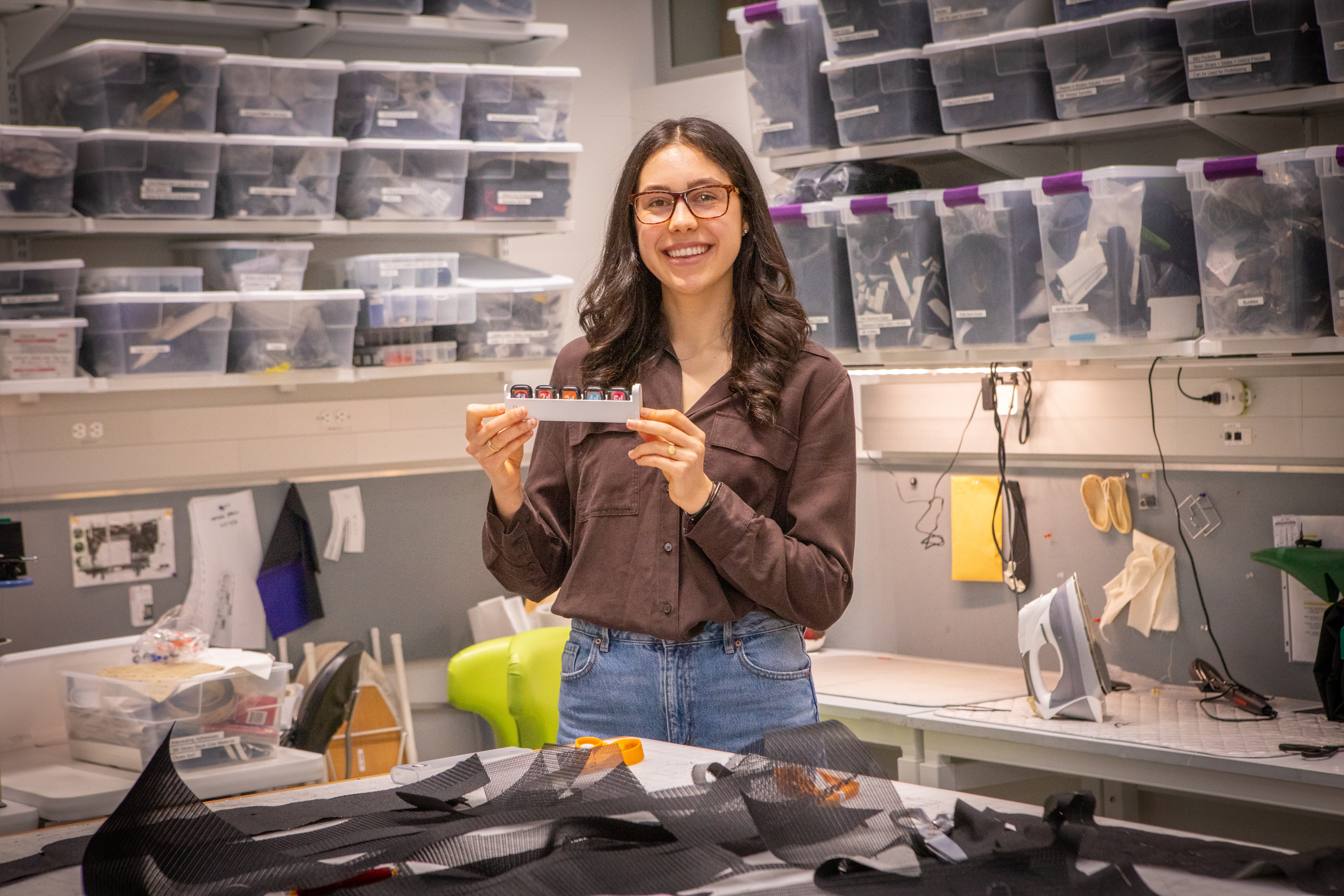
As a member of the Harvard Biodesign Lab, Alissia Di Maria analyzes data from smartwatches placed on the wrists of patients recovering from strokes (Eliza Grinnell/SEAS)
Before joining the Biodesign Lab, Di Maria spent two semesters at DtAK, working with Finale Doshi-Velez, Herchel Smith Professor in Computer Science to explore the potential harms of artificial intelligence systems, and what testing methods might prevent that.
“Before diving into building these systems myself, I wanted to understand where they could go wrong,” she said. “In healthcare, we see now more than ever how AI is being integrated into clinical settings, including tools making recommendations that affect real people. My research at DtAK was an opportunity to really sit with the question: where do these systems fail, and how do we build them responsibly? I spent time distilling human-computer interaction and machine learning research to understand failure points from a technical standpoint, but also a human one. The output was a framework for assessing foreseeable harms in adaptive AI systems and matching them to the right testing environments before deployment at scale.”
For her master’s capstone project, Di Maria worked with WurQ, a Harvard-backed start-up spun out of the Biodesign Lab that helps athletes optimize their training through advanced movement tracking and analytics. Their app includes a conversational agent athletes can interact with directly. The project drew on Di Maria’s background in machine learning, developed through her work at DtAK and as an undergraduate researcher at the Quebec Artificial Intelligence Institute.
“Their conversational AI could only access one session at a time,” she said. “The goal was to change that - to build a system that could reason across a user’s entire wearable data history and deliver more personalized insights to help them reach their goals.”
After graduating, Di Maria plans to continue working in the wearable technology space and is hoping to take her experiences in Walsh’s lab to a company where she can turn real-world data into actual products people can use. Longer term, she hopes to be part of the broader public conversation about how data and technology can redefine how people experience their health.
“What I keep coming back to is this idea of proactiveness over reactiveness in health,” she said. “We don't have to wait for something to go wrong to understand what's happening inside of us. I deeply believe that we operate from the inside out - to be our best, we need to feel our best. Gaining independence, agency, knowledge, awareness of what's going on inside our bodies, or even just having the choice to do so, is powerful. I think wearables are how we get there.”
Topics: AI / Machine Learning, Data Sciences, Graduate Student Profile, Health / Medicine
Cutting-edge science delivered direct to your inbox.
Join the Harvard SEAS mailing list.
Press Contact
Matt Goisman | mgoisman@g.harvard.edu