News
Engineering Design Projects (ES 100), the capstone course at the Harvard John A. Paulson School of Engineering and Applied Sciences (SEAS), challenges seniors to engineer a creative solution to a real-world problem.
A Compact Point-of-Care System for Real-Time Mitochondrial Physiology Monitoring
Konstantinos Maliaris, S.B. '26, Electrical Engineering
Advisor: Vamsi Mootha
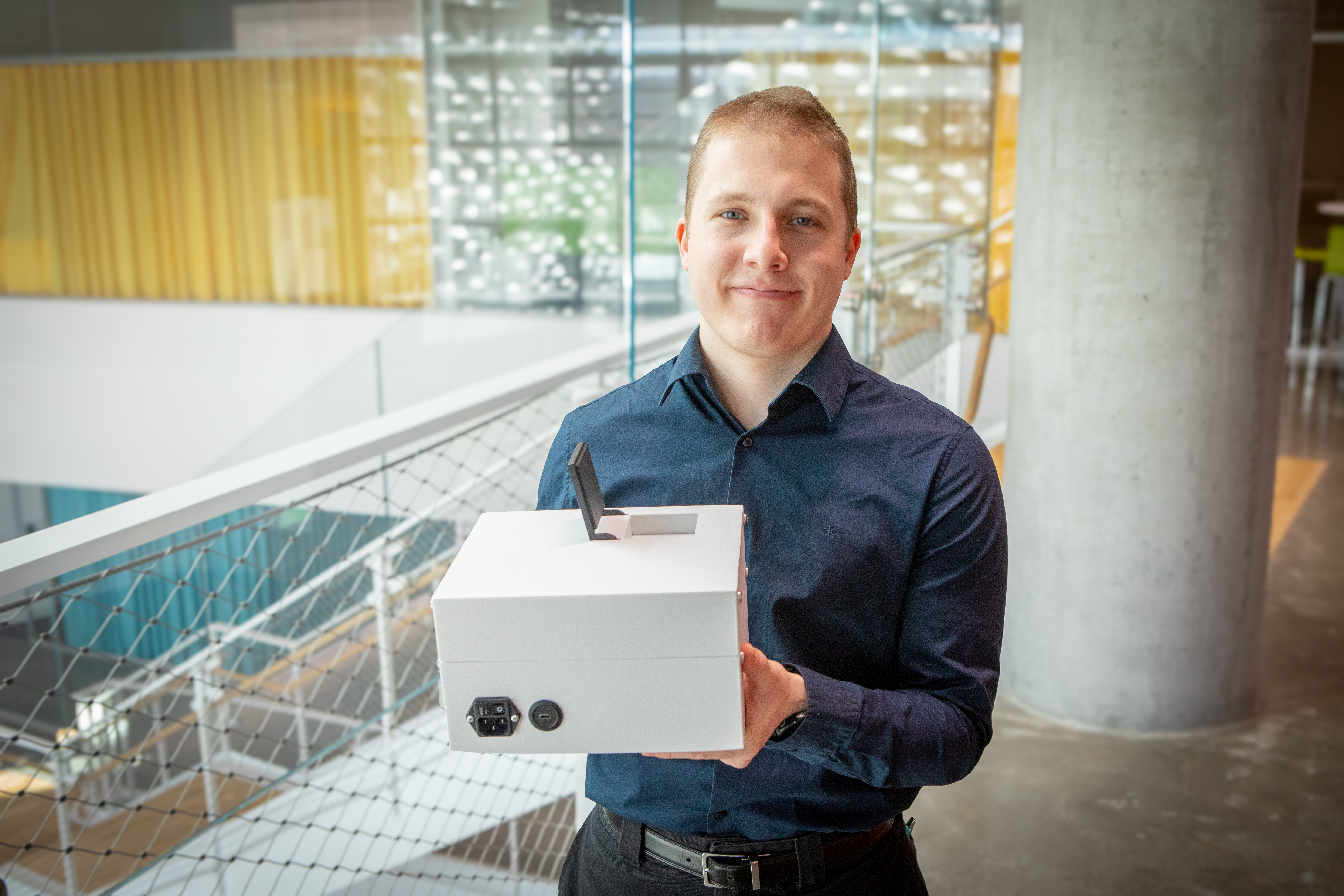
For his senior capstone project, Konstantinos Maliaris devised a more accurate way to test mitochondria in cells (Eliza Grinnell/SEAS)
• Please give a brief summary of your project.
This is a device that's meant to be used in molecular biology research to study the physiology of live mitochondria. Mitochondria are in most human cells. They're very important to metabolism, to converting the molecules derived from food into energy that the rest of the cell can use. They're critical to our very existence. Biomedical researchers will use this product, and it tells them whether a mitochondrial sample from a patient or test subjects are healthy or not, and whether they react in a healthy way to stimuli.
• What real-world challenge does your project address?
The portability is important because this is meant to be a very low-cost instrument that can be used all over the world. There are over 300 mitochondrial diseases, that are usually misdiagnosed. Patients with these diseases usually have to go through an average of eight different physicians to be diagnosed correctly, and more than half of them are initially misdiagnosed. This would be used to accelerate the diagnosis process, but also the research that's essential to us learning more about how to cure these diseases and how to make the lives of all of these patients better.
• How did you come up with this idea for your final project?
For the last two years, I've been working with the Mootha Lab at MGH, and the research interest of the group is to study metabolism and mitochondria. So it was just a natural progression to go from working with this research group to creating this prototype and this device for my senior thesis.
Maliaris's work was recognized with a Dean's Award for Outstanding Engineering Projects.
Topics: Academics, Electrical & Computer Engineering, Health / Medicine
Cutting-edge science delivered direct to your inbox.
Join the Harvard SEAS mailing list.
Press Contact
Matt Goisman | mgoisman@g.harvard.edu