News
Engineering Design Projects (ES 100), the capstone course at the Harvard John A. Paulson School of Engineering and Applied Sciences (SEAS), challenges seniors to engineer a creative solution to a real-world problem.
Self-Assembling Protein Nanoparticles for HSPC-targeted Gene Editor Delivery
Omolivie Eboreime, S.B. '26, Bioengineering
Advisor: Feyisayo Eweje
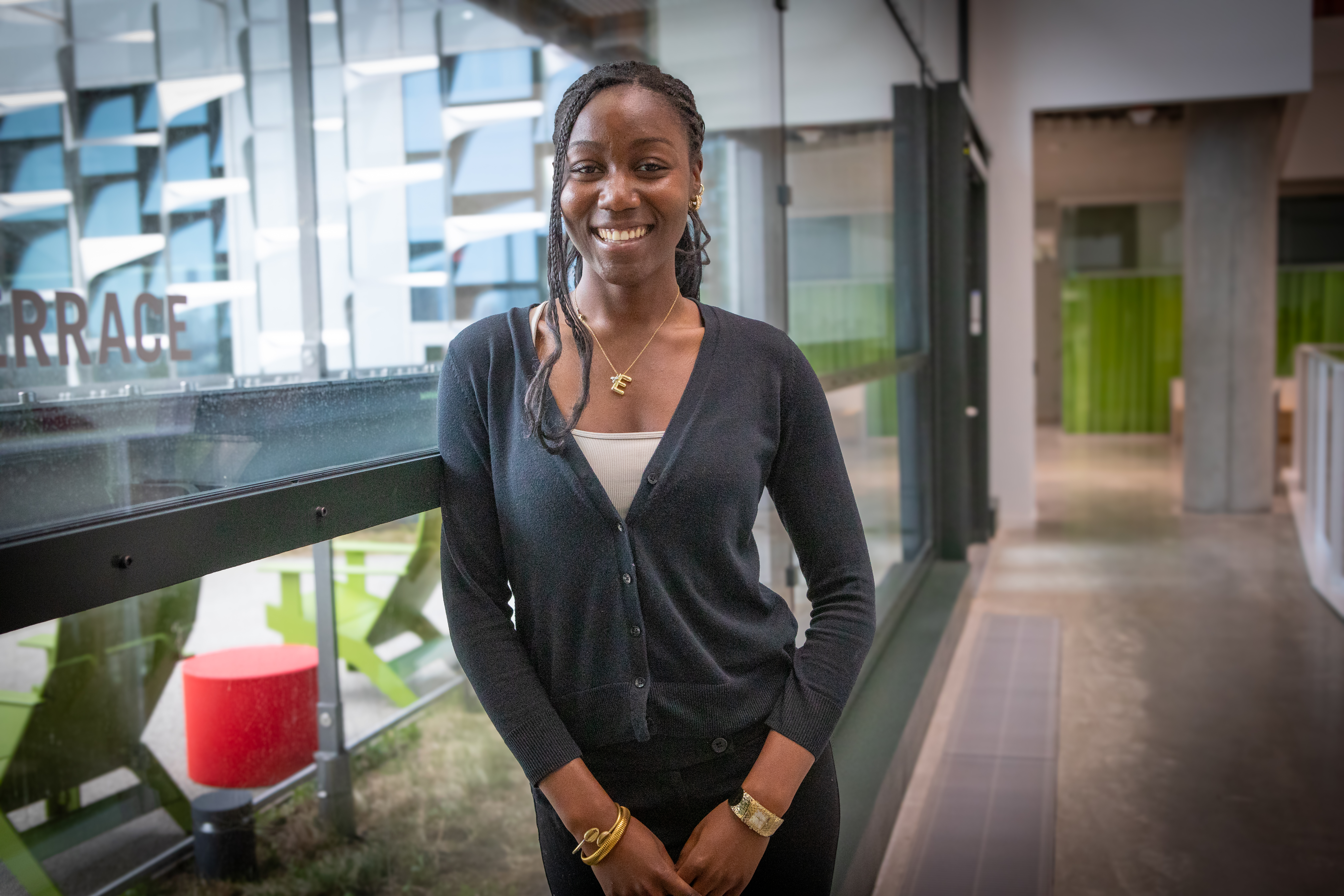
For her senior capstone project, Omolivie Eboreime proposed a nanoparticle for gene-editing blood diseases (Eliza Grinnell/SEAS)
• Please give a brief summary of your project.
My project focused on developing a protein nanoparticle for the delivery of gene editor cargo for the treatment of hemoglobinopathies, which are diseases related to the blood system. A lot of different hemoglobinopathies have these mutations in a specific gene called the beta globin gene. My project focuses on creating a nanoparticle that delivers a gene editor system that breaks the protein that causes the expression of that specific type of beta-globin and actually recapitulates the body with a different type of hemoglobin that is mostly found in infants but can be reexpressed in humans for the treatment of the symptoms associated with those hemoglobinopathies.
• What real-world challenge does your project address?
The first CRISPR-related therapeutic is called Casgevy, and it does a similar process, but it requires you to take your HSPCs, which are the stem cells related to differentiation into the rest of the blood cell lineages. You have to take those cells out, you have to edit them and take them back into the body. It requires a lot of resources, a lot of time, and it is a lot of work for the patient. It impacts their quality of life. My therapeutic would be delivering that gene editor straight into the body and not requiring as many sessions or resources or money, especially because hemoglobinopathies disproportionately affect low-income countries, which don't have access to the same amount of resources and time and facilities that ex vivo, or out of the body, cell editing requires.
• How did you come up with this idea for your final project?
I worked with this lab at Beth Israel Deaconess Medical Center prior to this project, and I really appreciated the work they did, especially how it has these clinical implications that extremely impact the lives of patients, especially those who don't have access to treatments in the same way. I wanted to be able to contribute with my little piece of research.
• What part of the project did you enjoy the most?
It was a great experience. I love the ES100 project and experience. I think it taught me how to be a better scientist and to keep asking the question of why and how I can keep improving on that.
Topics: Academics, Bioengineering, Health / Medicine
Cutting-edge science delivered direct to your inbox.
Join the Harvard SEAS mailing list.
Press Contact
Matt Goisman | mgoisman@g.harvard.edu