News
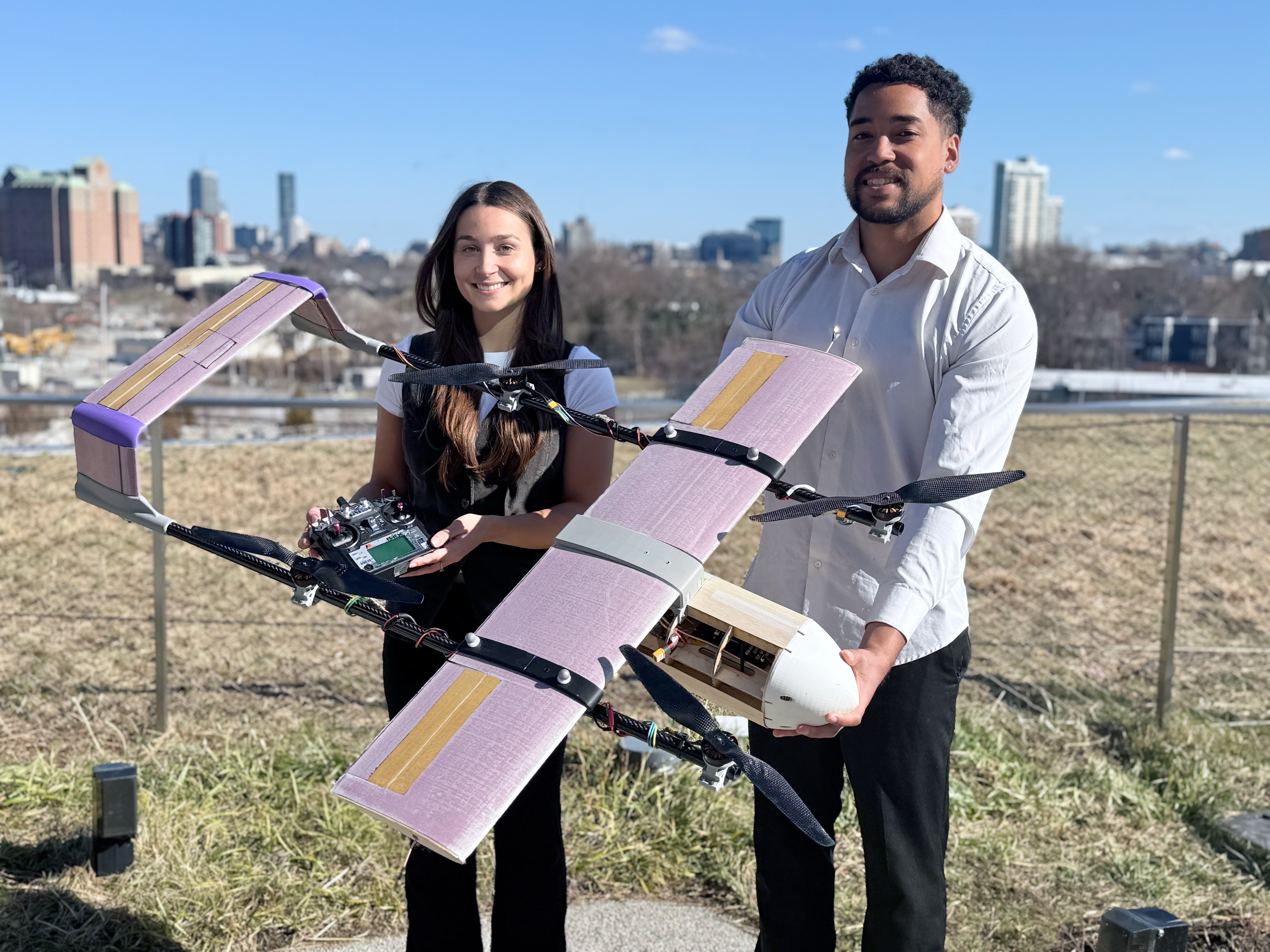
For their senior capstone project, Kuma McCraw and Mikaya Parente built a fixed-wing drone that can launch vertically and transition to fixed-wing flight (Matt Goisman/SEAS)
Engineering Design Projects (ES 100), the capstone course at the Harvard John A. Paulson School of Engineering and Applied Sciences (SEAS), challenges seniors to engineer a creative solution to a real-world problem.
Modular VHF Signal Sensing Fixed-Wing Drone Platform for Autonomous Sperm Whale Rendezvous Tracking and Validation
Kuma McCraw and Mikaya Parente, S.B. ‘26, Mechanical Engineering
Advisor: Stephanie Gil
• Please give a brief summary of your project.
Our project focused on the design, fabrication, and testing of a fixed-wing VTOL drone intended to support marine biology research, specifically for tracking sperm whales in Dominica. The drone is designed to launch vertically from a small research vessel, eliminating the need for a runway, and then transition into fixed-wing flight for efficient long-duration operation. The primary objective is to localize whales tagged with VHF transmitters, which do not provide GPS data. Instead, our system relies on measuring signal strength at multiple positions to triangulate the whale’s location. By flying the drone to different points and collecting VHF signal data, researchers can more accurately estimate whale positions in the ocean.
• What real-world challenge does your project address?
Our project addressed the difficulty of accurately locating sperm whales tagged with VHF transmitters. Unlike GPS-enabled systems, these tags only provide signal strength, meaning researchers must collect measurements from multiple positions to estimate a whale’s location. Current solutions rely on quadcopter drones, which are limited by short flight times, low energy efficiency, and suboptimal antenna configurations. These limitations reduce the amount of area that can be surveyed and make it difficult to maintain sufficient antenna separation for accurate signal triangulation.
• How did you come up with this idea for your final project?
Our interest in this project originated after building a 3D-printed quadcopter for MakeHarvard 2025, which sparked our curiosity in UAV design and flight systems. While the initial quadcopter performed well, we became interested in exploring more advanced aerial platforms. We began looking for opportunities to apply this interest in a meaningful context and connected with Stephanie Gil’s REACT Lab, which works on drone-based whale tracking and ocean fieldwork in collaboration with Project CETI — a global initiative focused on studying the bioacoustics of sperm whales.
• What was the timeline of your project?
We probably spent around a month on problem definition, defining our technical requirements, and understanding which components we would need to get our drone airborne. The next five months were dedicated to design and fabrication of the fuselage, main wing, and empennage. To enable rapid prototyping without prohibitive costs, we leveraged 3D printing, hot-wire foam cutting, and low-cost carbon fiber strips and tubes, allowing us to quickly manufacture, test, and refine components. Over the past month, we have focused on testing and validation, including flight testing, data collection, and running CFD simulations to model and better understand the aircraft’s fixed-wing performance.
• What part of the project proved the most challenging?
The most challenging part of the project was the fiberglassing process used to create smooth, lightweight, and structurally sound wing and empennage surfaces. This process required careful surface preparation, precise layering of fiberglass and Kevlar reinforcements, and accurate mixing and application of epoxy.
• What part of the project did you enjoy the most?
Test flying the drone outdoors was the most enjoyable part of the project. We also enjoyed running CFD simulations to better understand its aerodynamic performance after transitioning to fixed-wing flight.
• What did you learn, or skills did you gain, through this project?
This project significantly strengthened our abilities in CAD, aerodynamics, CFD, FEA, electronics integration, and dynamics and control. It also enhanced our skills in systems integration, iterative design, and debugging complex hardware-software systems.
Topics: Academics, Environment, Materials Science & Mechanical Engineering
Cutting-edge science delivered direct to your inbox.
Join the Harvard SEAS mailing list.
Press Contact
Matt Goisman | mgoisman@g.harvard.edu
Related News

Applying AI to Accelerate Design, Test and Manufacture
University of Washington Mechanical Engineering
AI / Machine Learning, Applied Physics, Computer Science, Electrical & Computer Engineering, Materials Science & Mechanical Engineering, Meet Our Faculty, Research, Technology