News
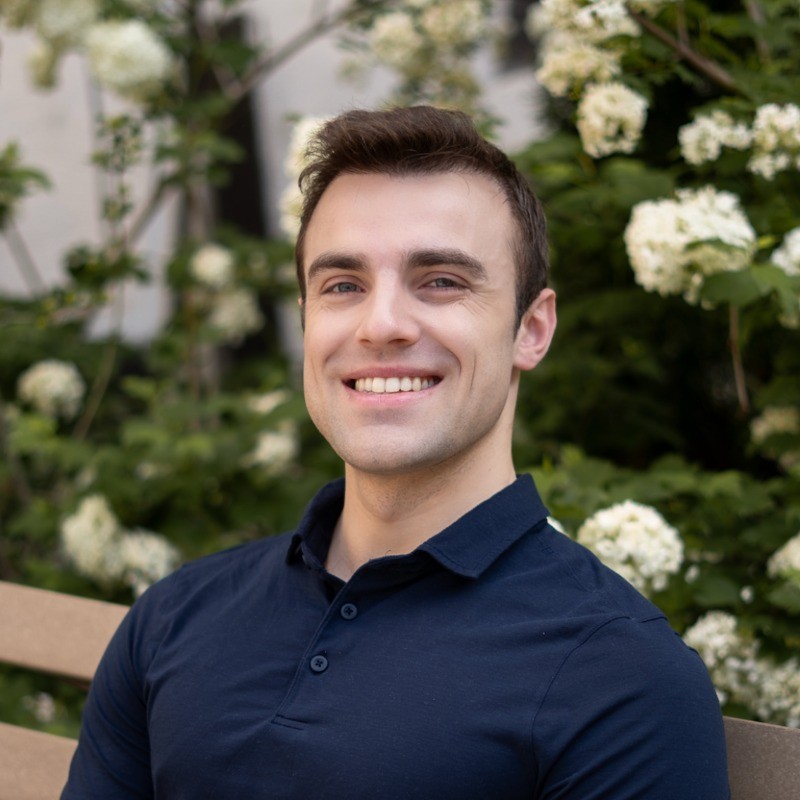
Matthew Stewart, S.M. '20, Ph.D. '23
When the COVID-19 pandemic hit, Matthew Stewart had to pivot his Ph.D. in environmental science and engineering at the Harvard John A. Paulson School of Engineering and Applied Sciences (SEAS). He’d been researching emissions in the Amazon Rainforest under Scot T. Martin, Gordon McKay Professor of Environmental Science and Engineering and Professor of Earth and Planetary Sciences, but the pandemic made travel and fieldwork impossible. So Stewart changed his focus to modeling.
“During that time I got very deep into machine learning,” Stewart said. “I started a mentorship with Vijay Janapa Reddi in the computer science department. We started working on ways to benchmark data sets, benchmark algorithms, benchmark hardware. So I got very deep into these socio-technical systems ideas, and how we build benchmarks in collaboration with industry and policymakers.”
After finishing his Ph.D., Stewart stayed with Reddi, Gordon McKay Professor of Electrical Engineering, as a postdoctoral researcher, where his projects explored the intersections of artificial intelligence and society. That work in AI continues to benefit Stewart, who now works as a lead AI researcher at Pelago Health, a leading digital substance use care provider.
“We're basically exploring this bridging factor of whether you can have an AI that allows people to get the clinical care they need, but with more safety guardrails and clinical oversight than a typical AI agent,” said Stewart, S.M. '20, Ph.D. '23.
Stewart arrived at SEAS after pursuing a joint bachelor’s and master’s degree in mechanical engineering at Imperial College in London. Originally from Leicestershire in central England, he initially wanted to build Formula 1 racecars. When the realities of working in that field convinced him to look elsewhere, he started thinking about pursuing a graduate degree.
“I noticed that all the professors I had really seemed to love what they did,” he said. “The last year of my undergrad, I was in Singapore for a year abroad, and I had a really good mentor who basically told me that if you want to do it, it's good to do it whilst you're young.”
Personal relations convinced Stewart to look to Boston-area universities, which led him to Martin’s lab research in the Amazon. Martin was looking for students with a mechanical engineering background, making Stewart a perfect fit.
“Most of the equipment that was built for environmental science was built by mechanical engineers, and he wanted someone to help him build drones to study the emissions of trees in the Amazon,” he said. “In environmental science, there's a lot of modelers, a lot of computer scientists, a lot of chemists, and policymakers. You have the full gamut of everything, and maybe that's what got me initially interested in this kind of interdisciplinary work that I do now.”
While Pelago’s focus has been on connecting users with substance use care services, Stewart’s work focuses on new tools related to mental health. He’s not trying to replace actual therapists, but rather designing an agent that users averse to traditional therapy might interact with. These conversations, which are sometimes as simple as asking about the user’s day or upcoming plans, can then be reviewed by healthcare professionals for warning signs of potential mental health crises.
“We have a publication right now that's going through review on how you can do suicidality monitoring using human-in-the-loop with an AI,” he said. "We have a system where, depending on what's going on with the conversations people are having, clinicians will get flagged, and they will reach out to people via phone. We'll send email resources if they need it. We refer them to third parties for having actual therapist conversations. Because this space still doesn’t have a gold standard for how to do it, we're still trying to feel out exactly what makes the most sense. But we're definitely taking a very safety-cautious approach in the way we're building it.”
Stewart worked in insurance technology before coming to Pelago. While there, he became aware of how difficult it was to challenge or contest claims decisions made by insurance companies or other institutions. That led him to publish a paper titled “Beyond Explanation: Evidentiary Rights for Algorithmic Accountability,” which analyzed 168 litigated cases involving algorithmic decisions to show that access to evidence was strongly associated with successful contestation. The publication was one of three papers selected out of 325 entrants for the Best Paper Award at the Association for Computing Machinery Conference on Fairness, Accountability, and Transparency, the flagship interdisciplinary forum for research on AI ethics, algorithmic bias, and sociotechnical systems.
“If I apply for a loan and get rejected, I have the right to know why I got rejected, but they could just come back to me and say my credit score was too low,” he said. “In this world where we have counterfactual rights, I can ask questions about whether factors such as my gender or age would change the outcome, and then they would have to give me an answer. I would also be able to test it myself and then go through an appeal process via them. Instead of the company saying, ‘This is your answer, you have to trust me,’ it's me being able to go and verify based on the questions that I have about the decision.”
Topics: AI / Machine Learning, Alumni, Computer Science, Environmental Science & Engineering, Health / Medicine
Cutting-edge science delivered direct to your inbox.
Join the Harvard SEAS mailing list.
Press Contact
Matt Goisman | mgoisman@g.harvard.edu
Related News

Applying AI to Accelerate Design, Test and Manufacture
University of Washington Mechanical Engineering
AI / Machine Learning, Applied Physics, Computer Science, Electrical & Computer Engineering, Materials Science & Mechanical Engineering, Meet Our Faculty, Research, Technology