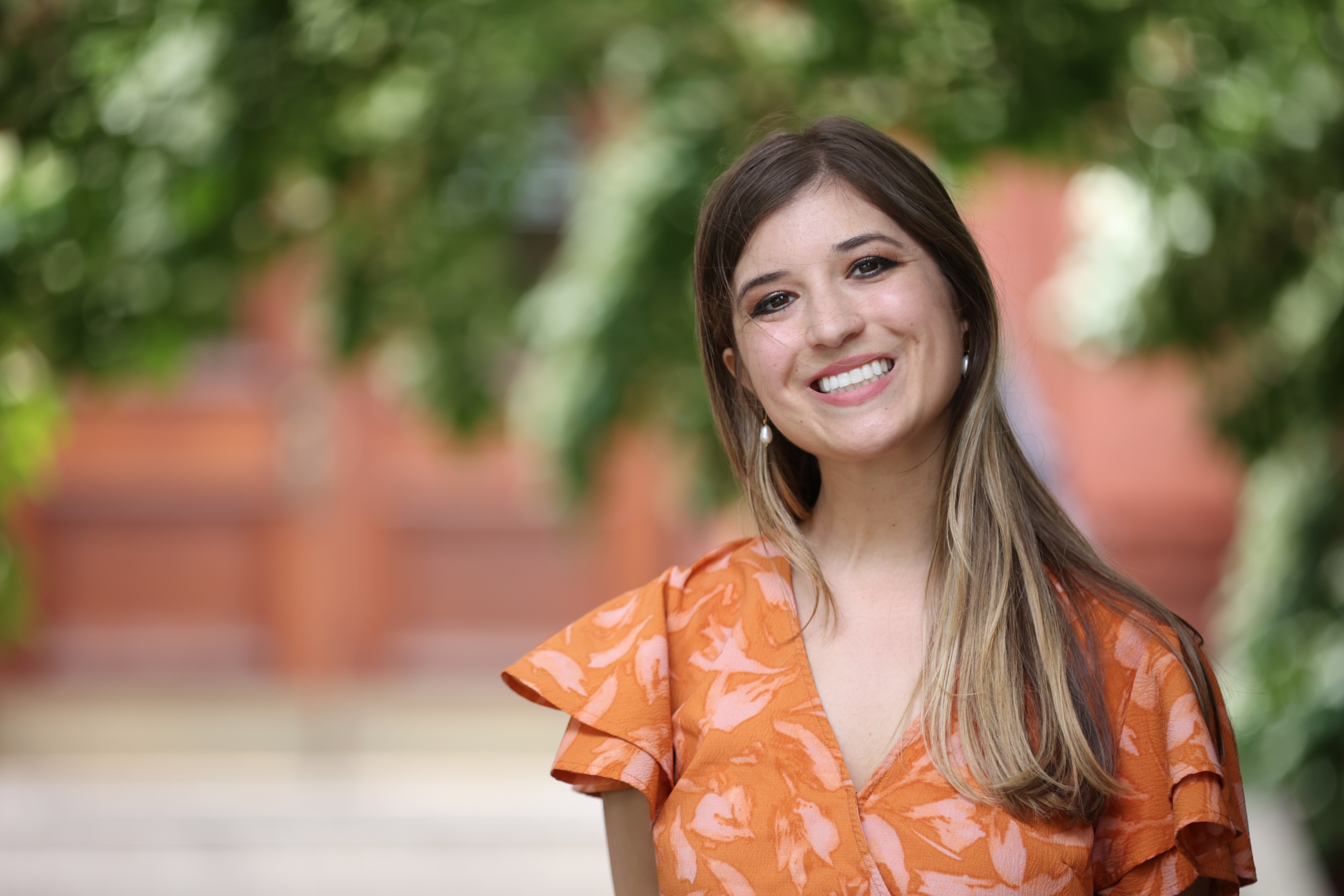
Nadia Colombi, S.M. '22, Ph.D. '25
As wildfire occurrences continue to increase, cities have to prepare. This is especially important in states like Utah, which have areas known as wildland-urban interface zones: mountainous communities surrounded by highly flammable vegetation. This year, damage from wildfires in Utah has exceeded $200 million. Understanding the risks and potential for wildfires can help developers in those zones design safer buildings, and help policymakers develop guidelines for safer communities.
“We're seeing more people that are becoming worried about their homes, and insurance companies are actually dropping people because the risk is so uncertain,” said Nadia Colombi, S.M. '22, Ph.D. '25. “I'm developing a wildfire risk model for the state of Utah that's informed by trends in climate that we can project into future scenarios, and I'm trying to suss out what features are most important for whether a building burns or not in a fire.”
Colombi is a postdoctoral researcher at the University of Utah and is supported through a National Science Foundation program known as the Regional Resilience Innovation Incubator. Her work draws on her research as a master’s student in environmental science and engineering at the Harvard John A. Paulson School of Engineering and Applied Sciences (SEAS), where she was part of the Atmospheric Chemistry Modeling Group (ACMG), working with Daniel Jacob, Vasco McCoy Family Professor of Atmospheric Chemistry and Environmental Engineering, and Loretta Mickley, Associate in Environmental Science and Engineering.
“We worked on a model that is a three-dimensional gridded model of the Earth's surface and atmosphere,” Colombi said. “We used that and various sources of data to simulate the atmosphere and see how reducing emissions can improve pollution.”
Colombi went on to earn her Ph.D. in Earth and planetary science.
A Phoenix native, Colombi enrolled at the University of California-Los Angeles planning to study environmental science but then go to law school. She wanted to pursue environmental policy and justice, but her plans changed when she took her first atmospheric chemistry class. That led to an undergraduate research position in the Land Surface Hydrology Research Group at UCLA, and her path was set.
“My first research opportunity was with Miriam Marlier at UCLA, who was a post-doc at the time and is now a professor,” Colombi said. “She was just really wonderful and patient with me. I was learning how to code for the first time. The project was so interesting, and I was able to go and present the work at an AGU conference. It started with learning more about the science, then trying out different research options and realizing I really loved it.”
Colombi continued researching atmospheric chemistry with the National Resource Defense Council and NASA Jet Propulsion Laboratory as she finished her bachelor’s degree in environmental science. Knowing she wanted to stay in academia, Colombi joined the ACMG, where she took advantage of both Jacob’s extensive experience in atmospheric chemistry and Mickley’s ongoing research into wildfires in the southwestern U.S.
“It's a really big group that Daniel and Loretta lead, so I felt like I was always learning from a lot of different people,” Colombi said. “It seemed like a lot of the people from this group go on to do really diverse things. They come out of it with pretty strong data skills, and some of them choose to apply that to atmospheric chemistry, and others take it somewhere else. I wanted to be able to have some flexibility with what I could do.”
Everything Colombi has studied now comes together at Utah. Her work uses the technical skills she learned at Harvard, but with the goal of turning models into data that policymakers, forest services departments and communities can use.
“I didn't ever want to give up the technical parts of the job that I do,” she said. “I like working in that space, and I like learning about new methods. But I also wanted to be able to interact with people more and feel like the work that I am doing can actually be useful.”
While her research is ongoing, Colombi is starting to think about what comes next. Academia has been her life for more than a decade, but she knows finding the exact faculty appointment she wants would be very competitive. If she wants to continue doing policy-focused environmental research, she may eventually have to look beyond university campuses.
“The emerging sector for people who want to work on things that I want to work on are the climate nonprofits and startups that are out there,” she said. “They're doing really innovative science, but they're also very impact driven. I think somewhere in the nonprofit space is what I'm looking towards.”
Press Contact
Matt Goisman | mgoisman@g.harvard.edu