News
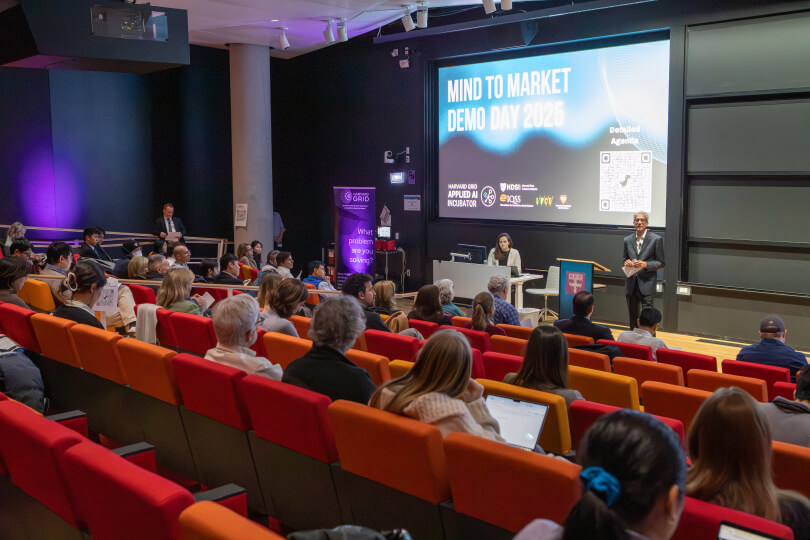
Harvard Grid Director Paul Hayre addresses the crowd at Mind2Market Demo Day (Eliza Grinnell/SEAS)
With the right deployment, artificial intelligence (AI) can improve so much of the human experience. Frustrations in the medical industry can be reduced; academic research and innovation can be accelerated; power grids can scale up efficiently; athletic improvement can be optimized; even marketing can feel more authentic and personalized. All it takes is the right idea, paired with the resources and mentorship to turn the idea into reality.
Last semester, 10 undergraduates participated in the Applied AI Incubator (A2I2), a new program from the Harvard Grid at the Harvard John. A Paulson School of Engineering and Applied Sciences (SEAS). In the eight-week program, students developed AI-first business models through a combination of accelerator workshops, Amazon Web Services credits and meetings with Harvard faculty, serial entrepreneurs, venture capitalists and industry partners.
“Our role was to identify students genuinely interested in pursuing applied-AI venture ideas and accelerate market validation of those ideas with credits, technical/build support, and business model advisory,” said Paul Hayre, Harvard Grid Executive Director. “It was a big, co-curricular program bite for students to chew during the Fall term, and not easy; all of the students in this inaugural cohort really stepped up and stepped forward in a great way. We are also grateful to the expert members of the A2I2 Advisory Board that enabled that success.”
Six of the 10 students then presented their projects at the Mind2Market Demo Day last December, competing for up to $15,000 in additional AWS credits.
“AI is a very vital technology,” SEAS Dean David Parkes said at the event. “It’s a disruptive technology, and we’re still very early in the development of different ways to build artificial intelligence. We’re still very early in grappling with how AI is going to change our world, but it’s absolutely something that we need to be paying very close attention to. Here at SEAS, AI sits within computer science, but it’s really permeating across the entire school.”
FIRST PLACE: SEMAGRAM
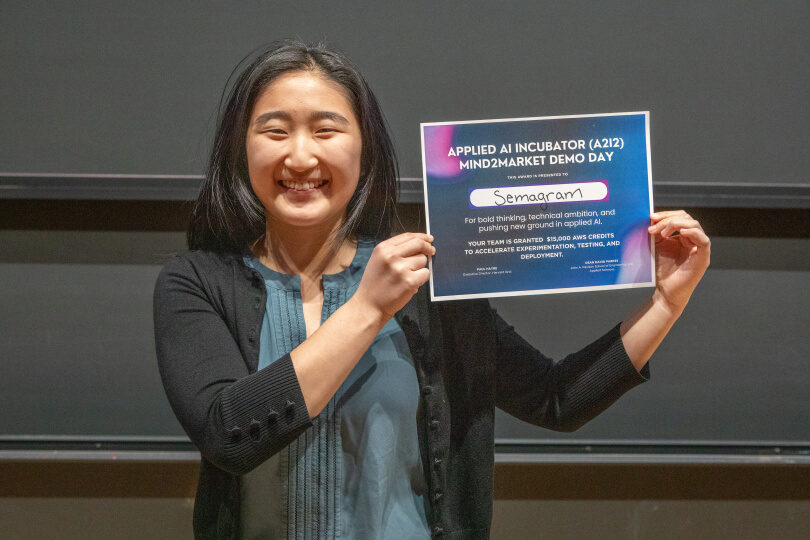
Semagram creator Karina Chung (Eliza Grinnell/SEAS)
The data centers that enable AI require a lot of electricity, and building them can put considerable strain on the land, water and power resources of local communities. More power plants are essential to meeting the ever-increasing electricity demands from AI, but onboarding new plants or data centers into the grid – a process called interconnection – can take years.
Semagram, the first-place winner at the Mind2Market pitch competition, is a potential solution to speeding up the interconnection process. Designed by fourth-year computer science and statistics concentrator Karina Chung, Semagram is building AI agents that can combine power systems expertise with AI modeling to accelerate the studies necessary for interconnection.
“These studies are repetitive workflows that humans are executing in a trial-and-error format, which makes them a perfect use-case for agentic AI,” Chung said. “Our story starts with AI data centers, but the efficiency gains extend to every other large load. Semagram can help connect the renewable power that we need to facilitate the energy transition along with all of our essential services – healthcare, hospitals, manufacturing, industry – all of these loads need to be connected to a very strained grid.”
Chung said the opportunity for mentorship is what drew her to A2I2.
“The program really helped me refine which aspects of my idea can actually be commercialized and have the potential to grow beyond the lab,” she said.
SECOND PLACE: THE YARD
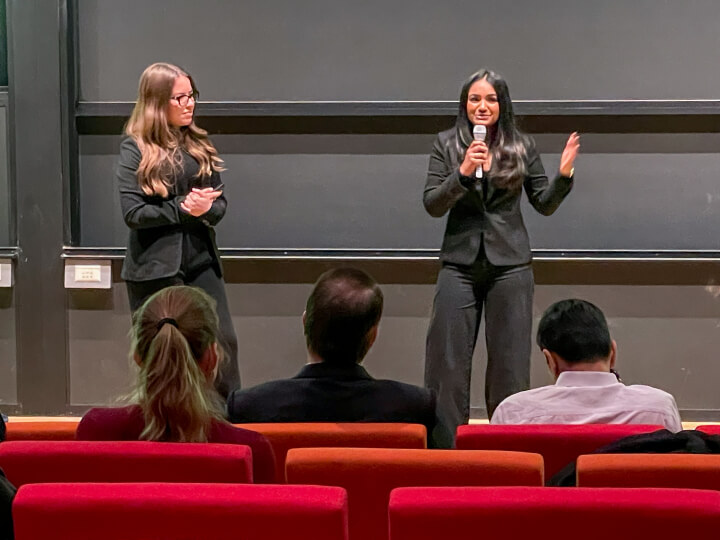
The Yard co-creators Julia Alvarenga and Alice Jacob (Eliza Grinnell/SEAS)
The Yard, co-created by fourth-year computer science concentrator Julia Alvarenga and economics and psychology concentrator Alice Jacob, is an AI-powered marketing platform tailored to Generation Z and college students. By tapping into content creators at specific schools, The Yard is able to craft messaging tailor-made to that student body.
“As content creators, club leaders and interns at brands trying to reach Gen. Z, we’ve seen the same problem over and over: brands trying to reach college students through cold emails, spreadsheets that take weeks to update, and a very crowded, saturated market with really no product differentiation,” Alvarenga said. “It was time for someone to do something, so we’re building the solutions companies have been asking for: a fast, cost-effective way to reach college students.”
Like Chung, Jacob said working with a mentor, Harvard Business School lecturer Lindsay Hyde, was the highlight of the program.
“She was so insightful for us throughout the entire process,” Jacob said. “We asked her a million and one questions, and she was always ready to hop on a Zoom call, work with us through the problem on how to think deeply and critically about what we were facing.”
THIRD PLACE: PRAXIS
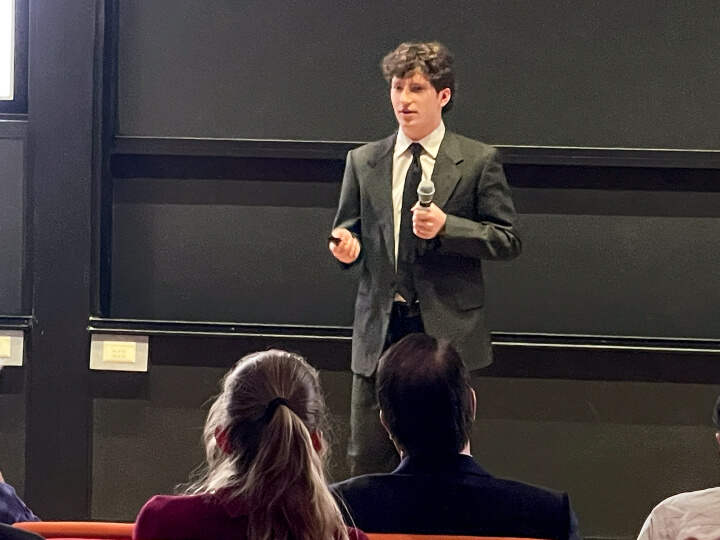
Praxis creator Andrew Morrissey (Eliza Grinnell/SEAS)
Golf, like most sports, can take years to master. And along the way, there’s going to be frustrations at the perceived lack of improvement.
“Every time I top the ball into a pond or slice it into the woods, I think, ‘Why the hell do I play this sport,’” said fourth-year electrical engineering concentrator Andrew Morrissey. “But then I realize after one pure shot that I’m hooked, and I need to play again.”
Getting better at golf either requires constant practice on your own, or potentially very expensive lessons with a private coach. Even video swing analysis programs can be awkward, as they require constantly setting down one’s phone camera to record, picking it back up to review and analyze footage.
To make personal improvement easier, Morrissey designed Praxis, an AI golf instructor that watches the user’s swing, provides vocal feedback and responds to questions.
“Praxis is a software and hardware solution that offers AI instruction that is personalized, effective, data-driven, and most importantly scalable,” he said. “We train a deep neural network on this data to learn exactly what makes a swing consistent in quality for each golfer’s unique swing mobility range.”
Topics: AI / Machine Learning, Computer Science, Entrepreneurship
Cutting-edge science delivered direct to your inbox.
Join the Harvard SEAS mailing list.
Press Contact
Matt Goisman | mgoisman@g.harvard.edu
Related News


Applying AI to Accelerate Design, Test and Manufacture
University of Washington Mechanical Engineering
AI / Machine Learning, Applied Physics, Computer Science, Electrical & Computer Engineering, Materials Science & Mechanical Engineering, Meet Our Faculty, Research, Technology