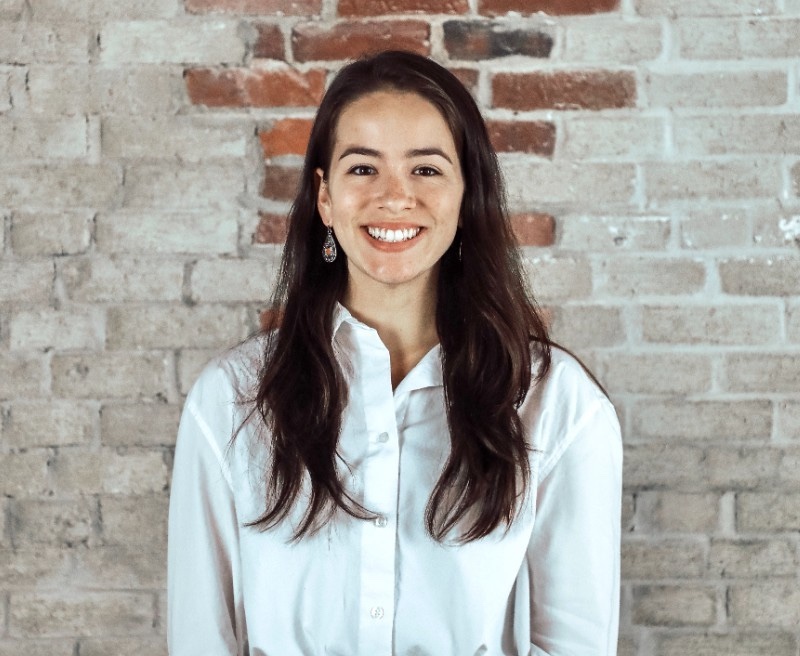
Rebecca Gracia, S.B. '18
Rebecca Gracia took her first high school physics class, and she knew she wanted to be an engineer. Technical work and design runs in her family – her grandfather worked as a mechanic at a Frito-Lay factory, and her father worked as a contractor. That mindset combined with physics fundamentals to inspire her to study mechanical engineering at the Harvard John A. Paulson School of Engineering and Applied Sciences (SEAS).
“I loved learning and translating how the world around us works, and so that's when I really started looking into engineering programs,” she said. “I fell into mechanical because I liked the types of problems that we solved. I liked that it was larger physical systems that you could see, and I found the classes at SEAS to be very exciting and fun. They had projects that were very hands-on and very collaborative.”
Gracia, S.B. ‘18, worked as a product designer for home goods company SharkNinja for two years after graduating from SEAS, then transitioned to the renewable energy sector in 2020. She’s worked in that space for the last six years, designing renewable energy projects for utility companies, municipalities, industrial and commercial organizations, and agriculture.
“I really wanted to pivot and focus on sustainability,” she said. “I really wanted to be a part of this greater force of providing more sustainable, renewable energy solutions to our grid to support our society long term.”
Growing up in Chino, California, Gracia planned to apply to universities more directly focused on engineering. A conversation with a friend who’d just come back from an Ivy League tour convinced her that Harvard’s educational breadth might actually serve her better.
“I really do enjoy the technical side of things, but I also like stepping out of that zone from time to time,” she said. “I found Harvard to be a really great place for me to flourish because I wasn't so locked into just engineering all the time with only engineers. I had a lot of diversity in my interests, academically as well as socially and with extracurriculars.”
That diversity serves Gracia well in her current work. While she uses some of the same engineering design software she learned in her mechanical engineering classes, she also has to interface with civil and electrical engineers, construction crews and a range of other departments and stakeholders. Her work requires collaboration and adaptability, skills she started developing immediately with her concentration’s introductory class, “ES51: Computer-Aided Machine Design.”
“My foundational engineering knowledge, physics knowledge, a lot of that was built at Harvard, and I'm really appreciative of it,” she said. “I really loved being a part of the ES51 final project of building a robot. That was one of the first times that I had seen such a cross-functional product come to life, because we had not only to think about the mechanical design, but also the electrical design. We had to work as a team. We had to divide up our own tasks individually and come together and build something together. That was one of my favorite projects that I got to work on.”
Alongside her classes, Gracia also loved the engineering community at SEAS. Some of her favorite memories are of staying up late to finish problem sets with her classmates, but she also played an active role in strengthening the SEAS community through her role on the board of the Harvard chapter of the Society of Hispanic Professional Engineers.
“It's incredibly important to support and build up underrepresented communities in the engineering space,” she said. “Getting your foot in the door, building up that courage to get in, seeing other people that you can connect to and relate to is really important and really critical in establishing yourself, your sense of belonging, and your confidence. To me, that was incredibly important to try to help foster so it would continue on past my graduation.”
Gracia’s pivot to renewable energy began when she joined Nexamp as a design engineer, designing and modeling power solutions for both individual construction projects and larger regional strategies for the western and southeastern United States. She spent four years at Nexamp before moving on to similar work at Qcells EPC and later Blymyer Engineers.
“I have so much gratitude towards my time at Nexamp,” she said. “I joke that it's where I learned my solar ABCs. I learned everything from the ground up, all the basics. I liked seeing a project progress from its first drawing all the way through its constructed final product. I liked being able to dive into the technical and do electrical drawings. I liked the energy modeling and equipment specifications, but I also liked being able to interface with people that were in the field.”
In her current work, Gracia helps design utility-scale solar and storage installations, which are facilities that can generate and store power, which can then be sold back to municipal or private utility companies or corporations with large power needs. For Gracia, industry expansion over recent years is proof that renewable energy is essential to meeting our nation’s power demands.
“The conversation can always shift about whether we want renewable energy resources, but I think at the end of the day, we need them,” she said. “Our energy demands have just continued to grow. Our grid is continually overburdened, and we see this play out with energy outages. It is the largest growing energy sector, and it continues to grow and improve over time.”
Press Contact
Matt Goisman | mgoisman@g.harvard.edu